312 Days to Process Criminal Cases... Abolition of Prosecutors' Supplementary Investigative Authority Could Lengthen It Further
Case Processing Time Increased 2.2 Times After Adjustment of Investigative Authority
Concerns Over Inability to Correct Police Investigation Errors
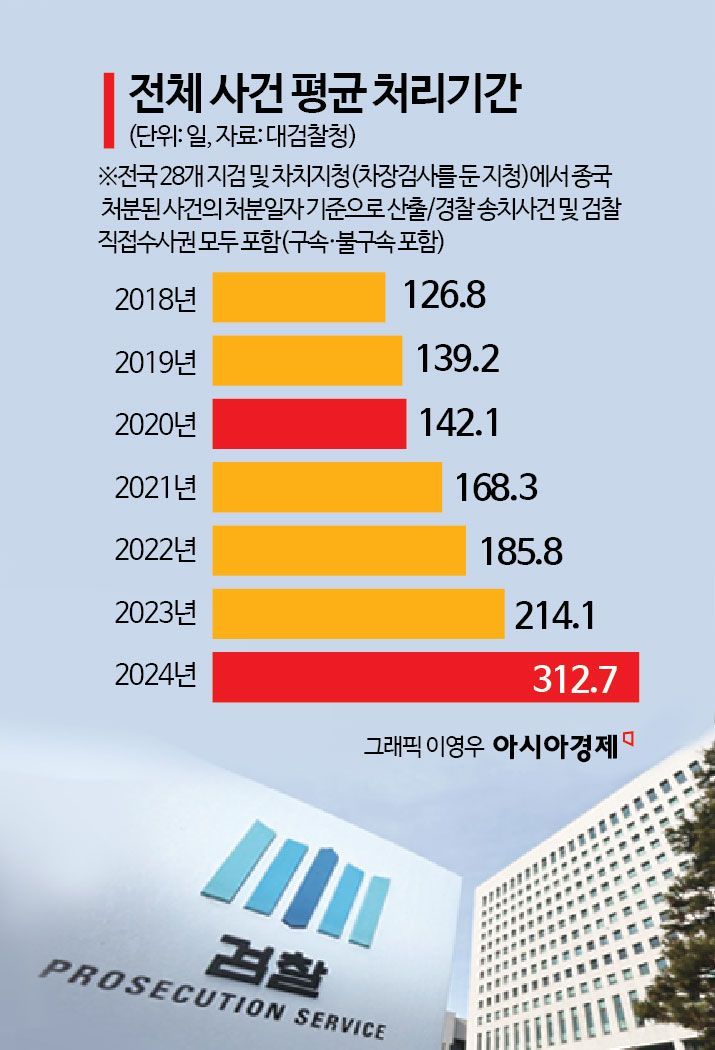
According to the legal community on July 23, whether the government and ruling party will allow prosecutors to retain "supplementary investigative authority" has emerged as a key issue. Critics point out that if prosecution reform results in a complete exclusion of prosecutorial investigative authority, including supplementary investigations, the problem of "delayed investigations" could worsen further.
The Four Prosecution Reform Bills proposed by the ruling party aim to prohibit the prosecution from exercising any investigative authority, including not only direct investigations but also supplementary investigations into cases referred by the police. Previously, with the adjustment of investigative authority between the police and prosecution, the prosecution's authority to direct investigations was abolished, and a supplementary investigation system (direct supplementary investigation and requests for supplementary investigation) was introduced. The ruling party's plan is to allow prosecutors to request supplementary investigations from investigative agencies but prohibit them from conducting direct supplementary investigations themselves.
Abolition of Prosecutors' Supplementary Investigative Authority: "Will Severely Exacerbate Delays in Investigations"
The most significant concern is that abolishing the prosecution's supplementary investigative authority could further lengthen investigation periods. If investigations, which often involve elements of human rights violations, are delayed, the restoration of crime victims cannot be achieved in a timely manner.
According to the Supreme Prosecutors' Office, after the adjustment of investigative authority, the average time required to process criminal cases?from initial police receipt, through requests for supplementary investigation, to the prosecution's final decision?was 312.7 days in 2024, compared to 142.1 days in 2020, an increase of approximately 2.2 times. In a situation where the adjustment of investigative authority in 2021 had already significantly increased case processing times, if prosecutors are only able to request supplementary investigations from the police rather than conducting them directly, delays in case processing are expected to become even more severe. A deputy chief prosecutor from a district prosecutors' office in the Seoul metropolitan area stated, "If supplementary investigative authority is abolished, the number of prosecutors' requests for supplementary investigations will increase exponentially, and the so-called 'ping-pong' phenomenon could lead to extreme delays in case processing."
"Difficult to Fully Uncover Cases Like the 'JMS Cult Leader Sexual Assault'"
There are also concerns that the opportunity to uncover the full truth of cases through the prosecution's supplementary investigations could be lost. Even if there are doubts about a police investigation, if prosecutors cannot hear testimony from those involved or collect evidence, errors in police investigations cannot be corrected. A prosecution official stated, "Last year, there were over 10,000 cases where prosecutors conducted direct supplementary investigations into cases referred by the police and concluded with 'no charges,' and about 1,000 cases where prosecutors indicted based on direct supplementary investigation or judicial oversight of police non-referral decisions. If suspects are unfairly detained at the police stage but prosecutors cannot directly investigate or collect relevant materials, it could actually undermine the protection of human rights."
The prosecution would also be virtually unable to go beyond the police's investigative results to uncover the full scope of cases, identify the real perpetrators, accomplices behind the scenes, or additional crimes. In fact, in the "JMS Cult Leader Sexual Assault" case, prosecutors conducted direct supplementary investigations, including searching the JMS headquarters training center and summoning more than 30 former followers, thereby uncovering evidence of organized sexual violence. As a result, two senior JMS members, including the group's second-in-command, were indicted in custody, and six others were indicted without detention. Other cases, such as the "valley murder case," the "three sisters' rental fraud case," and the "Busan roundhouse kick case," were also fully uncovered through the prosecution's supplementary investigations.
For these reasons, voices within the legal community are calling for a sophisticated institutional design that functionally separates investigation and indictment while minimizing the side effects of prosecution reform. There is a need for in-depth discussion to prevent abuse of prosecutorial authority while ensuring that the capacity to respond to crime is not diminished. Attorney Kim Yewon of the Disability Rights Law Center pointed out, "Investigations that have been susceptible to abuse due to their combination with prosecutorial authority (about 1-2% of special investigations) are different from 'supplementary investigations' (about 98% of all cases), which involve legal review and supplementation of referred cases under the right to initiate direct investigations." She added, "Legislative measures are essential to allow direct supplementary investigations within the scope of the identity of referred cases, while requiring prosecutors to request supplementary investigations from the police for cases outside that scope, in order to address the side effects of prosecution reform."
© The Asia Business Daily(www.asiae.co.kr). All rights reserved.
![Clutching a Stolen Dior Bag, Saying "I Hate Being Poor but Real"... The Grotesque Con of a "Human Knockoff" [Slate]](https://cwcontent.asiae.co.kr/asiaresize/183/2026021902243444107_1771435474.jpg)
















