Status of Urban Planning in South Korea
Over 90% of the Population Resides in Urban Areas Making Up Only 16.5% of the Land
It has been found that more than 90% of the entire population of South Korea lives in urban areas, which account for only 16.5% of the country's total land area.
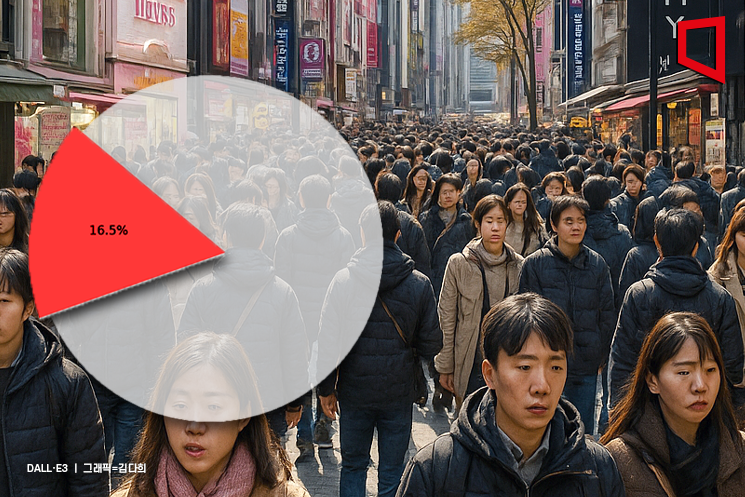
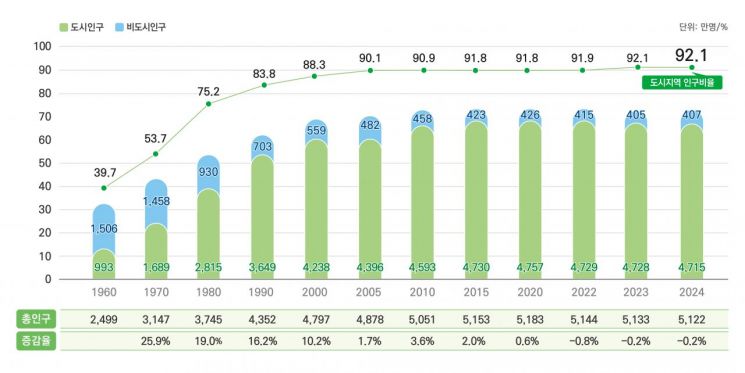
According to urban planning status data released by the Ministry of Land, Infrastructure and Transport on July 23, 2025, as of last year, the total land area of South Korea was 106,567 square kilometers, of which urban areas accounted for 17,639 square kilometers, or 16.5%. The population living in urban areas was 47.15 million, meaning that 92.1% of the registered population resided in urban areas.
In the 1960s, the urban area population ratio was less than 40%, but it increased rapidly thereafter, surpassing 90% in 2005. Since then, it has remained at a high level, maintaining the same ratio last year and again this year.
The designated land use zones that represent the use of national territory increased by 356 square kilometers compared to five years ago (2019), mainly due to reclamation projects. Land use zones are classified as urban areas (16.5%), management areas (25.7%), agricultural and forest areas (46.2%), natural environment conservation areas (11.1%), and unclassified areas (0.5%). Unclassified areas refer to regions where the land use zone has not been determined after reclamation projects such as public water surface reclamation.
As of last year, the number of growth management planning zones, which are designated to prevent haphazard development, stood at 11,975 locations covering 4,259 square kilometers. Until 2023, the area was about 899 square kilometers, but since January last year, growth management planning has been made mandatory for building factories in planned management areas, resulting in a significant increase. Last year, 186,080 development activity permits were issued. Development activities include constructing buildings, changing land features, installing structures, dividing land, and storing goods. After reaching 275,211 permits in 2021, the number has decreased for three consecutive years.
The area of long-term unexecuted urban and county planning facilities was 943 square kilometers, a decrease of 63.9% compared to ten years ago. The Ministry of Land, Infrastructure and Transport explained that this was because unnecessary facilities have been steadily released since the establishment of release guidelines. Urban and county planning facilities that people encounter in daily life, such as roads, parks, and general medical facilities, totaled about 366,000, covering 7,196 square kilometers in total.
© The Asia Business Daily(www.asiae.co.kr). All rights reserved.


















