Seeking Solutions for Service Quality Improvement and Taxi Industry Stability
Gathering Opinions from Citizens and Industry... Plan to Prepare Fare Adjustment Proposal
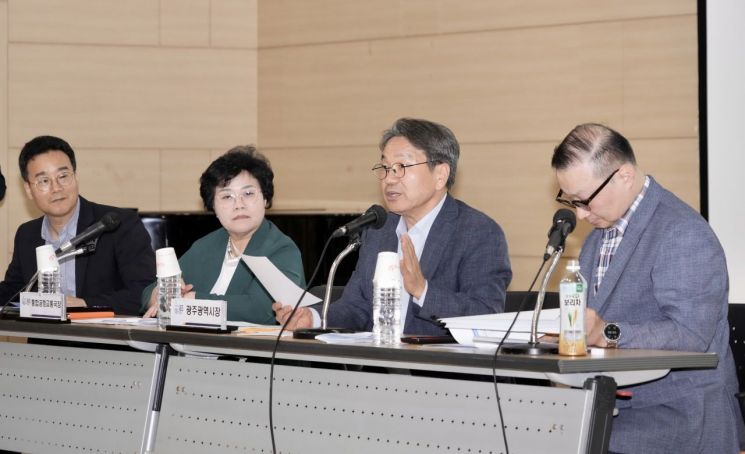 Gwangju Mayor Kang Kijeong attended the "Gwangju Citizens' Public Hearing for Taxi Fare Realization" held on the afternoon of the 22nd at the Gwangju Transportation Culture Training Center, where he shared the results of the appropriate taxi fare calculation service with the attendees and exchanged opinions. Provided by Gwangju City
Taxi fares in the Gwangju area are expected to be adjusted to reflect current realities. The city has reached a tentative agreement at a public hearing to increase taxi fares by 13.35%. This fare adjustment is considered the first step toward improving the treatment of transportation workers and enhancing service quality.
On the afternoon of July 22, the Gwangju City Government held the "Public Hearing for Taxi Fare Realization" at the main auditorium of the Gwangju Transportation Culture Training Center, where it shared the results of the appropriate taxi fare calculation study and listened to a wide range of opinions.
More than 400 people attended the public hearing, including Mayor Kang Kijeong, city council members, representatives from the taxi industry, civic groups, and transportation experts. During the hearing, the city shared the "Gwangju City-Taxi Industry Win-Win Agreement" signed last year. In accordance with this agreement, the city has implemented several measures: expanding support for card payment fees (40,000 won per vehicle), increasing work incentive payments for corporate taxi drivers, promoting advanced site visits for transportation workers, and collecting opinions on the taxi rotation system.
Among the agreement's provisions, the issue of taxi fare adjustment was addressed through this public hearing, where transportation experts' analyses and the taxi industry's demands were reviewed and opinions were gathered. The discussion on taxi fare adjustment was held to establish an appropriate fare system, as Gwangju's fares are currently set at about 70% of those in nearby cities such as Naju and Damyang. According to current law, taxi fares can be adjusted every two years through consultations.
The "Appropriate Taxi Fare Calculation Study" prepared by the city found that taxi fares in Gwangju are lower than the national average, and that an adjustment is inevitable when considering the taxi industry's financial situation. The research agency suggested that fare increases or structural reforms are needed in various areas, including the base fare, combined distance and time fares, and the late-night surcharge system.
Comparing base taxi fares by region: Seoul 4,800 won (1.6 km), Incheon 4,800 won (1.6 km), Busan 4,800 won (2 km), Daegu 4,500 won (1.7 km), Daejeon 4,300 won (1.8 km), and Gwangju 4,300 won (2 km), showing that Gwangju has a lower base fare than other regions. The average fare for a 5 km ride, reflecting distance and time, is 8,100 won in Seoul, 8,100 won in Incheon, 7,700 won in Busan, 7,800 won in Daegu, 7,400 won in Daejeon, and 7,200 won in Gwangju. The current transportation cost per kilometer has increased by 13.3% from 1,440.9 won in 2023 to 1,633.2 won.
During the subsequent open discussion, participants asked questions about the study results and shared various opinions. Suggestions included: the inevitability of a taxi fare increase, the introduction of a flexible fare system, transfer discounts, enhanced driver training, a mandatory taxi operation system (maintaining a minimum operation rate during disasters and commuting hours), and improvements to the call dispatch system.
The discussion on taxi fare adjustment was heated. At the public hearing, after collecting opinions from both individual and corporate taxi operators, a tentative agreement was reached to increase taxi fares by approximately 13.35%. The agreed-upon basic plan includes a base fare of 4,800 won (1.7 km), a travel fare of 132 meters, and a time fare of 32 seconds. The city plans to use this as a basic plan and further refine the fare calculation.
Going forward, once the taxi fare increase proposal is finalized, it will be reviewed by the Taxi Policy Review Committee and the Price Policy Review Committee before a final decision is made.
Mayor Kang Kijeong stated, "Adjusting taxi fares is directly linked to the lives of citizens and is a matter of survival for the industry, so thorough discussion is necessary. Based on the opinions expressed at this public hearing, we will collect a wide range of feedback to minimize the burden on citizens, improve service quality, and stabilize the taxi industry."
© The Asia Business Daily(www.asiae.co.kr). All rights reserved.

















