Gathering 1,000 Customer Voices to Plan the PV5
Taxis Without a Front Passenger Seat, Side-Door Access for Wheelchairs
Introducing New Technologies: Second-Generation PMSA, Pet Mode, and More
"Please make a vehicle without a front passenger seat."
Kia has unveiled new technologies and features installed in its first-ever dedicated electrified Purpose-Built Vehicle (PBV), "The Kia PV5" (hereafter referred to as PV5), in conjunction with its launch. The secret to creating this unprecedented "multi-variant vehicle" was more than 1,000 pieces of customer feedback collected from the planning stage.
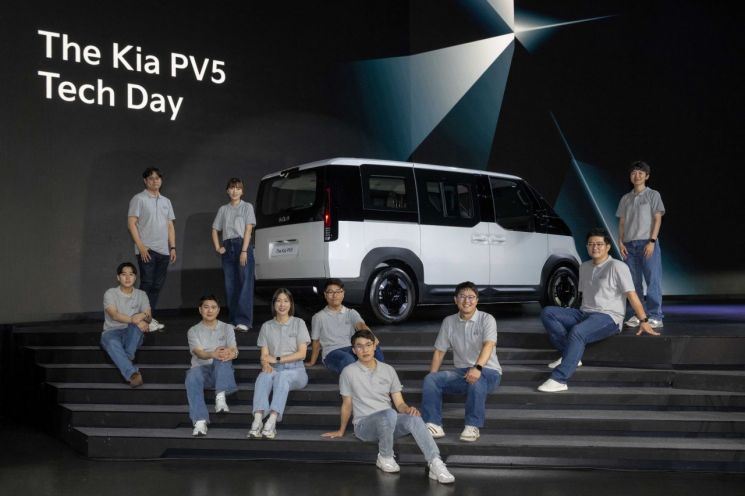 Group photo of presenters at the "The Kia PV5 Tech Day" held on the 22nd in Gwangmyeong, Gyeonggi. Kia
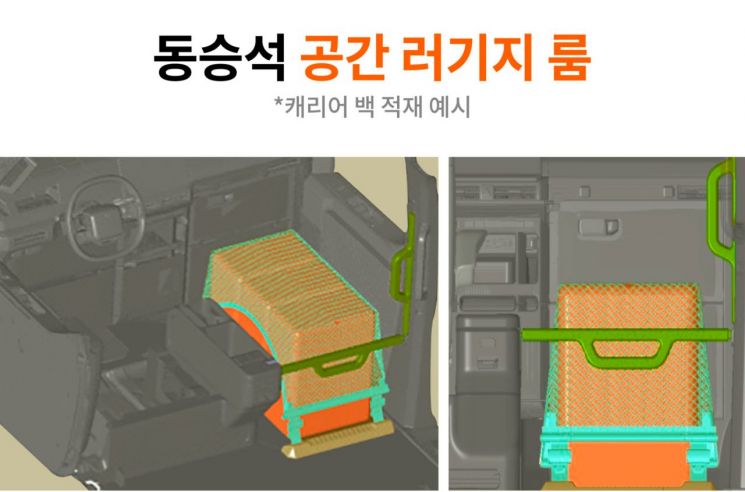
Ryu Jaecheon, Principal Researcher of Kia's MSV Project 7 Team, introduced the "vehicle without a front passenger seat" at "The Kia PV5 Tech Day" held on the 22nd in Gwangmyeong, Gyeonggi, and explained that the team listened to voices from taxi drivers, ride-hailing platforms, and other mobility industry stakeholders. Ryu stated, "By removing the front passenger seat and instead placing two seats each in the second and third rows, we can completely separate the spaces for the driver and passengers," adding, "The empty front passenger seat area can fit up to three suitcases."
For customers who frequently transport elderly parents with mobility difficulties, a 2-0-3 seating option was also introduced, leaving the second row empty. With no seats in the second row, it is easy to load and unload a wheelchair through the side door. Bang Kigyeong, Manager of Kia's Domestic Product 2 Team, said, "With the PV5, wheelchair users can board from the side of the vehicle just like non-disabled passengers, and the space between the first and third rows is spacious enough to turn and secure the wheelchair after boarding."
The research team explained that they implemented the multi-variant vehicle by collecting and analyzing around 1,000 user scenarios based on customer interviews conducted at the early stages of PV5 development. Kim Yoojeong, Principal Manager of the PBV Product Operations Team, said, "We received a lot of feedback and requests," adding, "The PV5 can be used for business purposes such as delivery or transportation, and is also suitable for car camping (overnight stays using the vehicle)."
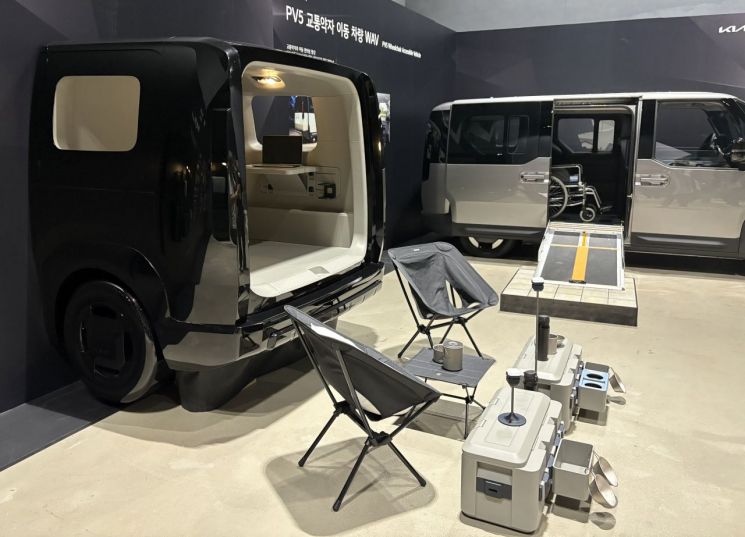 Using the Kia PV5 for car camping (overnight stay using a vehicle) or loading a wheelchair. Photo by Youngjoo Jeon
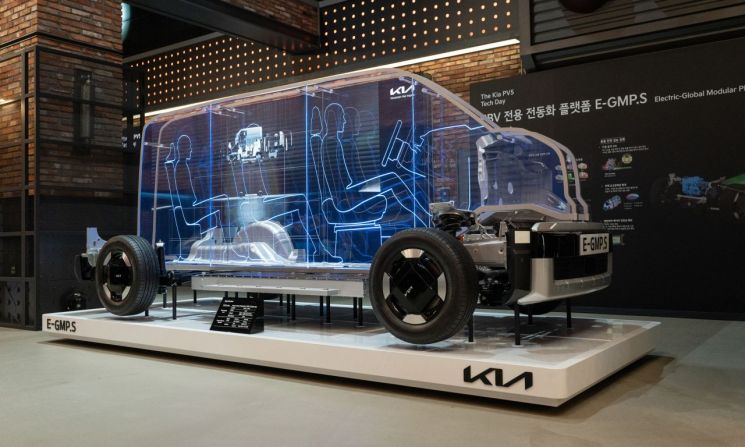
To meet a wide range of needs, the PV5 is the first to feature the "Flexible Body System." The Flexible Body System is a technology that modularizes key moving parts, exterior, and interior components such as the body and doors, allowing the vehicle to be assembled like building blocks. By combining the vehicle structure into modules, excluding the front section and the first row, the body lineup can be expanded to up to 16 types. The second-generation Pedal Misapplication Safety Assist (PMSA) is also installed.
The "Pet Mode" feature, designed for pets, also stands out. This function adjusts the vehicle's temperature and other settings so that dogs can remain safely inside the car when the driver steps away for a short period.
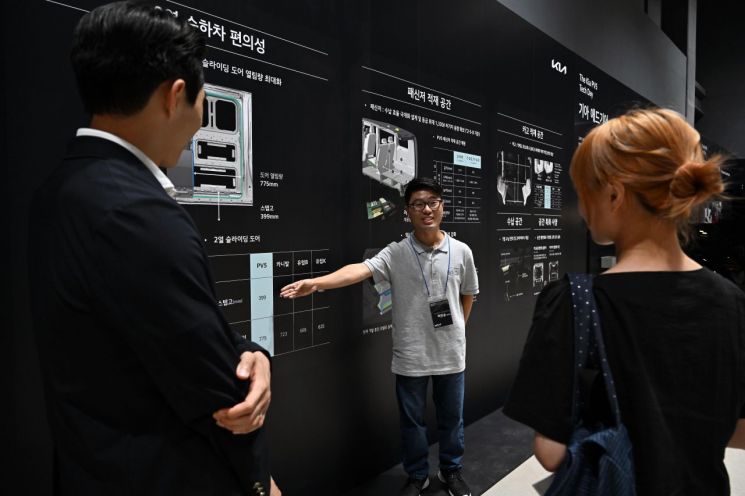 On the 22nd, researchers are giving a presentation at the "The Kia PV5 Tech Day" held in Gwangmyeong, Gyeonggi. Kia
The nickel-cobalt-manganese (NCM) battery used in the PV5 is also a newly developed technology from China's CATL. Principal Researcher Ryu explained, "CATL has developed a new battery exclusively for the PV5, equipped with the latest safety technology, and is supplying it in module pack units." When asked about plans to use domestic batteries in the future, he replied, "Since the criteria and required specifications for battery selection differ by vehicle model, it is difficult to comment on future vehicles at this time."
Kia plans to begin delivering the PV5 to domestic customers starting next month, and to introduce it sequentially to overseas markets, beginning with its European launch in the fourth quarter.
© The Asia Business Daily(www.asiae.co.kr). All rights reserved.



















