Citing Bloomberg News sources
Strengthening regulations on high-performance semiconductor smuggling
Reluctance over politically sensitive issues
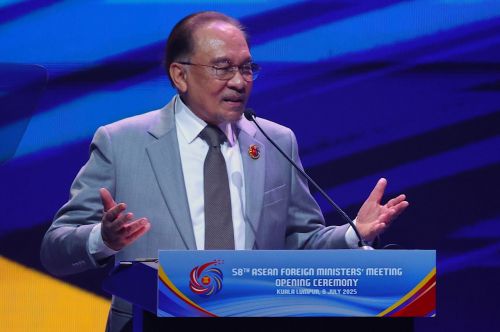 Anwar Ibrahim, Prime Minister of Malaysia, is delivering the keynote speech at the Association of Southeast Asian Nations (ASEAN) Foreign Ministers' Meeting event on the 9th (local time). Photo by EPA Yonhap News
Reports have emerged that Malaysia is continuing behind-the-scenes negotiations with the United States, aiming to reduce the mutually announced 25% tariff rate to 20%. However, Malaysia is reportedly taking a cautious stance on politically sensitive issues such as the extension of tax benefits for U.S. electric vehicles (EVs) and the reduction of fisheries subsidies.
According to Bloomberg News on the 22nd, Malaysia is negotiating with the United States to lower the 25% tariff announced by U.S. President Donald Trump to around 20%, which is the level applied to Indonesia and Vietnam.
The Malaysian government is said to have made some progress on the issue of high-performance semiconductor smuggling, which is a concern for the United States. For example, Malaysia has reportedly revised its industrial regulations regarding 'transshipment products' that pass through third countries. The U.S. government believes that China evaded sanctions during Trump’s first term by rerouting exports through countries such as Vietnam and Mexico. As a result, the U.S. is using the current trade negotiations as leverage to require countries to revise their transshipment regulations as part of the negotiation terms.
Malaysia has stated that no evidence of transshipment has been found so far, but it has nonetheless strengthened related regulations. Under the new rules, individuals or companies must obtain permission to export high-performance artificial intelligence (AI) semiconductors of U.S. origin. If there is a risk that these products may be used for restricted purposes or misused, it must be reported to the government.
On the other hand, Malaysian authorities are reportedly reluctant to agree to the extension of tax benefits for U.S.-made EVs?which are set to expire in December this year?relaxation of foreign ownership limits, and demands for reductions in fisheries subsidies. Sources explained that allowing these measures would likely require Malaysia to offer similar benefits to other countries as well.
According to Bloomberg News, Tengku Zafrul Aziz, Malaysia’s Minister of Investment, Trade and Industry, initially expressed optimism about trade negotiations with the United States, but has recently issued warnings against “hasty negotiations” by various countries.
Anwar Ibrahim, Prime Minister of Malaysia, also indicated the existence of non-negotiable standards, stating the previous day that the government has a "red line" when it comes to core national policies, including preferential policies for Malays and indigenous peoples.
Meanwhile, Vietnam, which was the first Asian country to sign a trade agreement with the United States, reportedly believed it had reached a more favorable agreement when it announced earlier this month that it had agreed to a 20% tariff with the U.S. The Vietnamese government has stated that detailed negotiations are still underway.
© The Asia Business Daily(www.asiae.co.kr). All rights reserved.

















