Kimchi Imports Reach $93.79 Million in First Half of Year... Up 11% from Last Year
Annual Imports May Surpass $200 Million for the First Time... Trade Deficit Deepens
Rising Raw Material Costs Due to Abnormal Weather Add to Price Burden
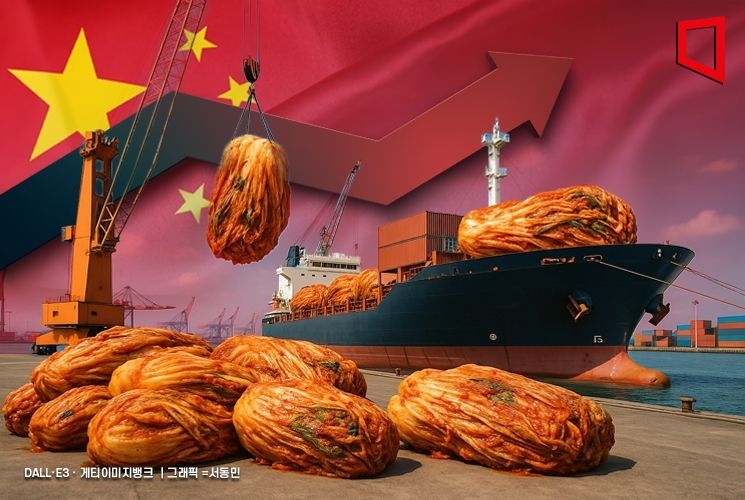
The scale of kimchi imports in the first half of this year reached an all-time high. As inflationary pressure increased, demand for relatively inexpensive Chinese kimchi rose, particularly among restaurants. This year, due to abnormal weather conditions such as intense heat and a delayed rainy season, the prices of raw ingredients like Napa cabbage have inevitably increased, and dependence on cheap Chinese kimchi imports is expected to grow even further.
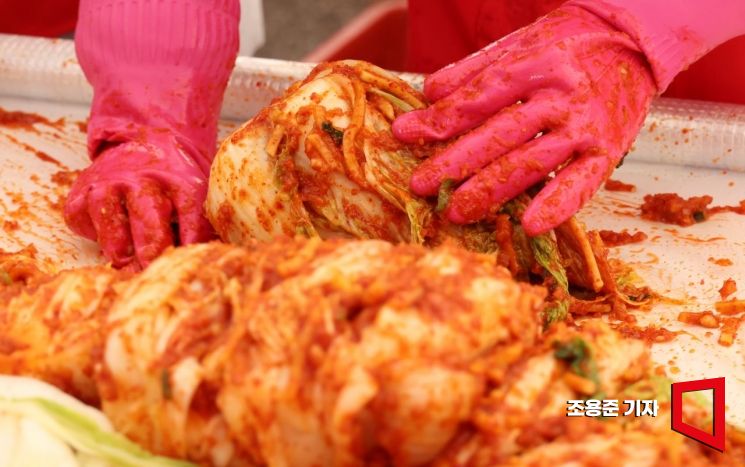
According to export and import trade statistics from the Korea Customs Service on July 23, kimchi imports in the first half of this year amounted to $93.79 million (approximately 130 billion won), an 11.2% increase compared to the same period last year ($83.24 million). If this trend continues, the annual import record is likely to surpass $200 million for the first time ever, setting a new all-time high. The import volume also reached 163,148 tons, a 10.1% increase from the same period last year (150,111 tons). Following last year, the annual import volume is certain to exceed 300,000 tons.
However, kimchi exports remain sluggish. As of June this year, kimchi exports amounted to $83.24 million (about 115 billion won), a 0.7% decrease from the same period last year ($83.81 million). While imports continue to increase every year, exports have stagnated, resulting in a growing kimchi trade deficit. In the first half of this year, the kimchi trade deficit widened significantly to $10.54 million (about 15 billion won), compared to $540,000 during the same period last year.
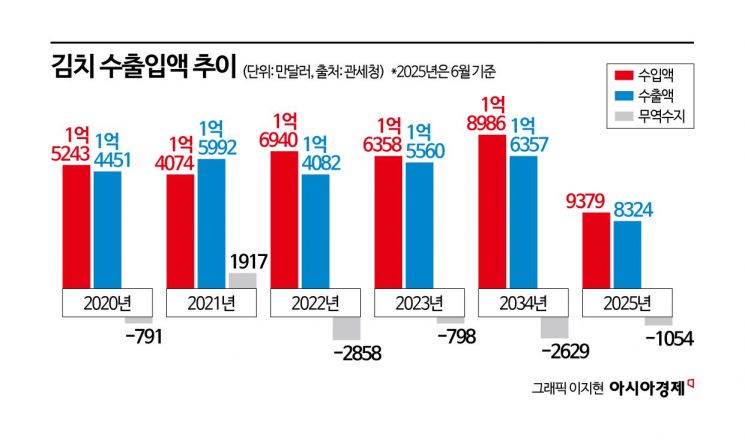
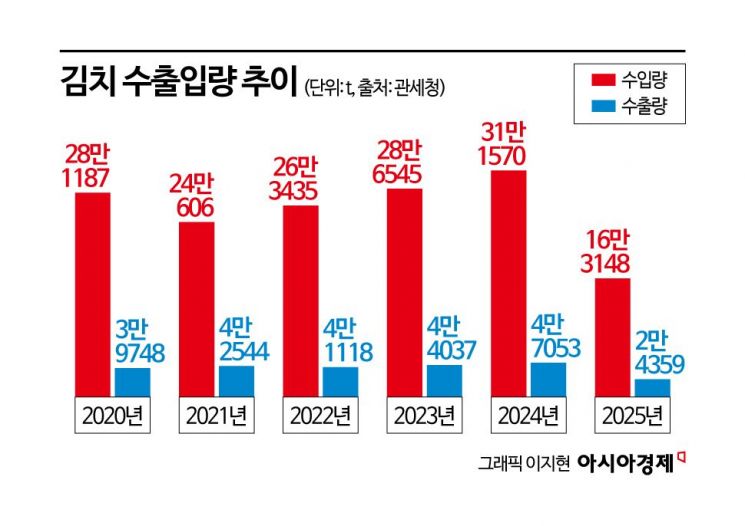
The widening kimchi trade deficit is due to increased imports of cheap Chinese kimchi as the cost of raw materials has risen amid recent inflation. Chinese kimchi is mainly consumed in restaurants rather than at home. Virtually all kimchi imported into Korea is from China, and because the price difference compared to domestic kimchi is significant, demand for imported kimchi is growing, especially among food service businesses with high consumption.
In fact, the burden of kimchi prices has far outpaced the average inflation rate. According to Statistics Korea’s consumer price survey, the price of kimchi last month rose by 14.2% compared to the same month last year. This is more than six times the overall consumer price inflation rate of 2.2%. The inflation rate for kimchi has remained in double digits for eight consecutive months since November last year.
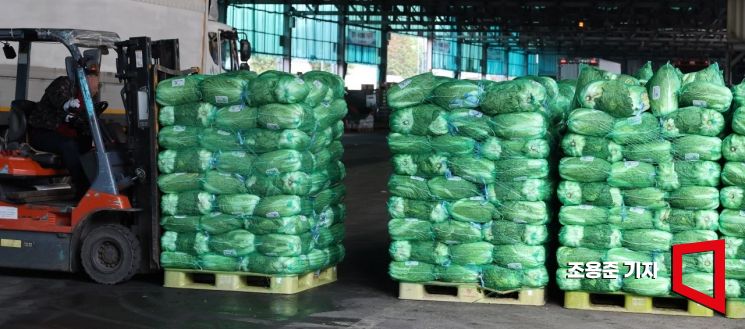
This year, abnormal weather conditions such as early heatwaves, extreme heat, and heavy rainfall have inevitably disrupted the growth of agricultural products, further increasing the cost burden of kimchi ingredients. According to the Korea Agro-Fisheries & Food Trade Corporation (aT) Agricultural Products Distribution Information (KAMIS), as of July 21, the price of one head of Napa cabbage was 5,240 won, a sharp 44.7% increase from a month earlier (3,621 won). This is also 9.1% higher than the average price for this time of year (4,804 won). In addition to cabbage, young radish (yeolmu) rose 56.4% per kilogram to 3,981 won from 2,545 won a month ago, and radish increased by 22.9% per piece to 2,553 won.
The upward trend in prices for raw materials such as Napa cabbage and radish is expected to continue for the time being. According to the Agricultural Outlook Center of the Korea Rural Economic Institute, this month’s shipment volume of Napa cabbage is expected to decrease slightly year-on-year due to delayed growth caused by recent high temperatures and drought, as well as some disease outbreaks. For summer cabbage, while growth was similar to last year’s level until mid-June, concerns have been raised that growth may stagnate due to high temperatures in the latter half of the month, and prices are expected to rise.
The government has also begun to respond to the supply of Napa cabbage. The government has secured 35,500 tons of Napa cabbage from available stocks and plans to release 100 to 250 tons of reserve cabbage per day into the market if summer cabbage supply becomes unstable due to abnormal weather. This release volume is equivalent to 25-50% of the average daily intake at Garak Market. In addition, the government has prepared 2.5 million reserve cabbage seedlings in case of loss or damage, and will provide pest control chemicals to minimize damage from pests and diseases.
© The Asia Business Daily(www.asiae.co.kr). All rights reserved.
![Clutching a Stolen Dior Bag, Saying "I Hate Being Poor but Real"... The Grotesque Con of a "Human Knockoff" [Slate]](https://cwcontent.asiae.co.kr/asiaresize/183/2026021902243444107_1771435474.jpg)


















