Departures to Nepal on the 21st and Indonesia on the 24th
The Seoul National University Global Social Contribution Group is once again dispatching volunteer teams to four countries this year to carry out sharing and exchange activities.
According to Seoul National University on July 25, the Global Social Contribution Group dispatched the "Global SNU Contribution Team" to Indonesia on the previous day, following Nepal on the 21st. The Global SNU Contribution Team, which officially launched with an inauguration ceremony on July 9, plans to send volunteer teams to Uzbekistan and Peru on August 4 and 7, respectively, completing the main dispatch with a ten-day program in each country.
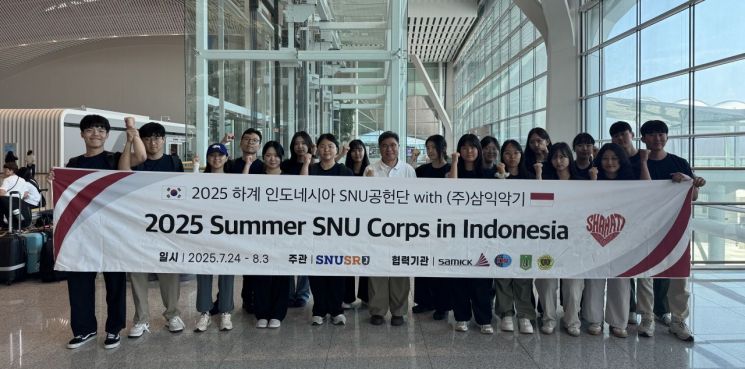 The SNU Contribution Team Shahatti is taking a commemorative photo before departing for Indonesia on the 24th. Seoul National University
More than a Decade of Service... "Aiming for Sustainable Change"
The Global SNU Contribution Team is the flagship program of the Seoul National University Global Social Contribution Group, launched in 2013 to contribute to the international community by dispatching student volunteer teams to developing countries in need of assistance. Dispatch activities are conducted twice a year. Student volunteer teams directly plan programs for each country, including ▲educational sharing ▲medical and health support ▲appropriate technology design ▲cultural exchange, and collaborate with local university students and institutions. A representative from the Global Social Contribution Group stated, "We have been implementing programs with the goal of achieving sustainable change in local communities, not just short-term outcomes, by establishing multifaceted cooperation with local partners and utilizing the university's academic resources."
This year’s summer SNU Contribution Team members were selected through a first round of document screening and a second round of interviews in May. They completed pre-dispatch training for each country and received education on human rights and safety required for international social contribution activities. The members held weekly meetings to concretize the program for each country and prepared for dispatch by communicating online with local members. The summer SNU Contribution Team consists of a total of 93 people, including supervising professors, members, and staff.
The SNU Contribution Team designed social contribution activities tailored to the needs of each country. The Nepal team, which departed on the 21st, will provide physical education, arts, and health education for underprivileged children in Kathmandu in cooperation with Seoul National University alumni, and will also hold health and child education seminars for parents. The Usshaeut:Sha team, composed of 29 Seoul National University students, members, and supervising professors, has partnered with Kathmandu University students to plan customized educational programs for children in educational blind spots in Kathmandu, including physical education, arts, cultural sharing, and health and hygiene. They have also prepared traditional culture experience booths and cultural performances from both countries, reflecting an intercultural perspective. Until July 31, they will conduct various contribution activities at schools in the Kathmandu area, including physical education, arts, health and hygiene education, and cultural sharing. Nepal has been a key partner country with continuous exchange since 2015, and the team will stay until July 31.
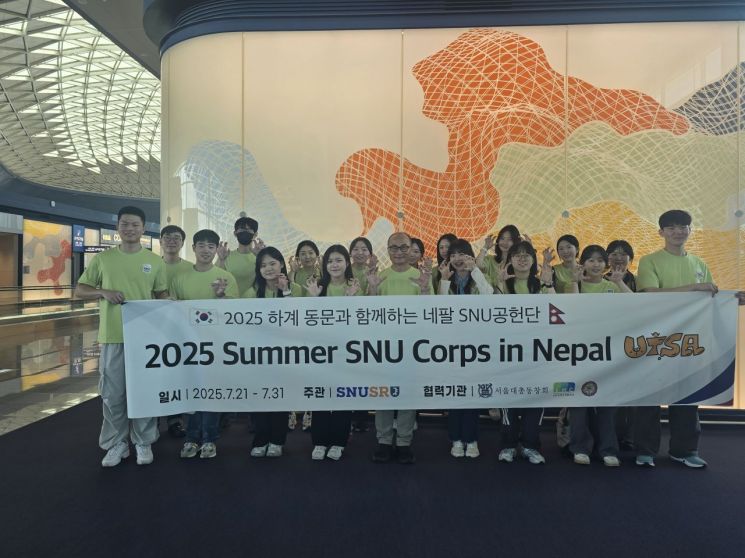 On the 21st, the SNU Contribution Group Usshaeut:Sha team is taking a commemorative photo before departing for Nepal. Seoul National University
The Shahatti team, which is the Indonesia team and a model for mid- to long-term contribution, departed for Indonesia on July 24 with Samick Musical Instruments to provide education aimed at strengthening the employment and entrepreneurship capabilities of out-of-school and unemployed youth in the Lombok region, as well as to address poverty issues. The contribution activities in Indonesia are part of a five-year long-term project sponsored by Samick Musical Instruments, and this is the sixth dispatch. The employment and entrepreneurship capability enhancement program consists of five stages: basic Korean, EPS TOPIK (Employment Permit System Korean Language Test), tourism Korean, business Korean, and digital business, with education tailored to the needs of local graduates. During this dispatch, the Shahatti team will also conduct various activities beyond the advanced practical training for the employment and entrepreneurship program, such as visiting local elementary schools, sharing arts and physical education, and collecting marine litter. By encompassing both cultural and environmental activities, the team aims to expand connections with the local community and lay the foundation for sustainable exchange.
The Uzbekistan team, in partnership with Youngone Corporation, plans to conduct educational sharing activities for kindergarten children in the Samarkand region and educational and cultural sharing activities for ethnic Koreans. The Peru team will provide health education to children and adolescents in impoverished urban areas of Lima and hold health fairs and health campaigns for local residents. While each team dispatched to the four countries has planned and implemented their activities in different ways, they all share the common goal of sharing and realizing the university’s academic resources with local communities through cooperation with local organizations.
Visited Eight Countries Last Summer and Earlier This Year
The Contribution Group also dispatched overseas volunteer teams last summer and earlier this year to carry out exchange and sharing activities. In July last year, starting with Indonesia, activities were conducted in a total of four countries: Uzbekistan, Peru, and Nepal. The Uzro team, which visited Uzbekistan, visited two public kindergartens in Samarkand to conduct early childhood education sharing based on Korea’s child-centered revised Nuri Curriculum and held a seminar introducing Korean early childhood education. They also conducted early childhood education activities under the theme of "Shape Land," where children learned about various shapes. The medical sharing campaign at the SOS Children's Village provided ▲heat stroke prevention ▲emergency care for fractures ▲CPR booth activities for local children and adolescents. Under the guidance of Professor Jang Yoonseok of the Department of Allergy at Seoul National University Bundang Hospital, who participated as a supervising professor, a medical seminar on anaphylaxis was also held for about 60 local doctors and nurses.
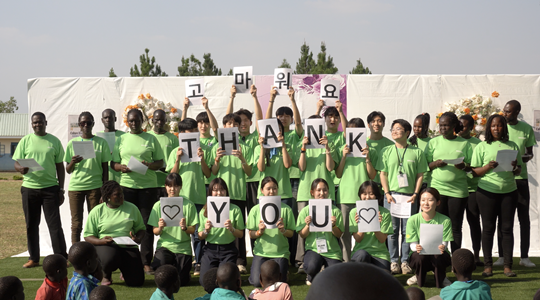 The Sharika Team of the SNU Contribution Group visited Uganda last January to carry out educational and cultural sharing activities. Seoul National University
In the winter program held in January this year, the teams visited Nepal, Uganda, Indonesia, and Uzbekistan. The Sharika team, which spent 11 days in Uganda, visited the Gulu region in northern Uganda to provide physical education, arts, health education, and cultural sharing for elementary school students. The Gulu region in Uganda has suffered from prolonged civil war and is a representative area marginalized from economic development due to the government’s southern-centered economic policies focusing on Kampala, the capital. The team conducted physical education and arts classes for children in the area, including "Create Your Own Stage," collaborative palm painting, water xylophone performances, and flying disc games. On the last day, the activities concluded with a cultural sharing event. SNU team members performed K-pop dances, cheerleading, and Taekwondo dances, while local members from Gulu University and elementary school students responded with traditional African dances and songs.
Seoul National University President Yoo Honglim emphasized, "I hope this journey will be one of practicing consideration and cooperation in places where international assistance is needed, and of delivering hope."
© The Asia Business Daily(www.asiae.co.kr). All rights reserved.



















