Crime Safety Budget Increased by 47%
Expansion of Infrastructure Including Intelligent CCTV
Gwanak District in Seoul (headed by Park Junhee) is working to alleviate residents' anxiety caused by a series of incidents in the Sillim-dong area by strengthening community safety and improving the local image, with the goal of transforming into a "city where residents feel secure."
According to the district on July 22, Park Junhee presided over a meeting on July 21 to discuss ways to strengthen crime prevention initiatives. The meeting was attended by 13 related departments, including the Safety Management Division, to review ongoing crime prevention projects and discuss supplementary measures.
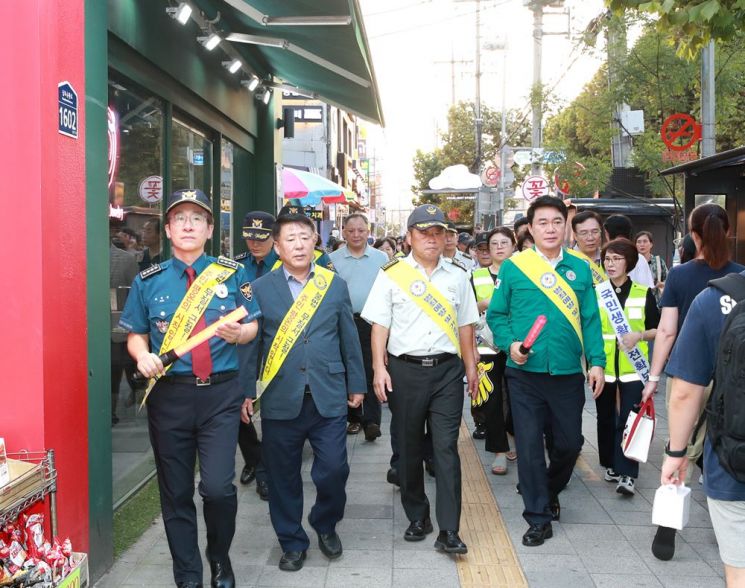 Park Junhee, head of Gwanak District Office, conducting a joint public-private police patrol around Sillim Station last September (fourth from the left). Provided by Gwanak District Office.
This year, the district has expanded its project areas to include "revitalizing local commercial districts" and "improving the regional image," allocating a total of 6.9 billion won, a 47% increase compared to previous years. Since 2023, the district has implemented area-specific crime safety measures, such as expanding crime prevention infrastructure, strengthening on-site patrols, providing security equipment for single-person households, preventing violent crime victimization, and supporting victims.
By the end of the year, the district plans to install nine additional "intelligent CCTV" cameras in the Sillim-dong area to detect abnormal behavior, thereby increasing the efficiency of surveillance operations and enabling rapid response to safety incidents.
On the back roads connecting Sillim Station to Dangok Intersection, 320 additional smart security lights will be installed. These smart security lights are linked to the "Ansim-i App," so when a pedestrian passes nearby, the lights automatically turn on. In emergencies, residents can shake their mobile phones to immediately report incidents to the Gwanak Smart Monitoring Center.
Given the high proportion of single-person households in the district, 200 such households vulnerable to crime and safety incidents will receive two types of "safety devices," including front door security locks, smart doorbells, or indoor home cameras. Moving forward, the district plans to secure additional funding for vulnerable residents' housing safety through the Seoul Metropolitan Government's "Safety Equipment Support Project" grant program.
In addition, the district aims to boost the positive image of the Sillim Station area, which has stagnated in the aftermath of recent incidents, and to revitalize nearby commercial districts. In particular, the "Sillim Healing Spot Recommendation Event" will encourage residents to discover and promote hidden attractions in Sillim, fostering a resident-led shift in perception of the area.
Meanwhile, the district is also focusing on identifying and managing high-risk individuals with mental health conditions. This year, through a "QR Code Mental Health Screening," more than 400 individuals with mental health disorders have been proactively identified, registered, and provided with treatment support and emergency intervention as needed. The district is also conducting practical crime prevention education, such as daily life recovery programs for reclusive or isolated households and self-defense seminars for residents.
Park Junhee stated, "Crime is a disaster that can strike anyone, anywhere, at any time, but we will focus all administrative resources on blocking crime damage in advance through highly effective prevention activities." He added, "Through close cooperation with related agencies such as the Gwanak Police Station, we will make Gwanak a 'city where people can live with peace of mind and want to live.'
© The Asia Business Daily(www.asiae.co.kr). All rights reserved.

















