Emphasis on Expanding Indo-Pacific Alliance to Counter China...
Similar Demands May Be Made to South Korea
President Marcos of the Philippines to Hold Summit with Trump on the 22nd
U.S. Secretary of Defense Pete Hegseth met with Philippine President Ferdinand Marcos Jr. and emphasized that the Mutual Defense Treaty between the United States and the Philippines applies anywhere in the Pacific region, including the South China Sea.
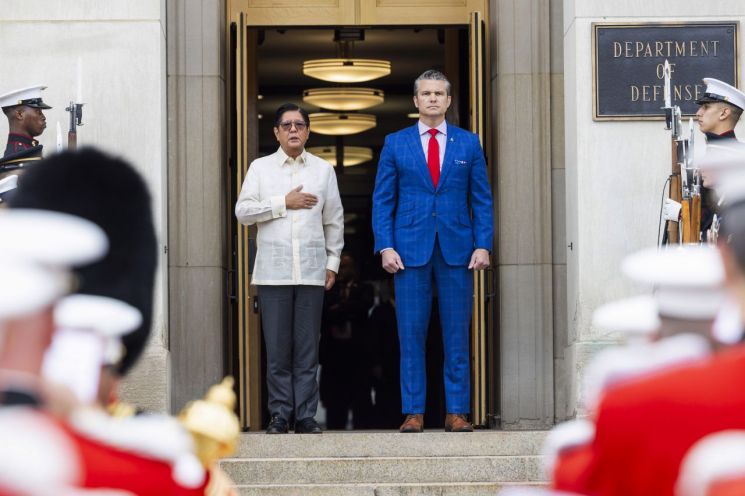 Philippine President Ferdinand Marcos (left) and U.S. Secretary of Defense Pete Hegseth are taking a commemorative photo on the 21st (local time) at the U.S. Department of Defense building near Washington DC. Photo by EPA Yonhap News
According to the U.S. Department of Defense on the 21st (local time), Secretary Hegseth stated during his meeting with President Marcos at the Department of Defense building near Washington D.C., "Our alliance, which has a rich history, has never been as strong or as essential as it is now," adding, "This treaty applies to any armed attack against our armed forces, aircraft, or public vessels (including those of the Coast Guard) anywhere in the Pacific, including the South China Sea."
Secretary Hegseth's remarks appear to underscore that the scope of the alliance between the two countries, aimed at checking and deterring China, could include not only Philippine territory and its surrounding waters but the entire Pacific region. This implies that if the Philippines is attacked by China in the South China Sea, the U.S. military would provide support to the Philippines, and conversely, if the United States is attacked by China in the East China Sea, including the Taiwan Strait, the Philippines would provide support to the United States.
Particularly noteworthy is the possibility that the logic applied by the Trump administration to the U.S.-Philippines alliance could also be extended to the U.S.-South Korea alliance. There are observations that the United States could expand the scope of U.S.-South Korea cooperation beyond the Korean Peninsula and its surrounding areas to the East China Sea and South China Sea, where U.S.-China conflict could occur, and further, that it may request South Korea to agree to guarantee the 'strategic flexibility' of U.S. Forces Korea.
Secretary Hegseth said, "The United States is willing to cooperate with other countries, including the Philippines, to advance President Trump's agenda of 'peace through strength,'" and added, "We do not seek armed conflict, but we are always prepared and will respond resolutely."
In response, President Marcos said, "I believe the alliance between the United States and the Philippines has played a major role in maintaining stability in the South China Sea," and added, "This is also true for the entire Indo-Pacific region." He went on to say, "We are very, very pleased to continue strengthening this relationship."
On the same day, President Marcos also met with Secretary of State Marco Rubio. The two underscored the importance of the ironclad alliance between their countries in maintaining peace and stability in the Indo-Pacific region. The State Department said they also emphasized their shared commitment to supporting a free and open Indo-Pacific, strengthening freedom of navigation and overflight, and maintaining deterrence.
President Marcos is scheduled to hold a summit meeting with President Trump at the White House on the 22nd.
© The Asia Business Daily(www.asiae.co.kr). All rights reserved.

















