Germany Renovates Air-Raid Shelters to Counter Drone Threats
Russia Develops Mobile Shelters in Preparation for Nuclear War
 An air raid shelter in Erfurt, Thuringia, Germany, used during World War II. Erfurt City Hall official website
As the German government has begun a full-scale effort to repair and renovate abandoned air-raid shelters across the country, Russia has also started developing and mass-producing large-scale mobile air-raid shelters. With growing concerns that Russia could launch additional invasions against NATO member states around 2029, European countries are moving to expand their air-raid shelter infrastructure.
German Government Expands Air-Raid Shelters... Neglected Since the Cold War
 The Saint Pauli Bunker in Hamburg, Germany, which was used as a fortress and air-raid shelter during World War II. It has now been remodeled into a hotel. Saint Pauli Bunker official website
According to the Wall Street Journal (WSJ) on the 21st (local time), the German government has launched a pilot project to repair and renovate air-raid shelters that were closed during the Cold War. The plan is to expand air-raid shelter capacity across Germany to accommodate 1 million people by the end of next year. While there are currently 2,000 remaining air-raid shelters in Germany, most have been closed or converted into hotels, art museums, and other facilities, leaving only about 580 still operational. These shelters can accommodate 480,000 people, which is about 5% of Germany's total population of 83 million.
Starting with the pilot project, the German government aims to build enough air-raid shelters to accommodate the entire population by 2029. This is expected to require at least 10 to 30 billion euros (approximately 16 to 48 trillion won) or more. Citing German government officials, the WSJ reported, "Last year, the German government developed a war contingency plan designed so that Germany could serve as a staging area for NATO forces," and added, "The core of the plan is to build air-raid shelters to protect critical infrastructure and to ensure that the government and economy can continue to function even under enemy attack."
In particular, the German government is envisioning air-raid shelters specialized for defending against drones, which Russia has used as a primary weapon in the war in Ukraine. Norbert Gebbeken, director of the Center for Risk Research at Bundeswehr University Munich, told the WSJ, "The greatest threat to civilians is drone attacks and missile fragments, so it is necessary to expand several small air-raid shelters that can be accessed immediately after an alert, rather than relying on one large facility," and explained, "The government is planning a range of shelters, from large underground facilities for core wartime functions to basic shelters that protect civilians from drone attacks."
It appears that the sharp increase in Russia's drone production has made drone defense a central focus in air-raid shelter construction. Previously, Zvezda, a channel under the Russian Ministry of Defense, released footage on the 20th showing that more than 5,000 drones are being produced each month at a factory in the Tatarstan region, behind the front lines in Russia, for use as suicide drones.
Russia Develops Mobile Air-Raid Shelters... "Preparing for Nuclear War"
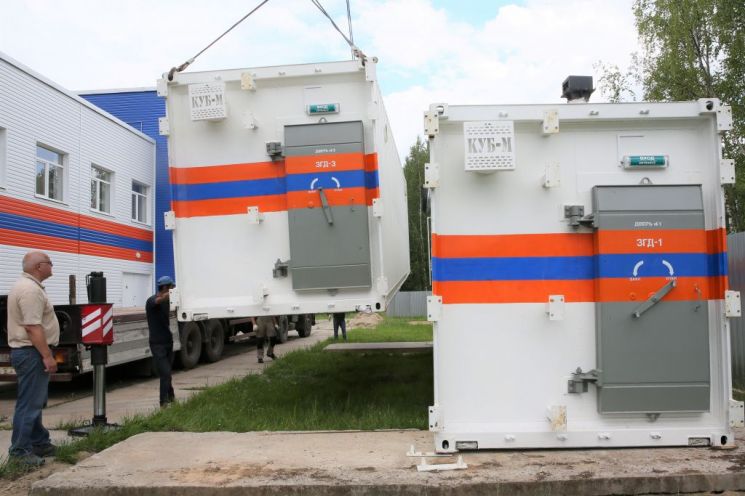 The mobile air-raid shelter 'KUB-M,' which began mass production in Russia since November last year. Russian Civil Defense and Emergency Situations Research Institute
Russia is also mass-producing mobile air-raid shelters and installing them in major cities, citing preparation for nuclear war. According to TASS, the Russian Civil Defense and Emergency Situations Research Institute, under the Ministry of Emergency Situations, has developed a mobile air-raid shelter called 'KUB-M' since November last year.
This shelter, reinforced from a steel container, has space to accommodate 54 people. The capacity can be expanded by adding more living modules, and it is designed to protect against explosions and shrapnel from conventional weapons, building debris, hazardous chemicals, and fire. It is also engineered to withstand the shockwave and radiation from a nuclear explosion for more than 48 hours.
The reason the Russian government is installing mobile air-raid shelters is reportedly to prepare for a possible war with NATO following the war in Ukraine. As military tensions rise in the Kaliningrad region, a border area between Russia and NATO countries, the threat of war is increasing.
According to Defense News, a U.S. military media outlet, Christopher Donahue, commander of U.S. Army Europe and Africa, said at a U.S. Army event in Wiesbaden, Germany, on the 17th, "NATO forces have the capability to erase Kaliningrad from the map instantly if necessary," and added, "Intelligence agencies have reported that there is a possibility that Russian forces could invade the territory of one of the NATO member states within the next 5 to 7 years."
The Russian government immediately expressed strong opposition and mentioned the possibility of a preemptive strike. Leonid Slutsky, chairman of the Russian State Duma Committee on International Affairs, said, "An attack on Kaliningrad is an attack on Russia," and warned, "We will take all corresponding retaliatory measures, including the use of nuclear weapons." Dmitry Medvedev, deputy chairman of the Security Council, also emphasized, "The West is effectively waging an all-out war against Russia. We must respond comprehensively, and if necessary, we must also carry out preemptive strikes."
© The Asia Business Daily(www.asiae.co.kr). All rights reserved.
![Clutching a Stolen Dior Bag, Saying "I Hate Being Poor but Real"... The Grotesque Con of a "Human Knockoff" [Slate]](https://cwcontent.asiae.co.kr/asiaresize/183/2026021902243444107_1771435474.jpg)


















