Lee Hoeseong Stresses "Investment in Energy and Industrial System Transformation to Reduce Costs and Address Instability" at BACO-25 Keynote
"Climate action should focus more on adaptation than on mitigation."
Lee Hoeseong, former chair of the Intergovernmental Panel on Climate Change (IPCC), made this proposal during his keynote speech at the '2025 IUGG Meteorology-Oceanography-Cryosphere International Conference (BACO-25),' which opened on the 21st at BEXCO in Busan. He stated, "As major economies are taking steps to reduce supply chain risks, resulting in structural changes in the energy and industrial systems that influence climate policy, climate action will increasingly be evaluated based on its contribution to reducing energy costs and alleviating economic instability."
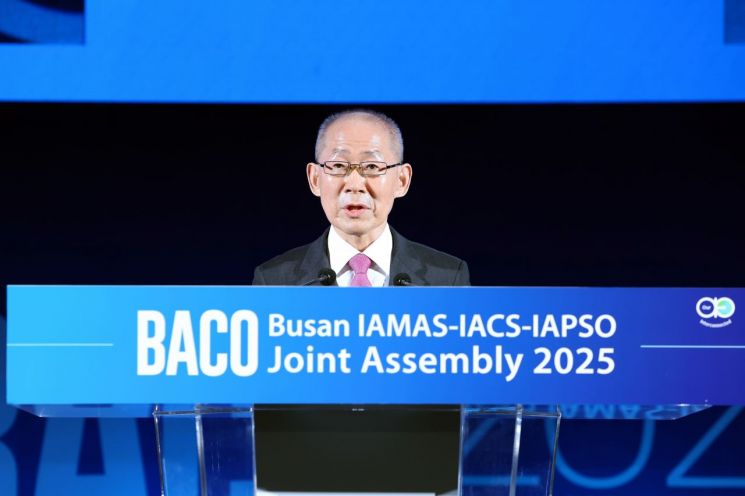 Lee Hoeseong, former chair of the Intergovernmental Panel on Climate Change (IPCC), is delivering a keynote speech at the '2025 IUGG Meteorology-Oceanography-Cryosphere International Conference (BACO-25)' which opened on the 21st at BEXCO in Busan. Provided by BACO-25 Organizing Committee
He explained, "Investment in climate change adaptation delivers both climate resilience and economic security within a much shorter timeframe than mitigation investment. In contrast, mitigation investment provides climate benefits that are long-term and global, but its costs are immediate and local."
Adaptation investment refers to funding that enables specific regions or communities to directly respond to the impacts of climate change?such as floods, droughts, or heatwaves?that they are already experiencing or will face in the future. The effects of such investments can be felt in the short term.
For example, constructing coastal barriers or improving drainage systems can immediately protect communities from typhoons or tidal waves, directly contributing to the safety of local residents and the stability of economic activity. As the impacts of climate change become more visible, this form of investment is highly attractive for countries or regions seeking to reduce damages immediately.
This year marks the 10th anniversary of the Paris Agreement, which aims to limit the rise in global average temperature to below 1.5 degrees Celsius. However, as major countries restructure their energy and industrial systems to reduce supply chain risks, even existing efforts to cut carbon emissions are facing uncertain outcomes.
The fact that Lee is emphasizing 'investment in adaptation' over 'mitigation investment' at this BACO-25 conference is highly significant.
Lee Myungin, a professor at Ulsan National Institute of Science and Technology and secretary-general of the BACO-25 Organizing Committee, said, "Dr. Lee has consistently emphasized that investment in climate change response can be an opportunity to create new industries and jobs and improve economic efficiency, going beyond mere costs. He has stressed that transition is crucial for climate change response, and that even if it takes time, we must turn crisis into opportunity based on carbon-neutral technologies."
Dr. Lee has consistently argued that "responding to climate change is not only a technical issue but also requires social tipping points and behavioral change," emphasizing that solving climate change cannot be achieved by technological development alone, but requires a shift in awareness and behavior across all members of society.
In his speech, citing the IPCC Sixth Assessment Synthesis Report, he noted, "Ocean warming and acidification are negatively affecting food production in fisheries and shellfish aquaculture, and half of the world's population is experiencing severe water shortages for at least part of the year due to both climate and non-climate factors." He also expressed concern that "particularly, vulnerable groups who have contributed least to climate change are suffering disproportionately from its impacts."
He further emphasized, "To maintain the resilience of biodiversity and ecosystem services on a global scale, effective and equitable conservation of about 30 to 50 percent of terrestrial, freshwater, and marine areas is necessary."
© The Asia Business Daily(www.asiae.co.kr). All rights reserved.

















