'Integrated Support Center' Opens on the First Floor of City Hall on the 22nd
One-stop Service from Civil Complaint Reception to Support
Kang Kijeong Inspects Flood-damaged Sites... "Restoring Citizens' Daily Lives"
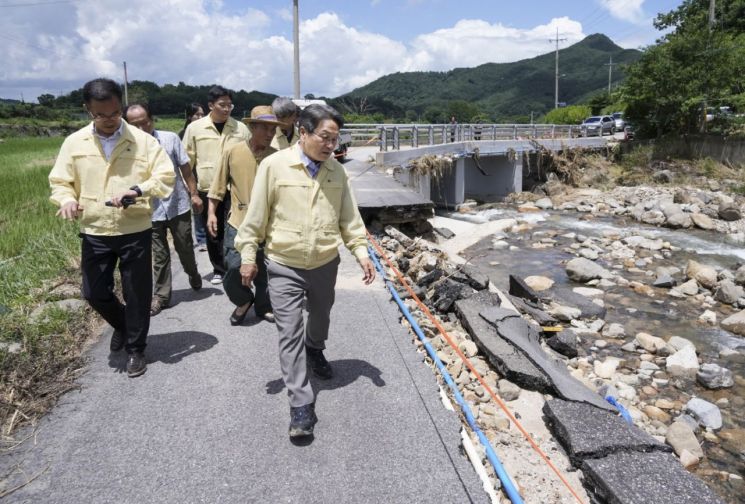 Gwangju Mayor Kang Kijeong is visiting Pyeongchon Village in Buk-gu on the morning of the 21st to inspect the flood damage site. Photo by Gwangju City
Gwangju City has activated a comprehensive response system to swiftly recover from the damage caused by the recent heavy rainfall, which recorded the highest daily precipitation of 426mm since weather observations began, and to prevent secondary damage.
On the 21st, Gwangju Mayor Kang Kijeong visited Pyeongchon Village in Buk-gu, where a river embankment was washed away, to assess the damage and ordered emergency restoration. Since the heavy rainfall began on the 17th, Mayor Kang has visited affected sites such as Sinan Bridge in Buk-gu, Hashin Village in Yonggang-dong, Bitgoeul Craft Creative Village in Nam-gu, and Sandong Bridge, making every effort to expedite emergency recovery.
Mayor Kang stated, "What Gwangju needs most right now is rapid damage recovery, prompt assessment of the damage situation, and a declaration of a special disaster zone based on that assessment." He added, "The city will focus all administrative resources to help citizens affected by the heavy rain quickly return to their daily lives, and we will respond promptly with one-stop services such as the Honam Region Integrated Support Center for Victims."
Mayor Kang also requested Prime Minister Kim Minseok, who visited Gwangju the previous day, to promptly declare a special disaster zone and to improve areas prone to frequent flooding in low-lying districts.
To ensure that citizens affected by the recent heavy rainfall can resolve various civil complaints without inconvenience, the city will establish the "Heavy Rain Victims Integrated Support Center" (hereinafter referred to as the Support Center) on the first floor of City Hall and begin operations on the 22nd.
The Support Center is composed of relevant central government ministries and agencies, including the Ministry of the Interior and Safety, Ministry of Health and Welfare, Ministry of Environment, Ministry of Education, National Tax Service, and financial institutions, to provide one-stop processing of damage-related civil complaints. The center will operate until the recovery process is complete.
Citizens affected by the disaster can receive various services necessary for practical recovery through the Support Center, including: ▲relief for displaced residents ▲medical and psychological support ▲funeral procedures ▲volunteer coordination ▲support for families in crisis ▲resolution of disruptions to communication, electricity, and gas supply ▲restoration of infrastructure such as roads and railways ▲waste disposal ▲consultation on recovery fund loans and loan deferments ▲insurance claim procedures, and more. To use the Support Center, citizens can check with a representative via the Gwangju City website or by phone (120), and then proceed with in-person or phone consultations.
Meanwhile, along with the operation of the Support Center, the city plans to provide guidance on various support programs to prevent citizens from missing out on disaster relief applications, including reductions in water and sewage fees, tax payment deferrals, and postponement of military enlistment dates. The city will also actively promote these programs to ensure that victims do not miss out on available benefits.
© The Asia Business Daily(www.asiae.co.kr). All rights reserved.

















