Korea Customs Service Releases July 1-20 Trade Figures
Exports to China Down 5.9%, United States Down 2.1%
"July's Overall Export Performance Expected to Turn Positive"
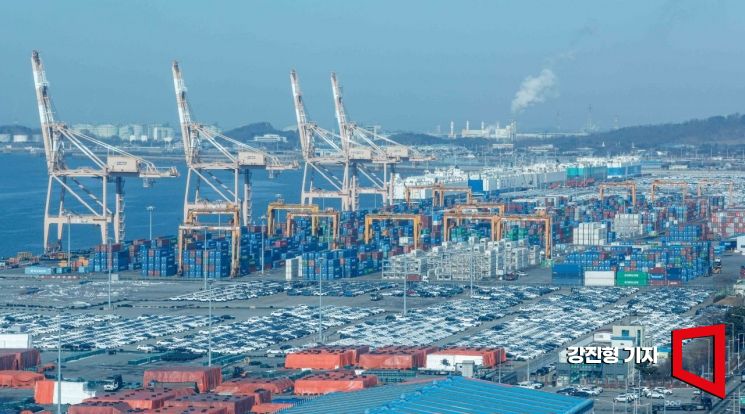
As of the 20th of this month, exports had declined by about 2%. This was attributed to a simultaneous decrease in exports to the United States and China, which are Korea's two largest export markets, following the impact of U.S. tariff measures. However, the government expects that the overall export figure for July will turn positive, citing that the recent decline was also affected by a shortage of working days.
According to export and import statistics for July 1?20 released by the Korea Customs Service on the 21st, exports during this period totaled $36.1 billion, down 2.2% from the same period last year.
However, when accounting for the number of working days, average daily exports reached $2.33 billion, marking a 4.1% increase. The number of working days from the 1st to the 20th of this month was 15.5, one day fewer than the same period last year.
An official from the Ministry of Trade, Industry and Energy stated, "Although the total number of working days in July this year is the same as last year, there was one fewer working day from the 1st to the 20th, which explains the decline. By the end of the month, the number of working days will be the same, so we expect the decrease to be offset and for the overall figure to turn positive."
By product category, among the top 10 export items, only semiconductors (16.5%), passenger cars (3.9%), and ships (172.2%) saw increases as of the 20th of this month, while exports of the remaining seven items declined. Petroleum products and steel products fell by 17.5% and 9.7%, respectively. Exports of auto parts (-8.4%), wireless communication devices (-16.8%), computer peripherals (-7.9%), precision instruments (-6.3%), and home appliances (-20.9%) also continued to decrease.
By country, exports to China and the United States dropped by 5.9% and 2.1%, respectively. Exports to Japan (-5.8%), Hong Kong (-33.7%), and Singapore (-9.5%) also declined. In contrast, exports to the European Union (EU, 3.0%), Vietnam (1.1%), and Taiwan (29.9%) increased.
Imports from July 1?20 totaled $35.6 billion, down 4.3% from the same period last year. While imports of machinery (6.6%) and semiconductor manufacturing equipment (28.3%) increased, imports of crude oil (-11.6%), semiconductors (-0.6%), and gas (-6.2%) decreased. Total energy imports?including crude oil, gas, and coal?fell by 9.7%. By country, imports from the EU (8.6%), Japan (0.9%), and Taiwan (0.5%) increased, while those from China (-0.01%) and the United States (-28.4%) decreased.
Because imports declined more sharply than exports, the trade balance from July 1?20 recorded a surplus of $500 million. Including this, the cumulative trade surplus for the year up to the 20th of this month increased to $28.245 billion.
Previously, exports in June of this year totaled $59.8 billion, up 4.3% from the same period last year, marking a return to positive growth. This was due to record-high semiconductor exports of $14.97 billion, up 11.6%, and automobiles at $6.3 billion, up 2.3%, both of which set new records for the month of June.
An official from the Ministry of Trade, Industry and Energy said, "Semiconductor exports are expected to continue increasing through the end of the year, and automobile exports in July will likely grow as well due to the base effect from last year's Korea GM strike. The government will make every effort to minimize the impact of U.S. tariff policy uncertainties on Korean companies."
© The Asia Business Daily(www.asiae.co.kr). All rights reserved.

















