Record of Activities in the International Human Rights Law Society Under Scrutiny
On July 21, rival parties engaged in a fierce debate over the political orientation of Kim Sanghwan, nominee for both Chief Justice and Justice of the Constitutional Court, during his confirmation hearing. Kim was nominated by President Lee Jaemyung.
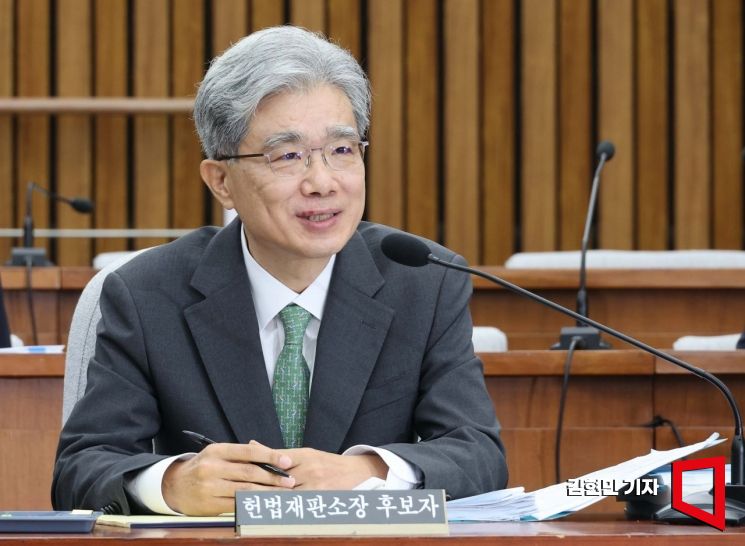 Kim Sanghwan, nominee for Chief Justice of the Constitutional Court, is answering questions at the confirmation hearing held at the National Assembly on the 21st. Photo by Kim Hyunmin
The National Assembly's special confirmation committee, chaired by Lee Jaejung, a three-term lawmaker from the Democratic Party, convened the hearing in the morning to assess Kim's commitment to political neutrality and the protection of fundamental rights as Chief Justice.
The People Power Party raised concerns about Kim's potential political bias, pointing to his background in the International Human Rights Law Society. Seo Beomsoo, a member of the People Power Party, asked, "What kind of relationship do you have with President Lee Jaemyung, who holds the power of appointment?" He continued, "It appears you are connected because you delivered a not-guilty opinion in President Lee's 2020 public official election law violation case." Kim firmly responded, "I have no personal relationship."
Woo Jaejun, another People Power Party lawmaker, said, "There are too many members of certain associations, such as the Woori Law Society and the International Human Rights Law Society, in the Constitutional Court," questioning whether this could lead to political bias. Representative Cho also pointed out, "Progressive-leaning justices often reach perfectly aligned conclusions. Does this not undermine political neutrality or independence?"
On the other hand, Jin Sunmi of the Democratic Party voiced support for Kim, stating, "I believe that those who have continuously studied and reflected on issues such as the International Human Rights Law Society should naturally become Constitutional Court justices."
Jin further remarked, "There are areas, such as children's rights, disability rights, and social rights, that do not yet meet international human rights standards. To bring greater attention to these issues, the Constitutional Court's rulings must send an important message that prompts countless citizens in Korea to reconsider the ideals of the Constitution and fundamental rights."
In response, Kim said, "I strongly agree," and added, "When I worked as a research officer at the Constitutional Court, I heard from the first group of justices that, at the time, politicians from both ruling and opposition parties participated. They greatly contributed to the richness of early debates and the diversity of thought in the Court."
Prior to the hearing, Kim submitted written answers to the confirmation committee, addressing concerns about his past involvement in the Woori Law Society and International Human Rights Law Society. He stated, "Judges strive to excel in their work and trials, and to do so, they cannot neglect their studies. While there are various study groups within the court, I believe these are academic organizations that judges voluntarily join to obtain useful materials for trials and to further their studies."
Kim is a graduate of Seoul National University School of Law and a former Supreme Court Justice. He is regarded as an expert in constitutional theory and interpretation. He has served twice as a research officer dispatched to the Constitutional Court. Since his appointment as a judge at the Busan District Court in 1994, he has held positions including judge at the Uijeongbu Branch of the Seoul District Court, judge at the Western Branch of the Seoul District Court, research officer at the Supreme Court, presiding judge in charge of warrants at the Seoul Central District Court, presiding judge at the Seoul High Court, and chief presiding judge of Civil Division 1 at the Seoul Central District Court.
Meanwhile, lawmakers from both parties plan to assess Kim's qualifications and submit the appointment motion to the National Assembly plenary session for a vote. The appointment of the Chief Justice of the Constitutional Court requires approval of the appointment motion by the plenary session.
© The Asia Business Daily(www.asiae.co.kr). All rights reserved.

















