"Atmospheric resonance turns water vapor into rain all at once"
A giant sponge-like air mass forms in the atmosphere...
"Will worsen with warming"
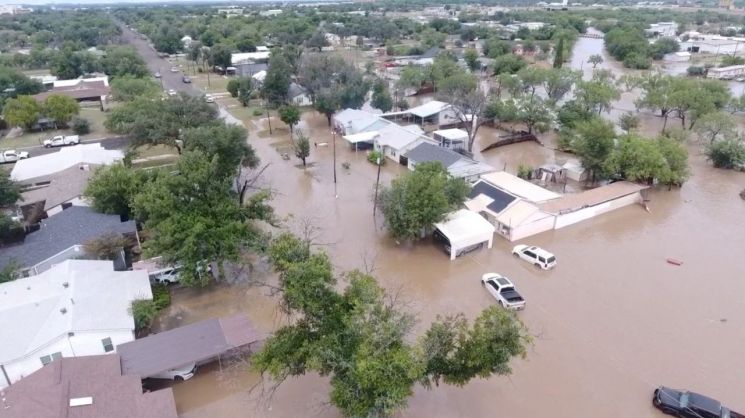 On the 4th (local time), houses flooded due to heavy rain in the San Angelo area of Texas. Photo by Reuters Yonhap News
Throughout July, torrential rains struck across Asia, the United States, and even Siberia, causing widespread damage. American scientists have identified "atmospheric resonance" as the main cause of these downpours. Atmospheric resonance is a phenomenon in which energy in the atmosphere is amplified due to external stimuli such as rising temperatures, causing a large amount of water vapor to be converted into rain all at once and resulting in heavy rainfall. As global warming accelerates, atmospheric resonance events are expected to occur more frequently, raising concerns that the frequency of record-breaking summer downpours will also increase.
"Atmospheric resonance causes water vapor to turn into rain all at once"
 On the 7th (local time), residents in Hojai, Assam, India, are crossing roads flooded due to heavy rain. Photo by AFP
In July 2025, large-scale floods occurred around the world, including in South Korea. In China, 25 million people were affected, while in Pakistan, more than 90 people died. Even in Oymyakon, a region in Siberia within the Arctic Circle, heavy rains flooded about 100 houses. Across the ocean, in Texas, the United States, large-scale floods resulted in 135 deaths.
In particular, Texas experienced a record-breaking downpour, said to occur only once in a thousand years, which led to severe flood damage. Normally, summer precipitation in Texas is only about 60 to 100 mm, and the region is known for being hot and dry in summer. However, the sudden heavy rain caused even greater damage. Between July 4 and July 7 (local time), some parts of Texas received 250 to 350 mm of rain in just three hours?equivalent to three months' worth of rainfall.
American scientists attribute the sudden downpours to intensified atmospheric resonance. Atmospheric resonance refers to the phenomenon in which the amount of energy entering the atmosphere from external sources increases due to rising temperatures and other factors, causing the amplitude of certain wavelengths to expand. When atmospheric resonance intensifies, various weather anomalies can occur, and it can rapidly convert atmospheric water vapor into rain, resulting in torrential downpours.
Michael Mann, a climatology professor at the University of Pennsylvania, told CNN, "Just as sound waves or ocean currents experience amplification when energy wavelengths match their natural frequencies, we are observing similar resonance phenomena in the upper atmosphere that persist for weeks." He added, "These weather patterns can cause extreme weather events, and since the mid-20th century, such patterns have increased more than threefold in summer."
A giant sponge-like air mass forms in the atmosphere... "Will worsen with warming"
 On the 8th (local time), Nepali soldiers are rescuing flood victims trapped in water in the Rasuwa Gadi area. Photo by EPA
As global warming intensifies, concerns are growing that extreme rainfall will become a routine occurrence every summer. As temperatures rise, the amount of water vapor in the atmosphere increases rapidly, and when this is combined with atmospheric resonance, large amounts of rain can be produced.
According to climate researchers at UCLA, for every 1-degree Celsius rise in the Earth's average temperature, the amount of moisture released from the ground into the atmosphere increases by 7%. As a result, the surface experiences severe heat waves and droughts, while atmospheric water vapor increases significantly, eventually leading to torrential rains and floods. This phenomenon, in which water vapor rapidly leaves the surface and then returns as heavy rain, is called "hydroclimate whiplash."
Daniel Swain, a climate researcher at UCLA, told CNN, "Throughout this summer, a giant sponge-like air mass formed in the atmosphere, absorbing surface moisture and creating unusually high humidity. Later, all the water in the air was suddenly released, resulting in record rainfall." He pointed out, "Even if average precipitation does not change significantly in the future, the risk of extreme, localized downpours will increase."
© The Asia Business Daily(www.asiae.co.kr). All rights reserved.



















