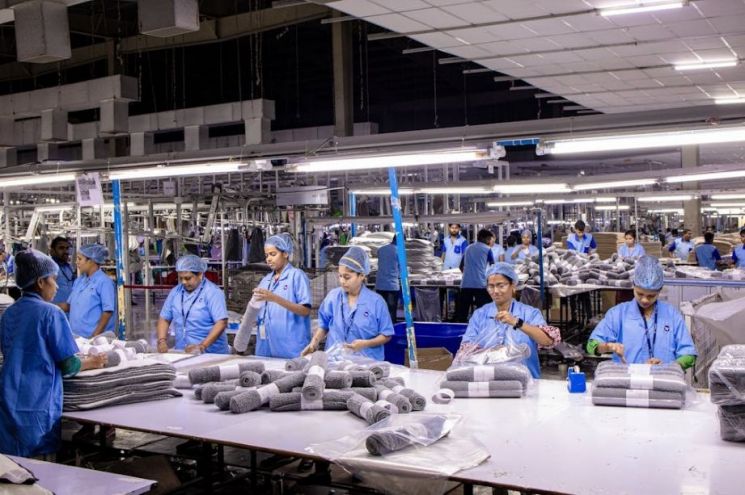
 This is a reference photo to aid understanding of the article and is unrelated to the article content. Pexels
There are claims emerging in Japan that the influx of low-wage foreign workers is acting as a factor that suppresses wage increases for Japanese workers. Japanese politicians have been making such remarks during the House of Councillors election, prompting Japanese media to conduct fact-checks by quoting experts.
On July 19, the Mainichi Shimbun published a report titled, "Is it true that Japanese wages do not rise when the number of foreigners increases? We ask the experts." According to the report, during the House of Councillors election, some political parties have repeatedly argued that "if the number of foreign workers increases, Japanese wages will not rise." Naoki Hyakuta, leader of the conservative party, claimed, "According to the data, foreign workers are working at about 70% of the wage level of Japanese workers," and added, "If cheap labor continues to come in, it is only natural that Japanese wages will not rise." Munetori Kamiya, leader of the Sanseito party, also stated, "If there is a labor shortage, wages are raised to attract people, but if the supply increases, wages naturally go down," and added, "On average, foreign workers are working for wages about 30% lower than those of Japanese workers. They are considered cheap labor."
It is true that the average salary of foreigners is about 70% of that of Japanese workers. According to the 2024 Basic Survey on Wage Structure by the Ministry of Health, Labour and Welfare, the average monthly salary for general workers (excluding overtime and other allowances) is about 330,000 yen (3.09 million won). In contrast, foreign workers earn about 240,000 yen (2.25 million won) with an average length of service of 3.3 years, which is about 70% of the salary of general workers. The average monthly salary for general workers has been rising, albeit gradually, and has increased by about 30,000 yen compared to 2014. In addition, according to the Ministry of Health, Labour and Welfare's statistics on the employment status of foreigners, the number of foreign workers has been increasing every year, reaching a record high of 2,302,587 as of the end of October 2024.
Mainichi asked two experts for their opinions. Yuk K orekawa, Director of International Relations at the National Institute of Population and Social Security Research, rebutted the wage gap between foreigners and Japanese workers, saying, "Most of the difference comes from external factors, such as foreigners being younger or working at smaller companies." He pointed out, "There is not much difference between Japanese and foreign workers working at the same workplace," and added, "The claim that an increase in foreign workers prevents Japanese wages from rising has not been proven." He also stated, "For the next 50 to 100 years, the trend of the working-age population decreasing by 400,000 to 1 million people annually will not change," and added, "Even if 300,000 foreigners are accepted each year, there will still be many occupations with labor shortages. Therefore, it is difficult to see the increase in foreign workers as having a direct impact on Japanese wages."
Professor Akinori Tomohara of Aoyama Gakuin University commented on the politicians' claims, saying, "No specific conditions, such as the scale of acceptance of foreign workers, have been presented, so it is impossible to make any definitive statement from an economic perspective." Regarding the impact on wages, he said, "There are multiple complex factors involved, such as the global economy and internal corporate reserves. Foreign workers are only one of many factors."
© The Asia Business Daily(www.asiae.co.kr). All rights reserved.
![Clutching a Stolen Dior Bag, Saying "I Hate Being Poor but Real"... The Grotesque Con of a "Human Knockoff" [Slate]](https://cwcontent.asiae.co.kr/asiaresize/183/2026021902243444107_1771435474.jpg)











