Demand for UV-Protective Parasols Surges in the US
Once Unfamiliar in the West, Now Emerging as a Major Trend
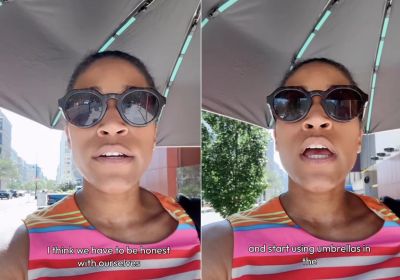 TikTok user Amber Ferguson posted a video about the effects of Yangsan
 [Image source=Screenshot from Amber Ferguson's TikTok]
As climate change leads to increasingly frequent heatwaves around the world, parasols?long considered an exclusively Asian accessory in countries like Korea?are now gaining attention in Western countries as a summer item.
On July 19 (local time), the New York Post reported that demand for UV-protective parasols is noticeably rising in the United States, which has recently been experiencing record-breaking heatwaves. While parasols are commonly used in Asian countries such as Korea, China, Japan, and Thailand, they have until now been a relatively unfamiliar cultural item in the West, including the United States and Europe.
Dr. Helen He of the Mount Sinai-Clinique Dermatology Center explained, "In Asian countries, UV protection is considered important for cosmetic reasons," adding, "Parasols have long been used as an effective tool to prevent melasma, hyperpigmentation, and premature aging."
TikTok user Amber Ferguson shared a video holding a parasol, saying, "The only thing keeping me from melting in this heat is my parasol." The video was met with enthusiastic responses praising the effectiveness of parasols, with comments such as, "Now we have to avoid the sun like we avoid the rain."
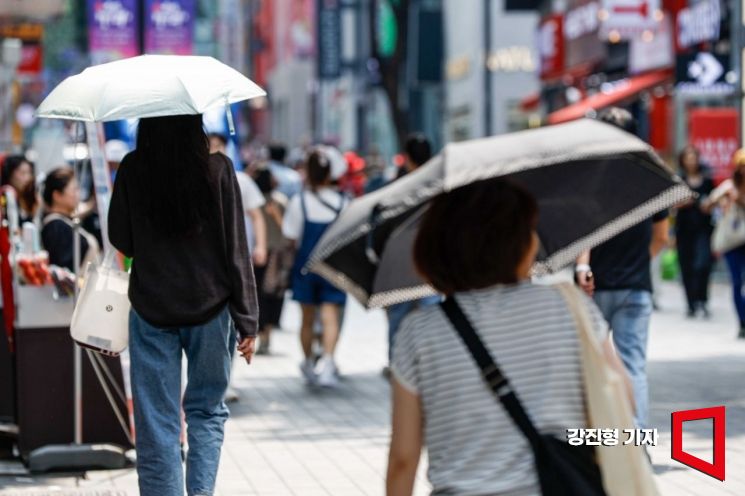 Citizens are shading themselves from the sun with parasols in Myeongdong, Jung-gu. Photo by Asia Economy DB
While moderate exposure to ultraviolet rays helps the body synthesize vitamin D, excessive exposure can cause sunburn, skin damage, premature aging, and even increase the risk of skin cancer. For this reason, parasols are also gaining attention as a means of health protection. Additionally, they are effective at blocking infrared rays, which cause a sensation of heat, making parasols useful for lowering the perceived temperature on hot days.
Dr. He explained, "Products with a tightly woven fabric and UV-blocking (UV) coating are best," noting that the UV protection effect is indicated by the 'UPF (Ultraviolet Protection Factor)' rating. She added, "A UPF 50+ product can block more than 98% of ultraviolet rays, and the larger the parasol, the greater the area of protection."
She also advised that darker colors are more effective at blocking both UV rays and heat due to their higher absorption of sunlight, and for those who prefer bright colors, products with black or silver reflective coatings are recommended.
Furthermore, experts emphasize that parasols alone cannot provide complete UV protection. They recommend using sunscreen in addition to a parasol, wearing clothing with UV-blocking features, and avoiding outdoor activities between 10 a.m. and 3 p.m., when sunlight is strongest.
© The Asia Business Daily(www.asiae.co.kr). All rights reserved.


















