Yellow Envelope Law: "Balanced Response Needed Rather Than Unconditional Opposition"
Tariff Resolution: "Expecting Substantial Results at APEC"
Agricultural Market Opening: "Low Effectiveness and High Political Burden"
RE100: "Even Big Tech Has Given Up... Energy Prices Are Key"
AI Industry: "Government Must Create the Market... 20,000 Startups Needed"
Manufacturing Crisis: "The Lost Decade... Without AI Transformation, Exit Is Inevitable"
Korea-Japan Cooperation: "Data Sharing with Japan Needed for AI Competitiveness"
Choi Taewon, chairman of the Korea Chamber of Commerce and Industry, expressed a cautious stance regarding the mandatory retirement of treasury shares. He voiced concerns about the introduction of such a system, noting that it could reduce companies' incentives to repurchase their own shares.
At a press conference held during the Korea Chamber of Commerce and Industry Summer Forum in Gyeongju, North Gyeongsang Province, on July 17, Chairman Choi stated, "I wonder whether companies will continue to buy back their own shares in the future."
He further emphasized, "If you reduce freedom (autonomy), the incentive to repurchase may actually decrease." He explained that if companies are forced to retire treasury shares, not only will they have to dispose of existing holdings, but future buybacks themselves may also decline.
Recently, the political sphere has been accelerating discussions on amending the Commercial Act to require the mandatory retirement of treasury shares after acquisition. While the move is being justified as a way to enhance shareholder value, companies are pushing back, arguing that treasury shares serve various strategic functions such as defending management rights, managing liquidity, and sending signals to the market.
Regarding the proposed amendment to the Trade Union Act (the so-called "Yellow Envelope Law"), Chairman Choi said, "It is true that there are negative impacts from a corporate perspective," adding, "Rather than simply opposing it, we need to seek a response that balances it with other regulatory relaxations."
He continued, "Since the government is emphasizing corporate growth, not everything will necessarily work against companies," and added, "If restrictions are introduced, there could also be institutional improvements that benefit companies."
On the amendment to the Commercial Act, he noted, "Our position could change depending on the details of the amendment," and stated, "If the revision is made through social consensus, we will have no choice but to accept it. However, if problems arise after implementation, we should propose modifications."
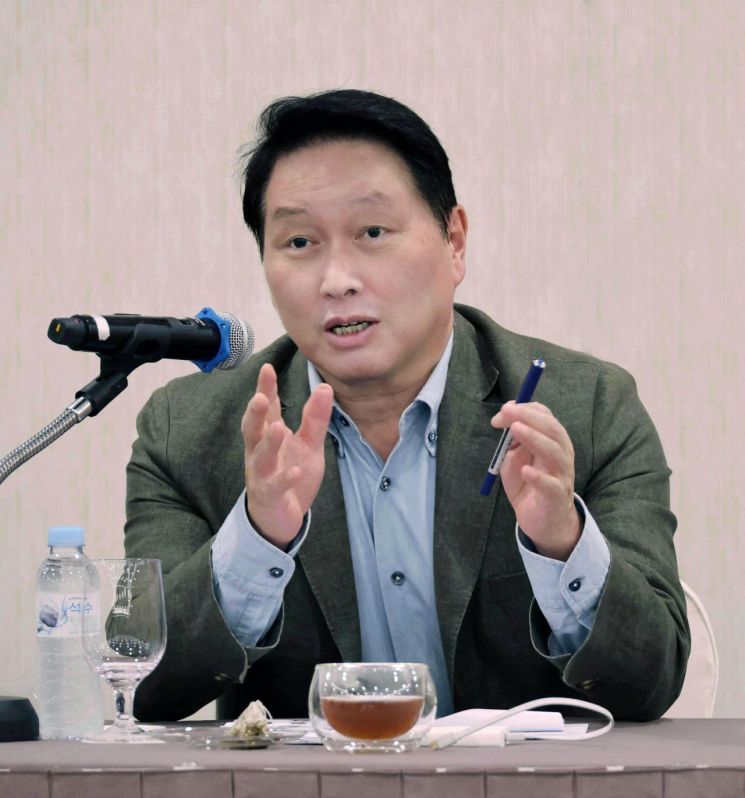 Choi Taewon, chairman of the Korea Chamber of Commerce and Industry, is answering reporters' questions at the press conference of the 48th Korea Chamber of Commerce Summer Forum. Korea Chamber of Commerce and Industry
Tariff Negotiations: "Hoping for Resolution at APEC... Agricultural Products Have Limited Effectiveness"
Regarding the possibility of resolving tariff disputes at the Asia-Pacific Economic Cooperation (APEC) summit to be held in Busan this October, he commented, "If tariff issues are resolved, it will reduce economic uncertainty and send a positive signal," adding, "I hope to see cooperative achievements in various sectors such as semiconductors, steel, shipbuilding, and automobiles."
He expressed skepticism about the effectiveness of opening the agricultural market, which has recently been discussed as a potential measure to adjust South Korea's trade surplus with the United States. He said, "While issues like rice and beef are politically sensitive, they account for a small portion of our total trade volume," and added, "Such items are unlikely to serve as a substantial bargaining chip in trade negotiations with the United States." He stressed, "Protecting our farmers is also important," and emphasized the need for a balance between protection and market opening.
RE100: "Energy Prices and Environmental Goals Are Disconnected... Cautious Approach Needed for Participation"
Regarding participation in industrial complexes under the Renewable Energy 100% (RE100) initiative for carbon neutrality, Chairman Choi stated, "Energy prices and environmental goals are disconnected," and added, "No matter how good the intentions, if electricity costs are excessively high, it will be difficult for companies to set up operations."
Chairman Choi explained, "Even among the global big tech companies I have met, many have effectively given up on RE100," adding, "Because it is difficult to meet current energy demand with 100% renewables alone, companies are also using other sources such as nuclear and gas power." He commented, "While RE100 is a meaningful concept, insisting on it alone creates a gap with reality."
He also pointed out, "In some parts of the United States where RE100 is working well, it is because the unit cost of solar and wind power is lower than conventional electricity," and added, "Domestic industrial complexes also need to carefully consider how energy will be supplied."
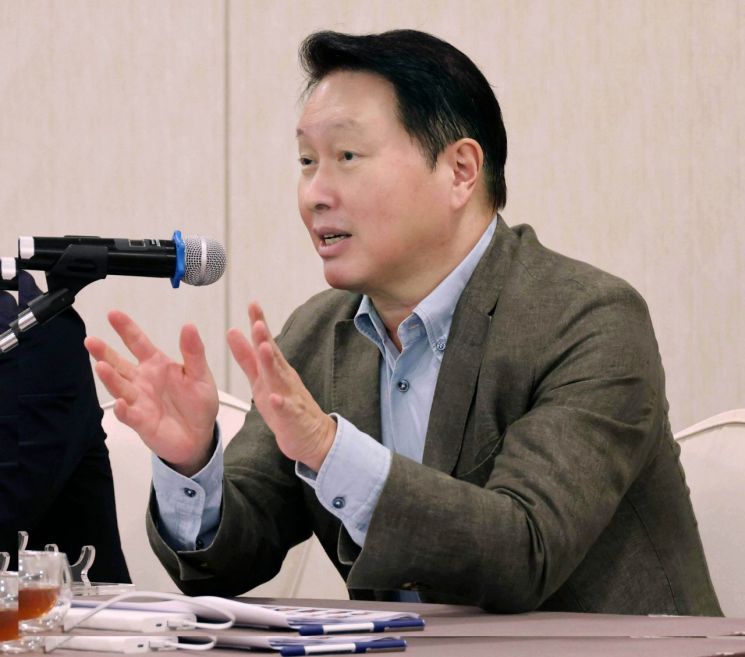 Choi Taewon, chairman of the Korea Chamber of Commerce and Industry, is answering reporters' questions at the press conference of the 48th Korea Chamber of Commerce Summer Forum. Korea Chamber of Commerce and Industry
"The Lost Decade... Manufacturing Cannot Survive Without AI"
Regarding securing AI competitiveness, he repeatedly emphasized the role of the government. He stated, "The government must create an AI market," and added, "Public sector projects should be commissioned so that startups and small- and medium-sized enterprises can gain experience." He warned, "With AI, speed is as important as scale. If we hesitate as we are now, we could fall behind in global competition."
He said, "South Korea's AI readiness ranking has fallen to around 15th place," and added, "We need to open public data and provide GPU (graphics processing unit) resources to the private sector to create an environment where everyone can utilize AI."
He also mentioned the need to expand the AI startup ecosystem. Chairman Choi emphasized, "There are currently about 1,000 AI startups in Korea, but we need to increase this to at least 20,000 to be globally competitive," and added, "Just as we once experienced a venture boom, we need an AI startup boom to seize a new leap forward."
He expressed a strong sense of crisis regarding the challenges facing Korean manufacturing. He said, "I consider the past 10 years to be a 'lost decade,'" and diagnosed, "The foundation of Korean manufacturing is being shaken across the board due to China's industrial advancement and low-cost offensive, as well as the rising competitiveness of the Middle East and India." He continued, "Facilities have become outdated and strategies have been lacking," and warned, "Unless we achieve industrial restructuring through AI, large-scale exits will be inevitable within the next 10 years."
Regarding Korea-Japan cooperation, he said, "South Korea alone cannot build AI competitiveness," and stressed the need for data sharing and joint development with Japan. He added, "There was no negative response from Japanese business and political circles," and conveyed, "Both countries recognize the need for cooperation from an economic security perspective."
© The Asia Business Daily(www.asiae.co.kr). All rights reserved.
![Clutching a Stolen Dior Bag, Saying "I Hate Being Poor but Real"... The Grotesque Con of a "Human Knockoff" [Slate]](https://cwcontent.asiae.co.kr/asiaresize/183/2026021902243444107_1771435474.jpg)

















