Seodong Wook Criticizes Lack of Local Reinvestment from Major Development Projects
No Record of Community Returns in Namak, Shindae, and Other Key Districts
Concerns have been raised that the development profits generated from various housing site developments and industrial complex projects underway in South Jeolla Province are not being properly returned to the local community.
On July 18, Seodong Wook, a member of the Jeonnam Provincial Assembly (Democratic Party of Korea, Suncheon 4), stated during the 392nd temporary session's provincial administration questions, "There needs to be a fundamental reflection on who truly benefits from the large-scale development projects currently being actively pursued across South Jeolla Province, and whether those benefits are actually being returned to the local community."
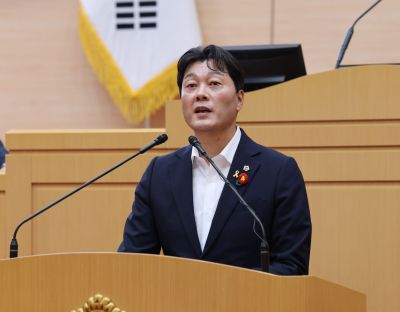
Seodong Wook pointed out that for all five major development projects in the province?including the Namak, Oryong, and Jukrim housing site developments, as well as the Shindae and Seonwol districts in Suncheon?there have been no records of collecting development charges, nor have any plans for reinvesting the profits into the local community been established.
He specifically criticized the Shindae and Seonwol district development projects being promoted by the Gwangyang Free Economic Zone Authority, saying, "Although reinvestment of development profits is mandatory under the Free Economic Zone Act, the authorities are consistently taking ambiguous approaches such as 'planning after project completion' and 'future consultations.' The problem lies in the lack of administrative commitment and insufficient coordination capabilities on the part of South Jeolla Province."
He also referenced comparisons with other regions. Seodong Wook remarked, "Unlike cases such as the Daejang District in Seongnam and Myeongji International City in Busan, where the public sector recouped development profits worth hundreds of billions of won through pre-negotiations, South Jeolla Province remains stuck in a structure centered on private developers."
Concerns were also raised regarding the process of changing the development plan for the Seonwol district in Suncheon. The plan, which added 6,000 households to the originally planned 5,400 households, cited 'meeting middle and high school establishment criteria' as its justification. However, Seodong Wook countered, "According to the South Jeolla Provincial Office of Education, the number of households is not an absolute criterion for establishing new schools, and there are many cases in South Jeolla Province where new schools were established even when the standards were not met. This justification is merely a pretext."
He emphasized, "Expanding the scale of development based on the number of households only creates a structure favorable to private developers. There is an urgent need for a thorough review and improvement of the procedures for approving changes to development plans."
He further pointed out, "While it may be inevitable that private entities reap some profits, if those profits are not returned to the local community, the legitimacy of public development collapses." He called for institutional reforms such as making reinvestment plans mandatory when establishing development plans, introducing a pre-negotiation system, setting standards for the rate of recouping development profits, and establishing a system to monitor the use of such profits.
Seodong Wook stressed, "It is time to reflect on whether South Jeolla Province truly prioritizes local interests and whether proper oversight and supervision of public enterprises and the Free Economic Zone Authority are being carried out. There is an urgent need to establish strong institutional measures to ensure that all future development projects in South Jeolla Province become 'genuine development' for the benefit of local residents."
© The Asia Business Daily(www.asiae.co.kr). All rights reserved.

















