Record-Breaking July Rainfall in Gwangju
595 Cases of Flood Damage in Gwangju, 729 in South Jeolla
Property Damage Expected to Snowball
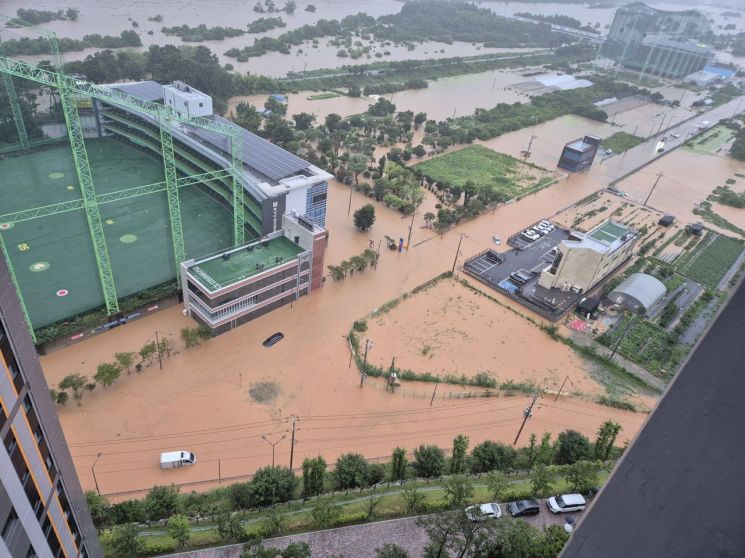 On the afternoon of the 17th, when extreme heavy rain poured across Gwangju, roads in the Sinyong-dong area of Buk-gu, Gwangju were flooded, and vehicles were submerged in water. Photo by Yonhap News
As more than 400 mm of extreme heavy rain fell within a single day in Gwangju and South Jeolla Province, additional damage is feared as strong rainfall is expected to continue.
According to the Gwangju Regional Meteorological Administration, as of 6 a.m. on the 18th, heavy rain warnings have been in effect for the second consecutive day across all areas of Gwangju and South Jeolla Province (excluding Geomundo and Chodo).
Since the previous day, cumulative precipitation has reached 433.4 mm in Gwangju, 432 mm in Naju, 385 mm in Bongsan, Damyang, 348 mm in Wolya, Hampyeong, and 334.5 mm in Haeje, Muan, among other locations.
On the previous day alone, Gwangju experienced a total of 426.4 mm of torrential rain. This is the highest daily rainfall ever recorded in Gwangju since meteorological observations began in 1939. Compared to the previous July record of 335.6 mm set on July 25, 1989, this is 90.8 mm more. Given that the average July rainfall is typically 294.2 mm, the city received a month's worth of rain in just one day.
The expected precipitation through July 19 is 100 to 200 mm, with some areas likely to receive more than 300 mm of rain.
◇ Roads and Buildings Suffer Repeated Flooding
Over two days, there were 274 cases of road flooding, 14 cases of road blockages, and 201 cases of building flooding in Gwangju alone, totaling 595 reported incidents of damage. In South Jeolla Province, 729 cases of flood-related damage have been reported.
In Gwangju, about 200 households, totaling 305 people, evacuated to temporary shelters such as nearby elementary schools, cultural centers, and senior centers across five districts. On the previous day, two people trapped in a vehicle were rescued from a flooded road in Jinwol-dong, Nam-gu. Additionally, in Docheon-dong, Gwangsan-gu, a driver was rescued by fire authorities after their vehicle was submerged.
Although no casualties have been confirmed so far, authorities are conducting search operations following a report that a person believed to be in their 60s was swept away by river water near Sinan Bridge in Buk-gu on the previous day, as well as a missing person report from Geumgok-dong in Buk-gu.
Service on Gwangju Metro Line 1 between Nongseong Station and Gwangju Songjeong Station was suspended after Sangmu Station was flooded due to the heavy rain, but resumed service on this day. Both directions of the Honam Expressway from Donggwangju IC to Seogwangju IC were also closed due to flooding until the morning of this day.
In South Jeolla Province, heavy rain has led to the closure of six national parks, 30 roads, one underpass, three Sewolgyo bridges, ten riverside parking lots, seven walking trails, three camping sites, and six stepping stone bridges. Due to the risk of river flooding and landslides, 1,902 people from 1,275 households were preemptively evacuated. Of these, only 138 people from 115 households have returned home.
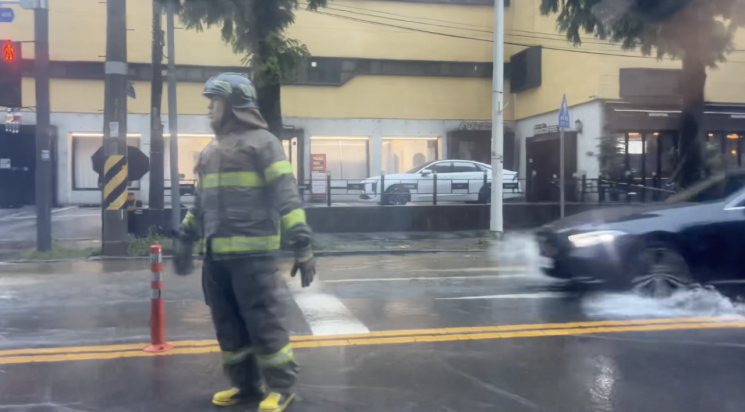 A firefighter is controlling vehicles in a flood-risk area at an intersection in downtown Gwangju. From the morning of the day, safety alert messages were continuously sent to various locations in Gwangju. Photo by Song Bohyun
◇ Property Damage Expected to Snowball
As of 7 a.m. on this day, disaster management authorities had received reports of flooding damage to 288 homes and businesses in Gwangju and 49 in South Jeolla Province.
In South Jeolla Province, 24.1 hectares of crops have been reported as flooded, but as the rain stops and damage assessments continue, the extent of the damage is expected to increase rapidly.
In the case of natural disasters, damage investigations must be completed within 10 days for private property and within seven days for public facilities. Residents who have suffered property damage can receive partial financial support for the amount of damage incurred.
If the total amount of property damage exceeds 3.2 billion won in Dong-gu, Nam-gu, or Buk-gu, or 3.8 billion won in Seo-gu or Gwangsan-gu, a significant portion of the budget can be supported by the national treasury.
© The Asia Business Daily(www.asiae.co.kr). All rights reserved.


















