A Hippo Devouring Electricity: 85% of Operating Costs Are for Power When Running AI
"Electricity Prices Should Vary by Region, Just Like Fuel Prices"
"The Same Electricity Rate Everywhere Is Misguided... Market Logic Must Be Introduced"
"Metropolitan Areas Should Pay More, Areas Near Power Plants Should Pay Less"
"AI Data Centers Require Power Plant-Level Infrastructure"
Choi Taewon, chairman of the Korea Chamber of Commerce and Industry, argued that "the map for determining electricity prices needs to change." He emphasized that since the artificial intelligence (AI) industry is structured to require high electricity consumption, it is necessary to reform the electricity pricing system to reflect regional supply and demand conditions, distance, and industrial characteristics.
Attending the 'Management Talk Show,' a side event of the KCCI Summer Forum held in Gyeongju on the 18th, Choi stated, "There is a need to make electricity prices in Korea cheaper," and added, "Areas closer to power plants should have lower electricity prices, while areas farther away should pay more. The idea of charging the same electricity rate everywhere is misguided."
He explained, "The AI data center built by SK in Gasan-dong requires facilities on the scale of a power plant. All the power generation equipment is installed underground, and in addition to the electricity supplied by KEPCO, we also need batteries for UPS (uninterruptible power supply). Excluding the initial construction investment, 85% of the operating costs go to electricity. It's a structure that devours electricity like a hippo."
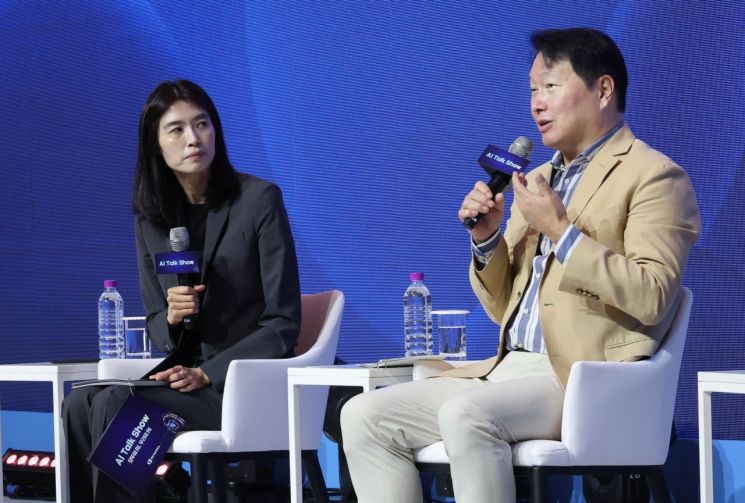 Choi Taewon, chairman of the Korea Chamber of Commerce and Industry (right), is attending the 'Management Talk Show,' a side event of the KCCI Summer Forum held on the 18th in Gyeongju, Gyeongsangbuk-do, and is having a conversation with Jeong Sina, CEO of Kakao. Korea Chamber of Commerce and Industry
He continued, "Before oil price liberalization, fuel prices were the same nationwide, but now they vary by region. Since electricity is also an energy source, its pricing must eventually follow the same structure. In metropolitan areas far from power plants, electricity rates should be higher, while regions near power plants should be supplied with cheaper electricity, which would also help realign the industrial structure."
Choi also stressed that, for the AI transition, data acquisition, regulatory reform, talent development, and improvement of the energy structure must all be pursued simultaneously. He said, "To create strong AI, you need to feed it well, and that food is data. In the industry, many want to acquire others' data but are reluctant to share their own. In this situation, further evolution is difficult."
He added, "If people share their data, there must be a system that gives them more incentives than those who do not. Cooperation through synergy, not competition, is important."
In this regard, Choi also mentioned the 'Mega Sandbox' concept proposed by the KCCI. He explained, "Although it is not a system designed specifically for utilizing AI data, it was introduced as a concept to drive regulatory innovation. For things like telemedicine, we need to try them out first and identify issues as we go."
Regarding talent acquisition, he said, "We may need at least 100,000 AI engineers, possibly up to 1 million or even 10 million. Since education alone will take time, we need to attract highly skilled foreign talent." He continued, "Currently, the best minds keep leaving, and only labor-intensive workers are coming in. We need to create an environment where foreign talent can enter targeted fields like AI."
On the subject of foreigner settlement, he added, "If we require them to speak Korean and take exams, good talent will not come. We need to create hub cities where people can work and live in English to be chosen."
Finally, he said, "The Mega Sandbox is a place where we can experiment with data, talent, and energy all at once. We need an environment where similar industries in a region can be grouped together to test solutions. It's important to have many opportunities to try things out first."
© The Asia Business Daily(www.asiae.co.kr). All rights reserved.

















