Investigation Conducted at 10 Key Points Including Ganghwa, Han River, and West Sea
No Significant Differences Found Compared to Previous Surveys
Regarding suspicions that North Korea has been discharging untreated wastewater from the Pyongsan uranium refinery in North Hwanghae Province into the Yesong River, the government conducted an on-site investigation and found no abnormalities in areas such as the Han River, Imjin River, and the West Sea.
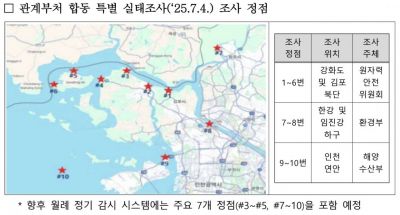
On July 18, the government announced that a special joint investigation into radioactive and heavy metal contamination was carried out in our territorial waters and rivers by the Nuclear Safety and Security Commission, the Ministry of Oceans and Fisheries, the Ministry of Environment, and other relevant agencies, and that no abnormalities were detected. Previously, the government collected samples from a total of 10 locations, including Ganghwa Island and the Han River estuary, which are closest to the mouth of the Yesong River where wastewater from the Pyongsan uranium refinery is discharged. The samples were analyzed for two types of radioactive nuclides and five types of heavy metals.
For uranium, one of the two radioactive nuclides, no significant difference was found at any of the 10 sampling points compared to the 2019 survey. At six points in Ganghwa and Gimpo, uranium concentrations ranged from 0.135 to 1.993 ppb, which was either lower or similar to the 2019 levels (0.59 to 1.97 ppb). At two points on the Han River and Imjin River and two points along the Incheon coast, the concentrations were 0.087 to 0.122 ppb and 2.541 to 3.211 ppb, respectively, which were not significantly different from those in 2019 (0.31 ppb and 2.87 to 2.99 ppb, respectively).
Radioactive cesium was also either below the minimum detectable activity (MDA) or lower than the levels measured in the West Sea over the past five years (0.789 to 1.92 mBq/kg) at all sampling points.
All five types of heavy metals (cadmium, arsenic, mercury, lead, and hexavalent chromium) were found to be either below the environmental standards set by the Framework Act on Environmental Policy and the marine environmental standards set by the Act on the Conservation and Utilization of the Marine Environment, or not detected at all at every sampling point.
The government stated, "For the time being, we will maintain a monthly regular monitoring system at the seven key points covered in this investigation and continue to operate an inter-ministerial consultative body, so that we can actively respond to public concerns at a pan-governmental level."
© The Asia Business Daily(www.asiae.co.kr). All rights reserved.
![Clutching a Stolen Dior Bag, Saying "I Hate Being Poor but Real"... The Grotesque Con of a "Human Knockoff" [Slate]](https://cwcontent.asiae.co.kr/asiaresize/183/2026021902243444107_1771435474.jpg)
















