The Korea Customs Service is focusing its organizational capabilities on responding to U.S. government tariff policies and protecting domestic export industries.
On July 18, the Korea Customs Service announced that Commissioner Lee Myunggu held a review meeting to assess the performance of the Special Response Headquarters for U.S. Tariff Policy Response and Domestic Industry Protection (hereinafter referred to as the US Response Headquarters) as his first official activity after taking office.
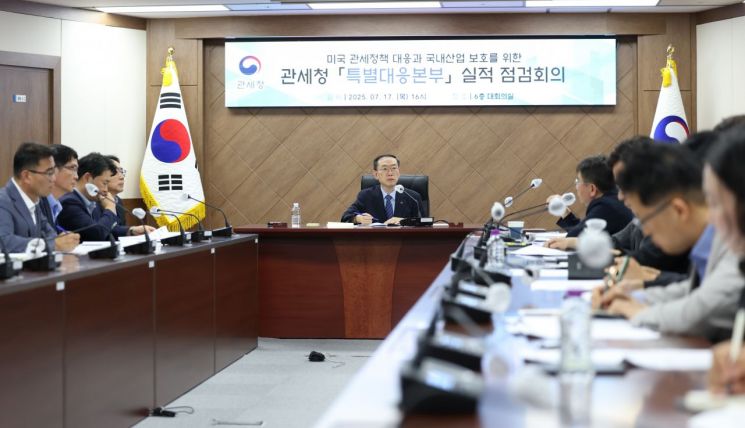 Lee Myunggu, Commissioner of the Korea Customs Service, is presiding over a performance review meeting of the US Response Headquarters activities at the Government Daejeon Complex on the 17th. Photo by Korea Customs Service
The review meeting was convened as a declaration of the agency's commitment to make the activities of the US Response Headquarters its top policy priority and to concentrate its customs administration capabilities on fully responding to U.S. tariff policies in order to protect export industries.
In particular, during the meeting, Commissioner Lee elevated the head of the US Response Headquarters from the deputy commissioner level to the commissioner level, thereby strengthening the agency-wide response system. He also expressed his determination to respond comprehensively to uncertainties in trade and customs environments faced by export and import companies on the ground.
The US Response Headquarters has been operating since May with three main pillars: the Enterprise Support Team, the Risk Inspection Team, and the Special Trade Security Investigation Team. The purpose of launching and operating the US Response Headquarters is to minimize the foreseeable disruptions that countries around the world, including Korea, are expected to face due to the U.S. government's reciprocal tariff policies.
Foreseeable disruptions resulting from reciprocal tariff policies include differentiated tariff rates, an increase in attempts to circumvent export and import regulations through indirect exports and actions undermining trade security, and disadvantages (risks) faced by domestic companies that now find it difficult to respond promptly to increasingly complex customs systems.
The Korea Customs Service's core strategy is to minimize such disruptions by mobilizing all available customs administration tools, based on the premise that sufficient support must be provided to domestic companies in order to respond proactively to these circumstances.
To this end, the Enterprise Support Team has strengthened working-level cooperation between Korean and U.S. customs authorities. A prime example is the 'Director-General Level Cooperation Meeting' held between the CBP Area Director and the Director General of International Customs Cooperation at the Korea Customs Service at the U.S. Customs and Border Protection (CBP) headquarters in Washington, DC, during May and June.
Additionally, Korean customs officers dispatched to various countries have worked to minimize confusion experienced by companies in rapidly changing trade environments by explaining trends in trade and customs policies of the U.S. and other host countries to domestic companies and holding 'Overseas Customs System Briefings' that provide one-on-one consultations.
During the same period, the Risk Inspection Team was tasked with preemptively assessing risks to domestic industries arising from the implementation of reciprocal tariffs. In practice, the Risk Inspection Team, together with the Korea Iron & Steel Association and the Chamber of Commerce and Industry, conducted a 'Special Crackdown on Country-of-Origin Labeling Violations of Foreign Steel Products' in May and June, uncovering violations totaling 16.5 billion KRW and, through intensive inspections at the customs clearance stage, has so far detected suspected country-of-origin laundering amounting to 13.1 billion KRW.
The Special Trade Security Investigation Team has been responsible for investigating and cracking down on acts that threaten trade security by exploiting uncertainties in the trade environment. Its main roles include investigating cases where country-of-origin is laundered to Korean origin or indirect exports are conducted to circumvent high U.S. tariffs and export/import regulations, and focusing on indirect exports of sensitive items (such as solar cells, electric vehicle battery components, graphite, steel, and aluminum) in industries with intense international competition and where the U.S. has raised tariffs for certain countries.
In this context, on June 24, the Special Trade Security Investigation Team held a 'Cooperation Meeting with the CBP Area Director' in Seoul, where it introduced the Korea Customs Service's role and enforcement cases in preventing indirect exports and illegal exports of strategic materials, and discussed ways to share information, thereby strengthening cooperation in the field of investigations.
Commissioner Lee stated, "Responding to U.S. tariff policies is currently the number one priority for the Korea Customs Service," adding, "We will focus our customs administration capabilities to ensure that domestic industries can maintain their competitiveness without disruption, even amid an uncertain trade environment."
© The Asia Business Daily(www.asiae.co.kr). All rights reserved.
![Clutching a Stolen Dior Bag, Saying "I Hate Being Poor but Real"... The Grotesque Con of a "Human Knockoff" [Slate]](https://cwcontent.asiae.co.kr/asiaresize/183/2026021902243444107_1771435474.jpg)
















