Suggestions Made at the Financial Services Commission Meeting on the 17th
Concerns Over Customer Credit and Funding Costs
Exploring Alternatives Such as Traditional Market-Specialized Cards
Welcoming the Expansion of Refinancing Loans for Sole Proprietors
When small business owners suggested the launch of exclusive low-interest financial products during discussions with the government, card companies and capital firms expressed discomfort. This is because customers who turn to the secondary financial sector generally have low credit scores, and it has become increasingly difficult for these companies to maintain profitability and secure funding due to factors such as the recent lowering of the interest rate cap on mid-interest loans in the card industry. As a result, developing related products such as traditional market-specialized cards, or expanding discounts and interest-free installment plans on existing products, is being considered a more realistic approach.
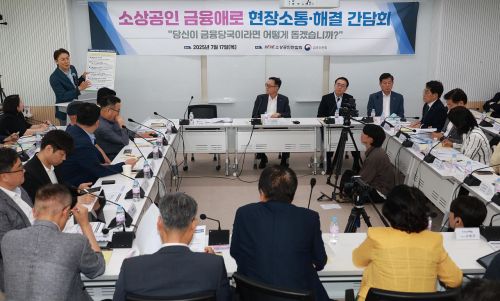 Daeyoung Kwon, Secretary General of the Financial Services Commission (top left), is speaking at a meeting with small business owners held on the 17th at the Small Business Federation Digital Education Center in Mapo-gu, Seoul. Financial Services Commission
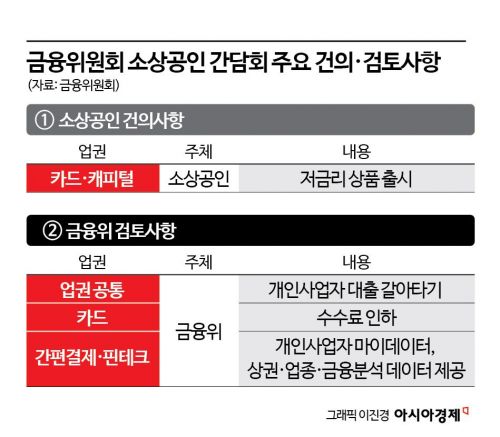
According to the Financial Services Commission and the financial sector on the 18th, at the 'On-site Communication and Resolution Meeting for Small Business Financial Difficulties' held the previous day by the Financial Services Commission and the Small Business Federation at the Small Business Federation venue in Mapo-gu, Seoul, requests were made for the launch of exclusive low-interest card and capital products for small business owners, as well as for a reduction in card fees. In response, the card and capital industries expressed reluctance.
At the meeting, Wankyu Jung, Chairman of the Credit Finance Association, firmly stated that lowering fees would be difficult, but made a general remark that other proposals could be considered. Chairman Jung explained, "It is realistically difficult to adjust card fee burdens due to the challenges of distinguishing fees by product category and the need for consultation with fiscal authorities," but added, "We will look into whether there are areas where the card industry can contribute to win-win finance for small business owners."
Card companies insisted that lowering fees is not possible, and that launching exclusive low-interest products for small business owners is also difficult. They noted that issuing debit cards with deferred payment transportation card functions for debt-restructuring applicants, which is currently being considered by lawmakers and regulators, is a more realistic option. Currently, the main products on the market for small business owners are KB Kookmin Card's 'Boss Support Card,' which offers a maximum monthly cashback of 70,000 won, and the 'KakaoBank Business Hyundai Card' from Hyundai Card and KakaoBank, which provides a 0.2% preferential interest rate service.
Given that card companies currently apply different mid-interest loan limits and rates based on customer credit scores, launching exclusive low-interest products is not easy. They explained that it is difficult to offer products that guarantee a specific interest rate (at least a certain annual percentage) exclusively for a specific group (small business owners), similar to bank savings products.
Another burden is that the upper limit for mid-interest loan funding rates for card companies has recently dropped by 0.06 percentage points from the first half of the year to 12.33%. In addition, the interest rate on card bonds, which are a key funding source for card companies, is also approaching 3%, making it challenging to secure funding. According to the Korea Securities Depository, from the beginning of this month until the previous day, the coupon rates on card bonds with remaining maturities of three to less than five years (credit ratings AA+ to AA-) issued by card companies ranged from 2.790% to 2.957%. While this is lower than the 3% range at the start of the year, card companies still consider funding costs to be high.
Even if a card company decides to launch a low-interest product for small business owners despite concerns about negative margins, it is highly likely that the Financial Supervisory Service would reject the application during the terms and conditions approval process.
A card company representative said, "Unless there is a clear signal from financial regulators encouraging the launch of such products and market demand for low-interest products for small business owners increases, few card companies are likely to attempt to launch such new products," adding, "Unless policy finance covers the loss costs, launching new low-interest products with high negative margin risks is not a realistic idea."
Instead, some card companies are working to develop alternatives such as traditional market-specialized cards. On January 23, Bokhyun Lee, then head of the Financial Supervisory Service, visited a traditional market in Yeongdeungpo with Wonseok Choi, CEO of BC Card, and encouraged him to develop a traditional market-specialized card. This effectively sent a message to the entire card industry. As a result, on June 30, KB Kookmin Card launched the 'Traditional Market Onnuri Card,' which offers up to 30,000 won in monthly discounts.
Capital companies have also made it clear that they have no plans to introduce low-interest products for small business owners or other mid-interest loan products. Instead, they plan to continue offering low-interest loan promotions for auto installment products to reduce the burden of car purchases for customers. Since July 8, Hyundai Capital has been running a special financial promotion with Hyundai Motor for major Genesis SUV models, offering a fixed annual interest rate of 2.9% for up to 60 months.
A capital company representative said, "Even now, the interest rates on auto installment products are lower than those on most unsecured loan products, so there are no additional products being prepared specifically for inclusive finance."
The secondary financial sector, including card, capital, and fintech companies, welcomed the financial authorities' announcement of plans to expand loan refinancing, MyData services for sole proprietors, and the provision of commercial district, industry, and financial analysis information for small business owners.
On June 19, the Financial Services Commission reported to the National Policy Planning Committee that it is considering including sole proprietors as eligible for refinancing loans as early as October (Q4). The following day, Daeyoung Kwon, Secretary General of the Financial Services Commission, stated at a meeting with small business owners that "We are reviewing the 'three-pronged interest rate reduction package,' including expanding refinancing loans for sole proprietors, and will also consider expanding MyData services for sole proprietors and providing commercial district, industry, and financial analysis information."
A fintech industry representative said, "Unlike salaried workers, small business owners lack the data needed for non-face-to-face financial screening, so it is nearly impossible to conduct screenings without using alternative data," adding, "If the government builds a data infrastructure through a comprehensive survey of small business owners in addition to expanding MyData, the non-face-to-face financial services industry could be greatly revitalized."
© The Asia Business Daily(www.asiae.co.kr). All rights reserved.


















