No Work Permit Issued If Hazards Are Present
Regular Training on Rescue Methods in Confined Spaces
Recently, after two fatalities occurred in Incheon due to toxic gas poisoning during work inside a manhole, Yeonsu District in Incheon has attracted attention by implementing a strengthened "Confined Space Program" for manhole work procedures.
This program includes education on work safety rules for tasks conducted in sewer pipes, manholes, and utility tunnels, as well as training on rescue methods in case of emergencies.
First, before starting work in a confined space, workers are required to use oxygen and gas concentration meters to ensure safety. Workers must measure the concentration of toxic gases both before and after ventilation in order to understand the air characteristics of the confined space. Additionally, if work is suspended and then resumed, workers must again measure the concentration of toxic gases in the same manner.
Furthermore, if there is a possibility that toxic gases may be present before starting work in a confined space, the area must be ventilated. If proper air quality cannot be maintained even after ventilation, workers are required to wear supplied-air masks or self-contained breathing apparatus.
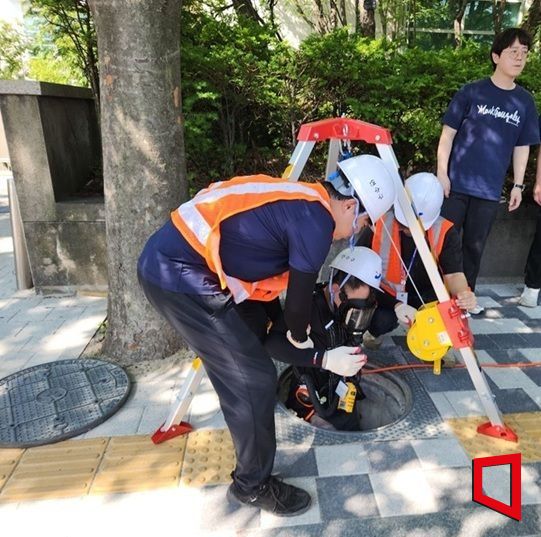 Yeonsu District in Incheon is providing education on work safety rules and rescue methods for accident victims to prevent safety accidents in confined spaces such as manholes. Yeonsu District in Incheon
The district has also made the procedures for starting work in confined spaces more stringent. Before entering a work area, workers must apply for a permit to access the confined space, and entry is only allowed after approval from the manager or supervisor in charge of the project.
If the manager issues a work permit, it is valid only for the day of issuance, and the permit must be posted at the entrance. However, if the work manager determines that there are safety or health hazards, the work permit may not be issued.
In addition, during the first half of this year, the district replaced a total of 280 concrete manhole covers with safer cast iron covers and installed fall prevention facilities. These proactive measures were implemented not only to ensure pedestrian safety for residents but also to prevent accidents among workers.
Regular training is also provided on rescue methods for accident victims. On July 9 and 10, the district conducted confined space rescue training for sewer and utility tunnel managers, related workers, and staff from local administrative welfare centers.
This training focused on understanding the Serious Accidents Punishment Act and the Occupational Safety and Health Act, procedures for obtaining permits and conducting work in confined spaces, rescue and emergency response methods, and rescue drills. In particular, the training emphasized the importance of ventilation during rescue activities and the requirement to wear supplied-air masks and self-contained breathing apparatus.
A Yeonsu District official stated, "We are thoroughly managing all work conducted in confined spaces such as sewer manholes and focusing our administrative efforts to ensure the safety of both residents and workers."
© The Asia Business Daily(www.asiae.co.kr). All rights reserved.

















