A 1%P Rise in Online Consumption... Non-Capital Region Retail Employment Falls by 8.3 per 10,000 People
A 10%P Increase in Online Delivery, Number of Self-Employed Food Service Businesses Drops by 3.4 per 10,000 People
Financial Support for the Self-Employed: Sufficient Scale, Focused on Startups, Youth, and Small Businesses
As online and delivery platforms have grown, employment has declined in regional areas, and polarization among self-employed businesses has also intensified. The gap between self-employed individuals who benefit from platforms and those who do not has widened due to competition among businesses and a winner-takes-all dynamic. However, experts suggest that government financial support for the self-employed should be directed toward those with high growth potential. For self-employed individuals who are pushed out of competition, support should be provided by strengthening the social safety net.
The Bank of Korea made these points on July 17 at the 2025 BOK Regional Economy Symposium held at the Kimdaejung Convention Center in Seo-gu, Gwangju, during the session titled “The Impact of Online Platform Growth on Regional Self-Employment and Response Measures.”
A 1%P Increase in Online Consumption... Non-Capital Region Retail Employment Down by 8.3 per 10,000 People
The growth of online distribution platforms has led to polarization both between regions and among brick-and-mortar retail businesses. Jung Minsoo, head of the Regional Economic Research Team at the Bank of Korea, explained, "When the share of online consumption in a region rises by 1 percentage point, retail employment in non-capital regions decreases by 8.3 per 10,000 people." He added, "This includes a decrease of 6.1 self-employed individuals and 3.7 employees of self-employed businesses, with most of the decline occurring in the self-employed sector." This is because the decline in the number of brick-and-mortar self-employed retailers is greater in non-capital regions, while the growth of non-store retail businesses, such as telemarketing, is concentrated in the capital region, where infrastructure such as large wholesale markets and fulfillment centers is well developed.
Polarization also appeared within the same region depending on business characteristics. In areas with a higher proportion of businesses adopting online sales, the decrease in self-employed individuals was 2.2 (about 30%) less than in other areas when the share of online consumption rose by 1 percentage point. The decline was greater among self-employed businesses in food and beverage (4.2 people) and apparel (1.0 person), which are more easily replaced by online consumption, while general retail businesses offering a variety of products did not see a decrease. The gap in sales growth rates between large and small retailers also widened, reaching 5.1 percentage points in the capital region and an even higher 7.2 percentage points in non-capital regions.
The emergence of delivery platforms has intensified competition in the food service industry, leading to more business closures and increased polarization. Jung stated, "When the share of online delivery rises by 10 percentage points, the number of self-employed food service businesses per 10,000 people in a region decreases by 3.4." He continued, "In the same situation, the gap in sales growth rates between large and small restaurants widened by 3.2 percentage points in the capital region and 6.3 percentage points in non-capital regions." However, total employment in the food service industry, including wage workers, actually increased by 14.1 per 10,000 people. This, too, is a result of polarization. Jung analyzed, "As delivery platforms expand the dining-out market, businesses that survive the competition are able to hire more employees."

Financial Support for the Self-Employed... Focused on Startups, Youth, and Small Businesses 'At Sufficient Scale'
It was emphasized that government financial support for the self-employed should be carefully targeted and provided at sufficient scale, focusing on startups, young entrepreneurs, and small businesses.
The effect of support was significantly greater for non-capital region businesses with borrowing constraints, with sales improvement of 0.9 percentage points. However, the sales improvement effect was concentrated among startups, young entrepreneurs, and small businesses. Jung pointed out, "Small-scale support of less than 20 million won did not improve sales and had little effect in preventing business closures," adding, "Moreover, businesses that received support for four years showed no additional improvement compared to those supported for two years." In contrast, support of 20 million won or more was found to significantly help increase sales (14.4%) and reduce closures (by 2.1 percentage points).
Excessive support for businesses that have lost competitiveness has led to inefficient resource allocation and negative externalities that hinder the growth of other businesses. Jung stated, "When the proportion of low-productivity self-employed businesses receiving financial support (those with declining sales over three years and per-employee sales in the bottom 25% of their industry) increases by 1 percentage point, sales of other self-employed businesses in the region are estimated to decrease by 1.7%."
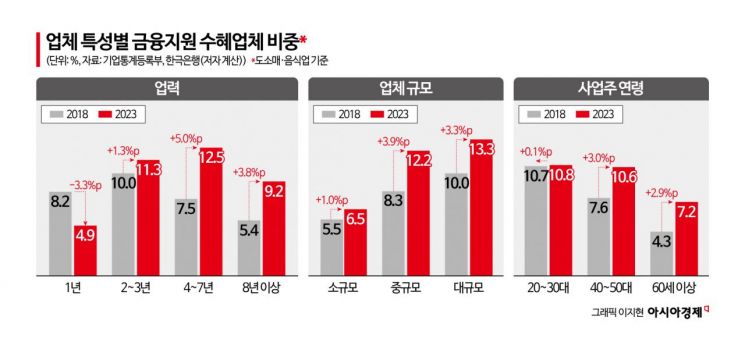
However, between 2018 and 2023, the proportion of beneficiaries among businesses in operation for four years or more, mid- to large-sized businesses, and those run by people in their 40s or older increased significantly. The share of low-productivity businesses receiving support also rose from 3.7% to 7.2%. The proportion of small-scale support under 20 million won among all support also increased by 7.9 percentage points. This trend of small-scale support was more pronounced in non-capital regions.
Jung emphasized, "As online platforms spread, it is necessary to strengthen the safety net for self-employed individuals who are pushed out of competition, while financial support should focus on growth policies that improve capital access and ensure growth opportunities for self-employed individuals with high potential." The social safety net should aim to protect 'people' rather than 'businesses' by improving the effectiveness of systems such as unemployment insurance. Jung said, "It is necessary to refer to cases in some advanced countries, such as France, where unemployment insurance is mandatory but the government reduces the insurance premium burden through support."
© The Asia Business Daily(www.asiae.co.kr). All rights reserved.
![Clutching a Stolen Dior Bag, Saying "I Hate Being Poor but Real"... The Grotesque Con of a "Human Knockoff" [Slate]](https://cwcontent.asiae.co.kr/asiaresize/183/2026021902243444107_1771435474.jpg)

















