Emphasizing the Formation of a "Super-Innovation Item Project Team"
"We Must Power Economic Growth with AI"
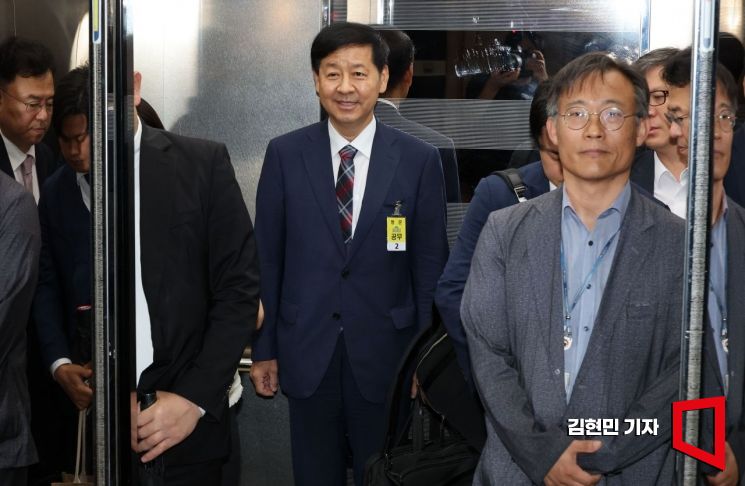 Koo Yoonchul, nominee for Deputy Prime Minister for Economic Affairs and Minister of Economy and Finance, is entering the National Assembly where the confirmation hearing is being held on the 17th. 2025.7.17 Photo by Kim Hyunmin
"Recently, our economy has experienced continued sluggishness, recording low growth rates of around 0% for four consecutive quarters. Due to the domestic market downturn, the number of self-employed business closures has surpassed one million for the first time ever, and the income of low- and middle-income households has actually decreased compared to a year ago. Over the past three years, consumer prices have accumulated an increase of more than 8%, further burdening the cost of living for ordinary citizens."
Koo Yoonchul, nominee for Deputy Prime Minister for Economic Affairs and Minister of Economy and Finance, emphasized the need to transition to a "leading economy" model at the National Assembly confirmation hearing held on the 17th. Koo stated, "While we hesitate at this new turning point, we are now facing a situation where even the progress we have made so far is threatened, due to a decline in potential growth rates and deepening disparities between sectors," and emphasized, "At this moment, when we must leap forward to become a leading nation, the existing system is no longer a suitable fit for us. We must achieve a complete and fundamental innovation of our economic, social, and national systems." He outlined a vision to build a "Corporation Korea" that delivers tangible results by introducing cost-benefit concepts into national management, and to provide the economy with a new growth engine through a major transformation driven by artificial intelligence (AI).
Koo stated, "We joined the ranks of advanced countries through the promotion of heavy and chemical industries in the 1970s and the IT revolution in the 1990s, and now it is time for a new leap forward through the AI transformation." He emphasized that "not only will we focus on developing AI technology, but we will also apply AI across all aspects of business, government, and daily life for our citizens." He also announced bold plans to innovate the talent development system. "We will nurture young people as AI-specialized talents and ensure that AI becomes an open opportunity for all citizens through nationwide AI education," he said.
He further stated, "We will apply AI to existing key industries such as petrochemicals and automobiles to advance them, and we will take a new approach to foster cutting-edge strategic industries?including quantum, space, bio, energy, K-culture, and defense industries?by linking them with AI technology and developing them into super-innovative sectors."
Koo said, "To achieve meaningful results from the AI transformation and super-innovation economy, we will select concrete core items as targets and concentrate national capabilities on them." He added, "We must bring together the best experts to form a 'Super-Innovation Item Project Team' and provide full support with all available resources?fiscal, tax, human, and regulatory easing, both tangible and intangible."
He stressed that, in order to implement such a national vision and strategy, it is essential to first strengthen the fundamentals of our economy and stabilize people's livelihoods.
Koo identified the weakening of growth potential as the greatest risk facing the Korean economy, and said, "To resolve the structural issues that hinder sustainable economic growth, we will respond to low birth rates and population aging, as well as the resulting demographic changes, by seizing the momentum to reverse the declining birth rate." He continued, "We will also actively pursue an energy transformation, including the expansion of renewable energy, to address climate change and achieve carbon neutrality."
For the stabilization of people's livelihoods, he stated, "We will mobilize all available resources to stably manage the prices of essential goods, agricultural and livestock products, and processed foods," and "We will execute the new administration's first supplementary budget as quickly as possible, and make every effort to revive domestic demand through revitalizing domestic tourism and promoting consumption."
He went on to say, "We will actively pursue regional priority policies to revive areas suffering from population decline and local economic stagnation," and emphasized, "We will support self-employed individuals, small business owners, and SMEs, and actively back the stabilization of livelihoods and empowerment of vulnerable groups such as youth, people with disabilities, women, and the elderly."
Regarding tariff negotiations with the United States, he stated, "Along with supporting companies affected by tariffs, we will also work to fundamentally strengthen export competitiveness by diversifying export items and markets."
© The Asia Business Daily(www.asiae.co.kr). All rights reserved.

















