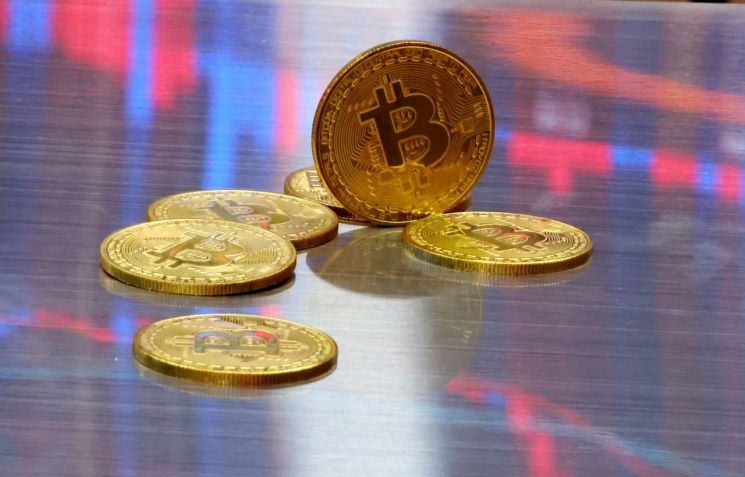
Interest in stablecoins is rising following the passage of the Guiding and Establishing National Innovation for U.S. Stablecoins Act?which has passed the U.S. Senate and is under review in the House of Representatives?and the enactment of Korea's Virtual Asset Act. On July 17, Eugene Investment & Securities published a report titled "Stablecoins and Several Macro Issues," analyzing that while the expansion of stablecoins increases the difficulty of government and central bank policy management, it is unlikely to lead to a reduction in demand deposits at banks in Korea.
Stablecoins Present New Challenges for Governments and Central Banks
Currently, the amount of U.S. Treasury securities directly held by stablecoins totals $13 billion, accounting for about 0.4?0.5% of the total. If stablecoin holdings of U.S. Treasuries rise to $1.5 trillion by 2028, this share would increase to about 4.5%. According to research by the Bank for International Settlements (BIS), inflows of funds into stablecoins lower yields on 3-month U.S. Treasury bills but do not affect yields on 2?5 year notes. However, 10-year yields declined slightly. Given that the proportion of short-term U.S. Treasuries already exceeds the recommended 20% threshold, a structural increase in short-term debt could heighten government refinancing risk and make it more difficult for the Federal Reserve to conduct monetary policy.
Korea, unlike the U.S., does not issue ultra-short-term government bonds, making the selection of assets to back stablecoins a key issue. While the Digital Asset Basic Act was proposed last month, it only provides rough guidelines such as allowing government or local bonds as collateral, without specific details. Since the Korean government only issues Treasury bonds with maturities of at least two years, there is a shortage of assets that can be used as collateral for stablecoins, as is done in the U.S. Lee Junghoon, an economist at Eugene Investment & Securities, noted, "There are doubts about whether money market funds (MMFs) can serve as stable collateral during periods of financial market stress, and monetary stabilization bonds are limited because they are used by the Bank of Korea as a tool for liquidity management."

Concerns Over Bank Deposit Outflows: Less of a Risk in Korea Than in the U.S.
The U.S. Treasury Borrowing Advisory Committee (TBAC) recently assessed that, due to the rapid growth of the stablecoin market, approximately $6.6 trillion in transactional deposits (mainly demand deposits) in the U.S. banking sector are potentially at risk of outflow. This is because most transactional deposits in U.S. banks are non-interest-bearing, while stablecoins can be used for domestic and international payments and remittances 24 hours a day, 365 days a year.
Up to now, stablecoins have primarily been used for cryptocurrency trading. If stablecoins develop into a truly widespread means of payment, both businesses and individuals may increasingly seek higher returns, which could heighten the risk of bank deposit outflows. As a result, banks would face higher funding costs and lending rates, while their capacity to lend and purchase U.S. Treasuries would weaken. From the Federal Reserve's perspective, a contraction in bank-based credit channels would undermine the effectiveness of monetary policy.
What about Korea? For Americans, stablecoins could become a cheaper payment method. In the U.S., credit card interest rates exceed 20%, and interest-free installment benefits are not as readily available as in Korea. As a result, a significant portion of card payments are made using debit rather than credit. In contrast, payment and remittance systems in Korea are much more convenient than in the U.S., and the advantages of using credit cards are significant, resulting in overwhelmingly high usage of postpaid credit cards. Therefore, even if stablecoins are introduced at the retail level, there is little incentive for active adoption. Economist Lee Junghoon stated, "If the risk of deposit outflows were to become a real possibility, it could be addressed by requiring a certain portion of stablecoin collateral to be held as deposits. The key issue for the introduction of won-based stablecoins is likely to be whether regulations such as anti-money laundering and foreign exchange controls can be enforced, rather than concerns over bank deposit outflows or the diminished effectiveness of monetary policy."
© The Asia Business Daily(www.asiae.co.kr). All rights reserved.


















