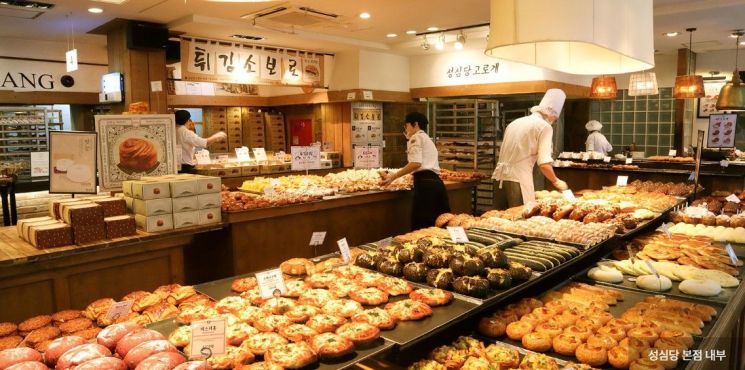
The number of well-known bakeries across the country applying for patents on breadmaking technology is on the rise. It has been confirmed that Seongsimdang, which has recently gained nationwide popularity, has also patented and registered the manufacturing technologies for its signature products such as Twigim Soboro at an early stage to secure intellectual property rights.
The Korean Intellectual Property Office announced on the 17th that patent applications for breadmaking technology increased by an average of 11% per year from 2005 to 2024. During this period, a total of approximately 3,500 breadmaking technology patents were filed.
The increase in patents for breadmaking technology is largely attributed to the recent changes in food culture and the resulting rise in bread consumption. According to the National Health Statistics from the Korea Disease Control and Prevention Agency, the daily per capita bread consumption among Koreans rose from 18.2 grams in 2012 to 21.5 grams in 2023.
The growing trend of "Bbangji Sunrae," a term referring to traveling to different regions to find unique local breads, has also become a consumer culture and appears to have contributed to the rise in patent applications by famous bakeries.
As of now, the signature products from regional bakeries that have been granted patents include: Daejeon Twigim Soboro (January 2012) and Buchu Bread (November 2013); Daegu Whole Corn Bread (August 2017); Cheonan Stone Oven Manju (November 2017); Busan Lotus Root Red Bean Bread (April 2018); Andong Cream Cheese Bread (April 2021); and Yeosu Stone Crab Bread (March 2023).
In terms of the proportion of patents by sector within breadmaking technology, processing technologies for producing various breads such as Sweet Red Bean Bread and sandwiches accounted for 47.5% (1,658 cases), while technologies related to additives that enhance nutritional value and appeal, such as dietary fiber and edible insects, comprised 29.4% (1,026 cases).
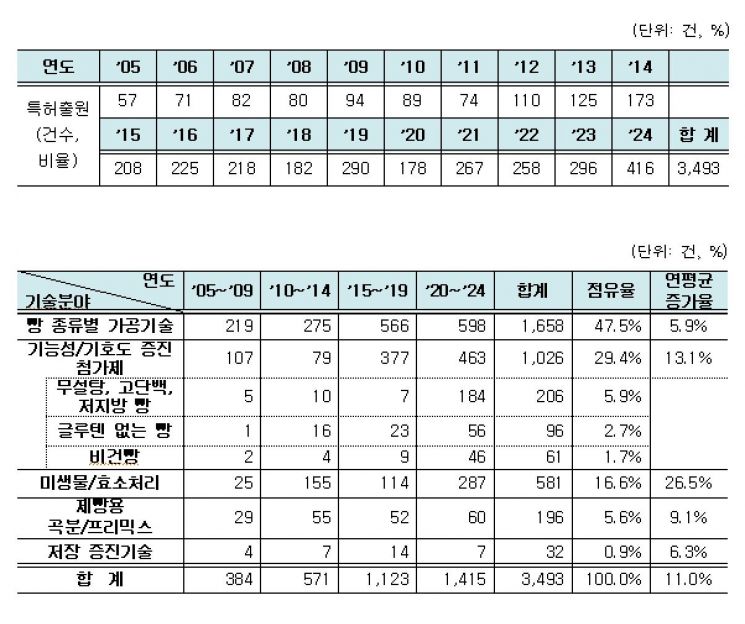 Trends in Patent Applications for Breadmaking Technology. Provided by the Korean Intellectual Property Office
In the trend of patent application increases (2005-2024), patents for breadmaking technologies that apply microorganisms or enzymes to dough, such as natural starters, reached 581 cases, recording an average annual growth rate of 26.5%.
Patents related to additives (1,026 cases) showed an average annual growth rate of 13.1%. Notably, among these additives, there were a significant number of applications for sugar-free, high-protein, low-fat breads with reduced calories (206 cases); gluten-free breads (96 cases); and vegan breads made without animal-based ingredients such as milk, butter, or eggs (61 cases).
By applicant, individual inventors accounted for 1,900 cases (54.4%), small and medium-sized enterprises for 814 cases (23.3%), and universities and research institutes for 293 cases (8.4%). Individuals and small and medium-sized enterprises together made up 77.7% of the total, driving the overall increase in patent applications.
Jung Yeonwoo, Director General of Patent Examination Planning at the Korean Intellectual Property Office, stated, "As demand grows for bread that satisfies both taste and health, patent applications for breadmaking technology are also increasing. We will continue to provide support to help the domestic baking industry secure patent rights and expand onto the global stage, thereby creating a new 'K-Bakery' market."
© The Asia Business Daily(www.asiae.co.kr). All rights reserved.
![Clutching a Stolen Dior Bag, Saying "I Hate Being Poor but Real"... The Grotesque Con of a "Human Knockoff" [Slate]](https://cwcontent.asiae.co.kr/asiaresize/183/2026021902243444107_1771435474.jpg)

















