Nowon District in Seoul (Mayor Oh Seungrok) is launching a resource circulation initiative that recycles coffee grounds, the residue left after brewing coffee.
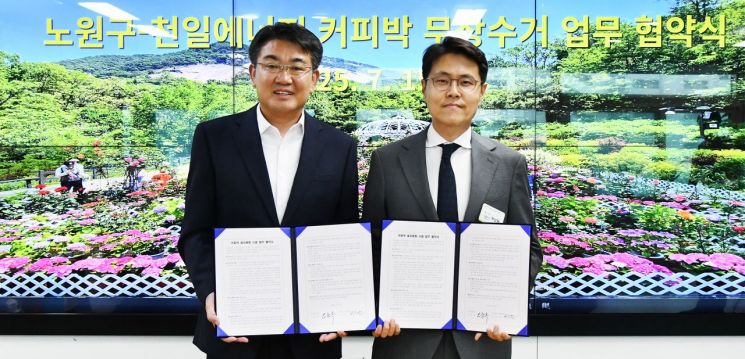 Nowon District signed a free coffee grounds collection business agreement with Cheonil Energy on the 15th. Left: Oh Seungrok, Mayor of Nowon District Office; Right: Park Sangwon, CEO of Cheonil Energy. Provided by Nowon District.
As part of its greenhouse gas reduction and carbon neutrality policies, the district has decided to launch a pilot recycling project to use coffee grounds as a resource rather than simply disposing of them as waste. On the 15th, Nowon District signed a "Free Coffee Grounds Collection and Resource Utilization Agreement" with Cheonil Energy (CEO Park Sangwon), a company specializing in coffee grounds recycling. Starting on the 21st, the district will recruit participating businesses among local coffee shops.
Businesses wishing to participate can install the mobile app "Jiguhada," sign up as a member, and then register their business. Once their status as a local coffee shop is verified and approved, they can dispose of coffee grounds at designated locations and request collection through the "Jiguhada" app. A collection agent will then visit the business to pick up the coffee grounds directly.
The collected coffee grounds are processed into biofuel by the collection company. The fuel is then used to generate steam, which is supplied as fuel to facilities such as dyeing factories.
Nowon District stated, "Recycling coffee grounds instead of landfilling them not only reduces waste disposal costs, but also decreases the overall amount of waste by producing fuel from the grounds. We also expect that the collection and recycling process will raise residents' awareness about environmental protection."
Coffee grounds are the residue left after extracting coffee from beans. Typically, about 15 grams of beans are used to make one cup of Americano, and 99.8% of this amount, or 14.97 grams, becomes coffee grounds. In particular, coffee grounds have been classified as household waste, placed in standard garbage bags, and either landfilled or incinerated.
Meanwhile, the district operates a recycling center to promote resource recycling. The center sells reusable items such as used home appliances (refrigerators, washing machines) and furniture at prices lower than the market rate, and also offers rental services for some items. Collection of unused secondhand goods is also available.
Mayor Oh Seungrok said, "This agreement, in which the public and private sectors join forces to turn discarded coffee grounds into a resource, will serve as a good example of resource circulation and greenhouse gas reduction. We will continue to pursue multifaceted carbon neutrality policies, from everyday practices to policy-level approaches."
© The Asia Business Daily(www.asiae.co.kr). All rights reserved.

















