Korea Electric Power Corporation (KEPCO) has begun full-scale discussions on the construction of energy highways following the launch of the new administration. In response to the rapidly increasing demand for power grids driven by the expansion of renewable energy and the major transformation brought by artificial intelligence (AI), KEPCO is focusing its organizational capabilities on the timely expansion of national backbone grids?both longitudinal and latitudinal?to connect the concentrated generation capacity in the Yeongho-nam and Gangwon regions with the large-scale power demand in the Seoul metropolitan area, including semiconductors and data centers.
A KEPCO official stated on the 17th, "Within the key themes that run through national governance, such as fostering new industries like AI, responding to the climate crisis, and expanding energy welfare, energy policy has emerged as a core pillar supporting the entire industrial base," adding, "We plan to accelerate the resolution of power industry issues in line with government policy directions such as the energy highway."
Since its inauguration, the new administration has been swiftly preparing to plan and implement national policy tasks. As a result, the role and responsibility of KEPCO in the power industry have become more significant than ever. However, amid surging power demand and the spread of renewable energy, the existing power grid is facing severe bottlenecks. The construction of major transmission networks has been stalled for years due to a combination of issues, including regional conflicts, permitting delays, and low community acceptance. In fact, the East Coast?Seoul metropolitan area high-voltage direct current (HVDC) transmission project has been delayed by about 82 months, and the 345kV Bukdangjin?Shintangjeong transmission line has been delayed by approximately 150 months.
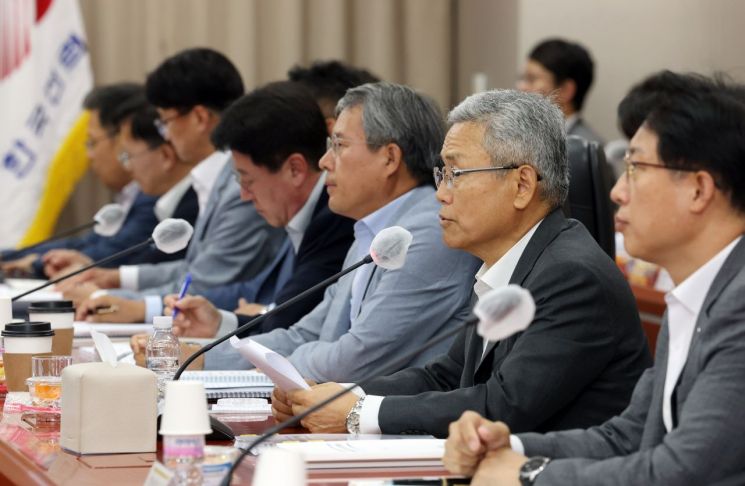 Kim Dongchul, President of KEPCO (second from left), held a grand forum at the Naju headquarters on the 24th and 25th of last month, with all former executives and first-level business site managers nationwide participating to conduct in-depth discussions on key tasks such as the construction of energy highways and the promotion of new technologies. (Photo by KEPCO)
Recognizing these realities, KEPCO held a grand forum for two days starting on the 24th of last month at its Naju Innovation City headquarters, with President Kim Dongchul, all former executives, and first-level business site managers from across the country in attendance. During the event, in-depth discussions were held on key challenges facing the company, such as the construction of energy highways and the promotion of new technologies.
The new administration has announced the construction of "energy highways" as a core pledge to secure power supply stability and expand renewable energy. According to the 11th Basic Plan for Long-term Electricity Supply and Demand, peak power demand is expected to increase by 132%, from 98.3GW in 2023 to 129.3GW in 2038, while renewable energy generation is projected to rise by 410%, from 56.6TWh to 232.1TWh over the same period. In response, KEPCO plans to push forward with massive facility investments totaling 72.8 trillion won by 2038, despite challenging financial conditions such as large accumulated deficits.
A KEPCO official said, "The timely construction of power grids is the most critical factor in securing national industrial competitiveness and determining the success of government policies," adding, "KEPCO will actively adopt a variety of construction methods to maximize efficient land use and minimize public complaints, including joint construction of social overhead capital (SOC), multi-circuit line construction utilizing existing facilities, the introduction of community-friendly substations, and securing power grid sites in cooperation with related organizations."
In particular, KEPCO has established special measures to ensure the timely construction of energy highways, such as exemption from preliminary feasibility studies, design-build integrated bidding, securing and localizing the supply capacity of key equipment, and more. Additionally, KEPCO plans to establish a dedicated special purpose company (SPC) for the construction of joint connection facilities needed to promote offshore wind power, and to expand neutral public awareness activities to address negative perceptions of electromagnetic waves among the public.
KEPCO is also actively promoting the advancement of new energy technologies and businesses. KEPCO is developing, possessing, and enhancing key technologies across the entire value chain of the power business, and has selected five core new businesses focused on power grid technologies, including total transmission and substation solutions, next-generation distribution management systems (ADMS), and intelligent digital power plants (IDPP). KEPCO is leveraging its competitiveness in grid construction and operation to enter overseas new business markets, centered on the "K-Smart Grid Platform," which packages generation, transmission, distribution, and ICT technologies. The goal is to commercialize more than five projects by 2027.
KEPCO President Kim Dongchul said, "All 23,000 KEPCO employees will do their utmost to unwaveringly pursue key tasks such as financial improvement, grid expansion, and fostering new technologies," adding, "We will continuously review the outcomes derived from the grand forum and incorporate feedback, and at the end of this month, we plan to present even more advanced innovation measures and implementation strategies at a workshop where all first- and second-level business site managers nationwide will gather at the Human Resources Development Institute."
© The Asia Business Daily(www.asiae.co.kr). All rights reserved.

















