Confirmation Hearing for Minister of Education Nominee
Lee Jinsuk: "Lack of Understanding of Academic Context"
Ruling Party's Kim Junhyuk: "Paper Writing Methods Differ Between Science and Humanities"
Lee Jinsuk, nominee for Deputy Prime Minister for Social Affairs and Minister of Education, addressed the controversy over alleged plagiarism in her thesis on July 16, stating, "All experts have pointed out issues with Copy Killer, but you cannot trust the results that simply come out after running it."
At the confirmation hearing held by the National Assembly's Education Committee that day, Lee responded to questions from Kim Daesik, a lawmaker from the People Power Party, and explained the plagiarism allegations raised against her. When Kim pointed out that the plagiarism rate of Lee's thesis reached 52 to 56 percent and argued that she was unqualified as an educator, Lee countered, "I have seen the Copy Killer results, but they are not accurate."
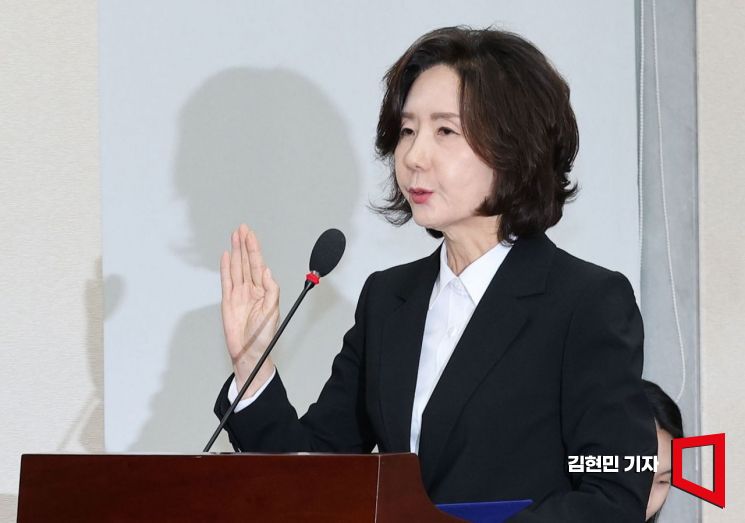 Lee Jinsuk, Deputy Prime Minister for Social Affairs and Minister of Education nominee, is taking an oath at the confirmation hearing held by the National Assembly's Education Committee on July 16, 2025. Photo by Kim Hyunmin
She also firmly denied allegations of appropriating a student's thesis. Lee emphasized, "In the process of granting a master's degree at Chungnam National University's Graduate School of Academic Administration, it is mandatory for professors and students in science and engineering to jointly publish a thesis in order to qualify for the degree. Joint research between students and professors is essential." She also dismissed claims that she excluded students' names and included only her own, saying, "That never happened."
Lee stated, "Before I was appointed as president in 2007, all 100 of my papers were verified by external experts and were found to have a similarity rate of less than 10 percent. These papers have been verified over a long period, and such results from Copy Killer are what you get when analyzing those papers." She added, "A true similarity rate is only obtained when an expert carefully excludes each similar paper one by one. The reports in the media are conclusions drawn without an understanding of the academic context."
Regarding the controversy, Kim Junhyuk, a lawmaker from the Democratic Party, remarked, "As a history major, I realized that the way I write papers is completely different from the writing style in science and engineering." He explained that the approaches of science and engineering and the humanities are different.
Kim said, "I asked professors in architecture, and I found out that it is different. In architecture, it is common to use some of the content developed with a professor in both a master's thesis and a doctoral dissertation." He continued, "So, does this mean it is not plagiarism or self-plagiarism? Those from the humanities or law tend to judge by their own standards, but there are aspects of the research system in science and engineering that are difficult to understand from that perspective."
He added, "When I wrote my thesis, my advisor helped, but it was thoroughly my own research. In science and engineering, however, doctoral dissertations are often further developments within the advisor's research. Because of experiments, the writing and thesis development in science and engineering cannot be the same as in the humanities, and the academic achievements are also different."
However, he also said, "As an advisor, I do wish that more first authorships were given to students when conducting research together."
In response, Lee explained, "I was the first author of my papers in the initial stages because I mainly did the planning, but in the later stages of the research, students were listed as first authors. There was no difference in the benefits for authors, and this was done for educational and fairness reasons."
© The Asia Business Daily(www.asiae.co.kr). All rights reserved.

















