Employment Rate Hits Record 70.3% for June
Manufacturing Down by 83,000, Construction Down by 94,000
Agriculture, Forestry, and Fisheries Also Decline Due to Weather
Youth Employment Rate Falls 1.0 Percentage Point to 45.6%
Unemployment Rate Drops 0.1 Percentage Point to 6.1%
Government Considers Raising This Year's Employment Forecast
"We Will Monitor Employment Risks in the Second Half of the Year"
Last month, the number of employed people increased by around 200,000 for the fourth consecutive month. The employment rate for those aged 15 to 64 reached 70.3%, the highest ever recorded for June. However, due to economic stagnation and trade risks, the number of people employed in manufacturing and construction?sectors considered to offer high-quality jobs?has remained negative for over a year. The youth employment rate also declined for the 14th consecutive month.
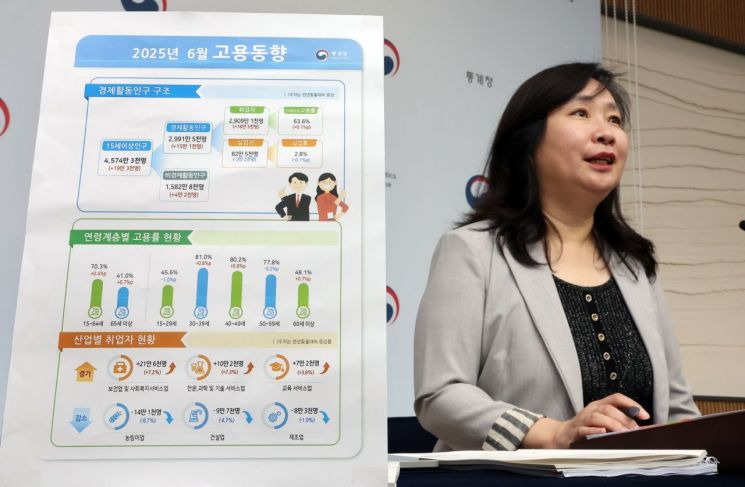 Gong Misook, Director of the Social Statistics Bureau at the Korea National Statistical Office, is explaining the "Employment Trends for June 2025" at the Government Sejong Complex on the 16th. Photo by Yonhap News
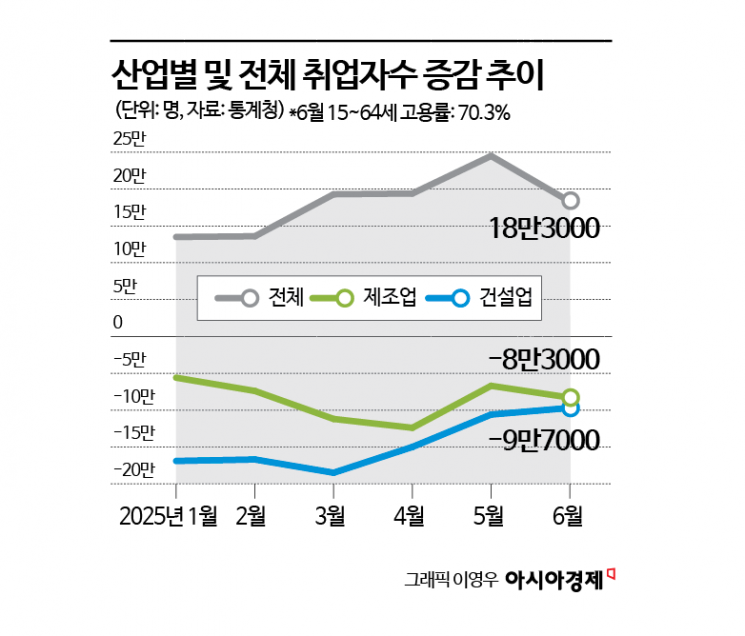
According to the "Employment Trends for June 2025" released by Statistics Korea on the 16th, the number of employed people last month was 29,091,000, an increase of 183,000 compared to the same month last year. The number of employed people has increased for six consecutive months since January (135,000). Since March (193,000), the increase has remained in the range of around 200,000.
By industry, employment continued to rise in health and social welfare services (211,000), professional, scientific and technical services (102,000), and education services (72,000). However, compared to the previous month, the increase in health and social welfare services (233,000) and professional, scientific and technical services (117,000) was somewhat smaller.
The number of people employed in manufacturing (-83,000) and construction (-94,000), both considered high-quality job sectors, decreased. Manufacturing continued to decline for the 12th consecutive month since July last year (-11,000), due to sluggish domestic demand and increased trade risks. The decrease was also larger than the previous month (-67,000). Construction has been decreasing for 14 consecutive months since May last year (-47,000). Although the decrease has narrowed for three consecutive months since April (-150,000), the year-on-year base effect played a role.
In agriculture, forestry and fisheries (-141,000), the structural decline in the farm population due to aging, combined with weather impacts such as heavy rainfall, led to the largest decrease since November 2015 (-172,000). This downward trend has continued for five months. Jang Juseong, Director of Workforce Policy at the Ministry of Economy and Finance, explained, "Many foreign workers are employed on farms, but since the economically active population statistics are based on household surveys, foreign workers tend to be undercounted."
By age group, employment increased among those aged 60 and over (348,000) and those in their 30s (116,000), both groups with growing populations. In contrast, employment decreased among those in their 20s (-152,000), 40s (-55,000), and 50s (-53,000). Looking specifically at the youth group (aged 15-29), the number of employed people fell by 173,000.
According to the OECD standard, the employment rate for those aged 15 to 64 rose by 0.4 percentage points to 70.3%, the highest ever recorded for June since statistics began. However, the youth employment rate fell by 1.0 percentage point to 45.6%, marking the 14th consecutive month of decline since May last year (46.9%). The employment rate for those in their 50s also dropped by 0.2 percentage points to 77.8%. The overall unemployment rate fell by 0.1 percentage point to 2.8%, while the youth unemployment rate also decreased by 0.1 percentage point to 6.1%.
The economically inactive population increased by 42,000 to 15,828,000. Among these, the number of people classified as "taking a break" rose by 60,000 to 2,434,000. The number of people "taking a break" increased among those aged 60 and over (54,000) and those in their 50s (17,000), but decreased among the youth (-18,000). Jang explained, "The increase in youth taking a break began in May last year, so the base effect is reflected, and this year, some of those who were taking a break have become job seekers."
The government plans to continue identifying key tasks to create more high-quality jobs through boosting domestic demand and fostering advanced industries, as well as to ensure employment stability for vulnerable groups such as the youth. In addition, since the number of employed people increased by 181,000 in the first half of the year, exceeding the initial forecast of 120,000, the government will consider raising its outlook when announcing the upcoming new economic policy direction. However, since there are considerable employment risks in the second half of the year, the government will closely monitor the situation.
Jang Juseong, Director of Workforce Policy at the Ministry of Economy and Finance, stated, "There are risks in the second half of the year depending on how long the economic downturn, especially sluggish domestic demand, continues." He added, "There are also concerns that trade risks could spread, particularly in export-driven industries." He further noted, "Structurally, the working-age population is also declining, and we expect that the impact of the population decline will gradually affect the number of employed people."
© The Asia Business Daily(www.asiae.co.kr). All rights reserved.


















