Presidential Office: "Personal Opinion"
Ahn: "Not Setting a Deadline, But Expressing Commitment to Pursue"
Although the presidential office has issued a clarification regarding the remarks made by Ahn Gyubaek, the nominee for Minister of National Defense, about pursuing the transfer of wartime operational control (OPCON) within the current administration's term, the controversy is expected to persist.
According to the Ministry of National Defense on July 16, Ahn clarified the previous day regarding his statement about "OPCON transfer during the Lee Jaemyung administration's term," saying, "The remark was not about setting a deadline, but rather about expressing my commitment to pursuing the OPCON transfer." This explanation was issued in response to the presidential office's attempt to distance itself from the comment, stating that it was "the nominee's personal opinion."
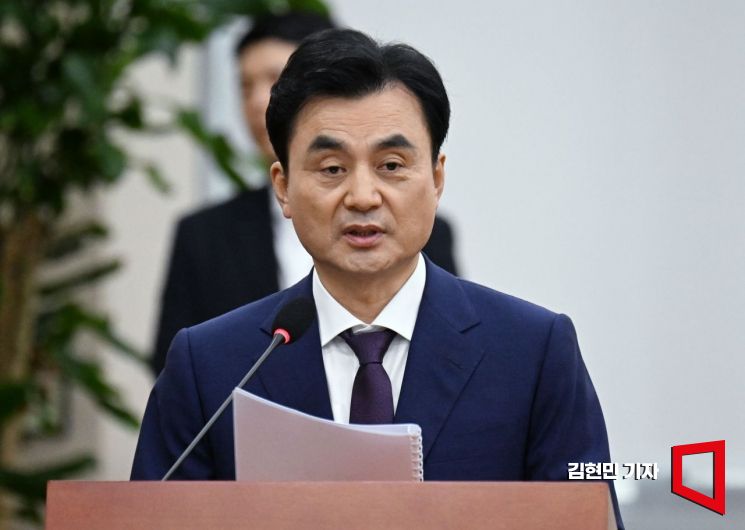 Ahn Gyubaek, the nominee for Minister of National Defense, is delivering opening remarks at the confirmation hearing held by the National Defense Committee of the National Assembly on the 15th. 2025.7.15 Photo by Kim Hyunmin
The OPCON transfer has been a long-term issue discussed by successive administrations since the Roh Moo-hyun administration. Initially, the transfer was scheduled to be completed in 2012, but during the Lee Myungbak administration, it was postponed to 2015. Under the Park Geunhye administration, the timeline was changed to "when conditions are met," without specifying a deadline. President Lee Jaemyung also included the OPCON transfer in his campaign pledges for Daejeon, although he did not specify a timeframe.
Within and outside the military, there are voices arguing that while the OPCON transfer must eventually take place, it should be approached with greater caution. During the confirmation hearing, Ahn estimated that an additional 21 trillion won in military spending would be required for the OPCON transfer. Considering that South Korea's defense budget is only 61 trillion won, this represents a significant financial burden that would be unavoidable.
It is also noteworthy that the second Trump administration is reportedly demanding that allies take on greater responsibilities, including resolving trade deficits, increasing defense spending, and readjusting the role of US Forces Korea. Recently, there has been speculation that the OPCON transfer could be included as part of a package deal in Korea-US tariff negotiations. In this regard, National Security Advisor Wi Sunglak dismissed the possibility, saying, "We do not see it as an important bargaining chip."
© The Asia Business Daily(www.asiae.co.kr). All rights reserved.

















