A domestically developed integrated platform now enables the creation of neural cell structures layered like the brain using 3D printing technology, allowing for precise observation of neural cell activity within those structures.
On July 16, KAIST announced that a joint research team led by Professors Jegyun Park and Yoonki Nam from the Department of Bio and Brain Engineering has developed an integrated platform capable of simultaneously analyzing the structural and functional connectivity of brain neural cells. This was achieved by fabricating high-resolution, multilayered 3D neural cell networks using a low-viscosity natural hydrogel with mechanical properties similar to brain tissue.
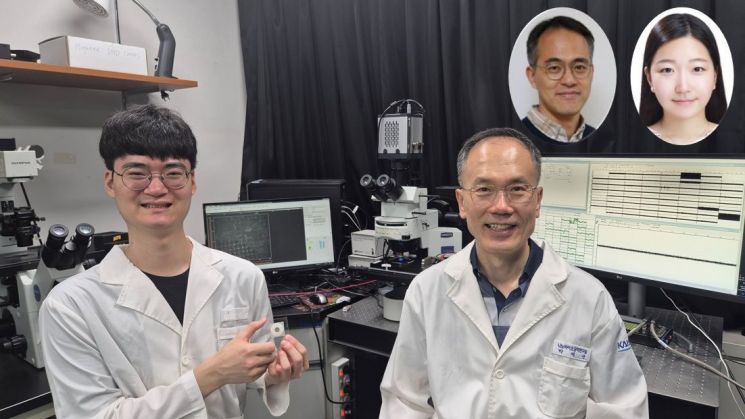 (From left) Dr. Dongjo Yoon, Professor Jegyun Park, (Top right) Professor Yoonki Nam, Suji Kim PhD candidate. Provided by KAIST
Conventional bio-printing technology required the use of high-viscosity bio-ink to ensure structural stability. However, this restricted the proliferation of neural cells and the growth of neurites, while low-viscosity, neuron-friendly hydrogels made it difficult to form precise patterns. As a result, it was challenging to analyze both structural stability and biological function at the same time.
In contrast, the joint research team completed a brain-mimicking platform by combining three core technologies that allow for the creation of precise brain structures using dilute gel, accurate alignment of each layer, and simultaneous observation of neural cell activity.
The three core technologies are the "capillary fixation effect," the "3D printing aligner," and the "dual-mode analysis system."
The capillary fixation effect is a technique that ensures the dilute gel (hydrogel) adheres completely to a stainless steel micro-mesh to prevent it from flowing, enabling brain structures to be reproduced with six times greater precision (resolution below 500μm) compared to previous methods.
The 3D printing aligner is a cylindrical design that ensures printed layers are stacked precisely without misalignment, guaranteeing accurate assembly of multilayered structures and stable integration with microelectrode chips.
The dual-mode analysis system measures electrical signals on the lower layer and observes cellular activity on the upper layer using light (calcium imaging), allowing for simultaneous verification of whether interlayer connections are functioning in multiple ways.
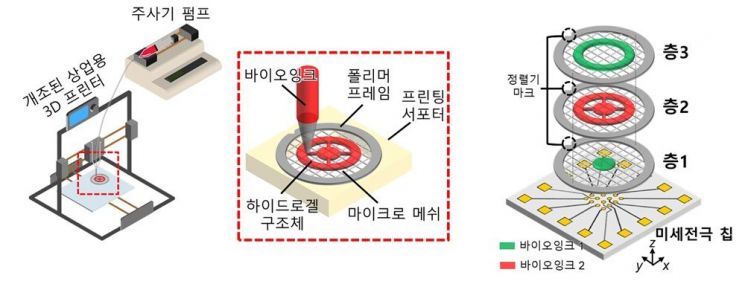 The integration process of stacked bio-printing technology and microelectrode chips. Provided by KAIST
Through these three core technologies, the joint research team used fibrin hydrogel with elasticity similar to that of the brain to fabricate a mini brain structure composed of three layers using 3D printing, and experimentally demonstrated that real neural cells transmit signals within this structure.
In the experiment, the team placed cerebral neurons in the upper and lower layers, left the middle layer empty, and designed the system so that neural cells could extend through the middle to form connections.
They also attached micro-sensors (electrode chips) to the lower layer to measure electrical signals, and observed cellular activity in the upper layer using light (calcium imaging).
During this process, when electrical stimulation was applied, neurons in the upper and lower layers responded simultaneously. When a synaptic blocker, a drug that inhibits neural connections, was introduced, the response decreased, confirming that the neurons were exchanging signals when connected.
Professor Jegyun Park stated, "This research is significant because we have developed an integrated platform capable of simultaneously replicating the complex multilayered structure and function of brain tissue." He added, "The integrated platform developed by our team can be utilized in a variety of brain research fields, including modeling of neurological diseases, studies of brain function, neurotoxicity assessment, and screening of neuroprotective drugs."
This research was supported by the National Research Foundation of Korea's Global Research Laboratory Program, the Mid-Career Researcher Program, and the Bio·Medical Technology Development Program.
The research results (paper), with Suji Kim PhD candidate and Dr. Dongjo Yoon from KAIST's Department of Bio and Brain Engineering as co-first authors, were published online on June 11 in the international journal 'Biosensors and Bioelectronics.'
© The Asia Business Daily(www.asiae.co.kr). All rights reserved.


















