Pioneer of Korean Abstract Art, Kim Hwan Ki
Frequently Captured His Affection for Joseon White Porcelain Jars in His Works
The 'Hangari' Series Embodies Eastern Sentiment and Lyricism
A 1958 Work Created Before His New York Period
Featured in the July K Auction
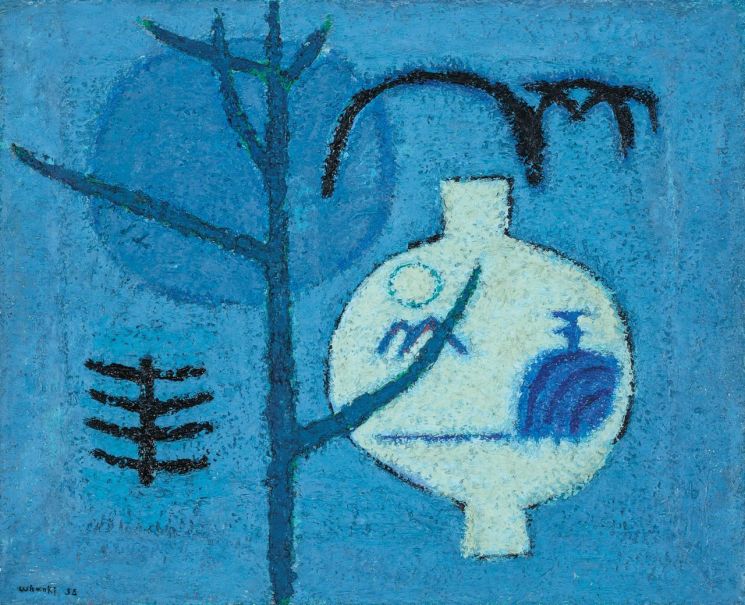
Kim Hwan Ki's work 'Hangari' (1958) is attracting attention as it is featured in the July K Auction. There is also growing interest in the artistic journey of Kim Hwan Ki, who is regarded as a pioneer of Korean abstract art, as well as in the artistic value of his representative 'Hangari' series.
Kim Hwan Ki (1913?1974) moved to Japan early in 1931 to cultivate his artistic talents. In 1934, he studied at the Avant-Garde Western Painting Research Institute, and in 1936, he co-founded the avant-garde art group 'Baekmanhoe' with Gil Jin Seop, Kanno Yuiko, and others. After graduating from the College of Art at Nihon University in Tokyo in 1936, he returned to Korea in 1937.
After Korea’s liberation, he served as a professor at both Seoul National University and Hongik University. In 1937, he formed the modern art group 'Sinsasilpa' with Yoo Young Kuk, Lee Kyusang, Jang Wook Jin, and others, and was active in the art scene. In 1956, he left for Paris to focus on his work. He returned to Korea in 1959, but in 1963, after participating in the 7th Sao Paulo Biennale, he moved to New York and began working internationally.
Kim Hwan Ki's works are largely divided into four periods, each centered on the places where he lived. ▲During the Tokyo period (1933?1937), when he studied in Japan in the 1930s, he expressed various trends such as Cubism and abstract art through experimental works. ▲In the Seoul period (1937?1956) after returning to Korea, he began to establish his own artistic world, depicting folk objects such as white porcelain jars, the moon, mountains, plum blossoms, deer, and cranes, as well as natural landscapes. ▲During the Paris period (1956?1959), he continued to focus on nature and objects imbued with Korean sentiment, simplifying forms and experimenting with lines. ▲In the New York period (1963?1974), after moving to the United States, he concealed specific motifs and composed his canvases mainly with dots and lines. In the late 1960s, he used simple primary colors, and in the 1970s, he created his signature dot paintings, repeatedly drawing square-bordered dots across the entire canvas.
The 'Hangari' works are a representative example of successfully integrating traditional Korean motifs into modern abstract painting. Kim Hwan Ki cherished and personally collected moon jars, a type of white porcelain from the Joseon Dynasty, and used them as artistic motifs. By juxtaposing or overlapping the moon and jars on the canvas, he conveyed poetic sensibility through form, color, and texture. The 'Hangari' (1958) work featured in the July K Auction was created in Paris before he moved to New York, and it is considered a work from the period just before he fully embraced abstraction. This piece, which reinterprets the jar through a contemporary pictorial language, is highly regarded for its profound infusion of Eastern sentiment and lyricism. The auction will start at 950 million won, and the work will seek a new owner at the K Auction headquarters in Sinsa-dong at 4 p.m. on July 23.
© The Asia Business Daily(www.asiae.co.kr). All rights reserved.

















