Kim Donggeun Highlights Uijeongbu's Transformation at 3rd Anniversary Press Conference
"Heungseon Re-Start Project" Launched to Restore Central Urban Functions
From Consumption City to Advanced Industry Hub... Shifting the Economic Ecosystem
"At a time when external conditions are changing rapidly, such as the groundbreaking of the GTX-C line, it is more important than ever for Uijeongbu to establish its own central role."
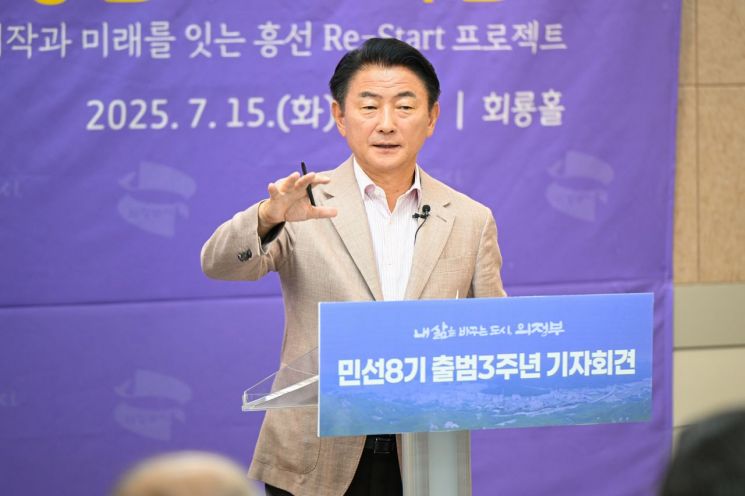 Mayor Donggeun Kim is holding a press conference for the 3rd anniversary of the 8th elected administration on the 15th at City Hall Hoeryong Hall (Medium Conference Room). Photo by Jonggu Lee
On July 15, Uijeongbu Mayor Kim Donggeun held a press conference marking the third anniversary of the 8th elected administration and declared the official launch of the 'Heungseon Re-Start Project.' He stated, "We will focus all our efforts on reconnecting the city's fragmented structure and building a city where daily life, industry, and culture function together, so that Uijeongbu can once again emerge as the central city of northern Gyeonggi Province."
The strategy is to transform Uijeongbu into a future-oriented industrial city by innovating its stagnant urban structure and restoring its central functions.
The 'Heungseon area' is a major transportation hub centered around Uijeongbu Station, where six railway lines are planned to intersect. With a residential population of approximately 210,000, it has long served as the center of Uijeongbu's economy and consumption activities.
However, a combination of structural aging and demographic changes is underway, including: ▲ east-west disconnection in the city center ▲ 3,488 apartment buildings (39% of the entire Heungseon area) ▲ an elderly population of 20,596 (20%) ▲ 21,472 single-person households (42%). These factors make it necessary to adopt new responses.
As the gap between urban structure and population distribution widens, everyday inconveniences such as traffic congestion, parking shortages, and pedestrian discomfort continue. In addition, the competitiveness of local commercial districts and the city's residential appeal are gradually declining due to a decrease in the daily population and the outflow of young people. There are also concerns that, after the opening of the GTX-C line, Uijeongbu could lose its competitive edge to neighboring areas such as Changdong, which may lead to a decline in real estate values and deepening regional inequality.
To fundamentally improve the stagnant urban structure and restore central functions, Uijeongbu City will fully implement the 'Heungseon Re-Start Project.'
Through this project, the city has presented three main strategies: ▲ 'Rebuild: Urban Space Reorganization and Innovation' to reconnect fragmented spaces and restore central functions ▲ 'Revive: Strengthening Living Infrastructure' to improve daily life foundations such as pedestrian pathways, transportation, and public facilities ▲ 'Reform: Regional Economic Restructuring' to transform the local economy into an ecosystem where advanced industries and commercial districts coexist.
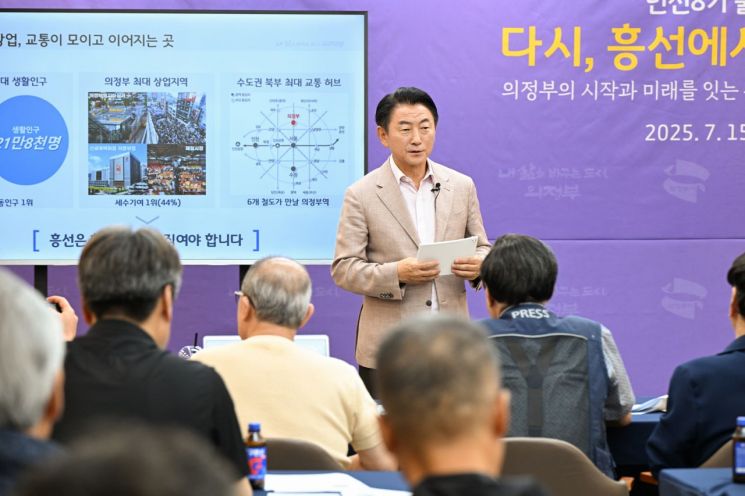 Mayor Donggeun Kim is holding a press conference for the 3rd anniversary of the 8th elected administration on the 15th at City Hall Hoeryong Hall (Medium Conference Room). Photo by Jonggu Lee
Each strategy will serve as the foundation for ongoing individual projects, such as ▲ Uijeongbu Station area development ▲ redevelopment and reconstruction ▲ opening and sharing of public facilities ▲ revitalization of downtown commercial districts. These will become the core pillars for the city's renewed movement and growth.
The city plans to leverage the Heungseon area's long-standing role as a center of transportation, commerce, and daily life by advancing urban functions and driving the city's overall resurgence through a phased approach.
Uijeongbu City has proposed a new urban model that goes beyond physical improvements, aiming to organically connect spaces, industries, and daily life for its citizens.
First, to restore the east-west axis of the city center, which has been divided by railways and parks, the city will reorganize urban spaces around the Uijeongbu Station area. This area is set to become a compact city with a multi-modal transfer center linked to the GTX-C and other railway lines, integrating transportation, commercial, and cultural functions.
After the opening of the GTX-C line, the travel time from Uijeongbu to Gangnam Samseong Station will be reduced to about 21 minutes. To maintain its competitiveness as a transportation hub, even as development accelerates in nearby areas such as Changdong, the city plans to counter the "straw effect" by restoring self-sustaining central functions and expanding commercial districts.
At the same time, the city will accelerate improvements to the residential environment. In response to demographic changes such as an aging population and an increase in single-person households, redevelopment and reconstruction projects will be systematically promoted in areas with concentrated old housing.
Together with urban space reorganization, the city is also focusing its efforts on improving living infrastructure closely related to citizens' daily lives. The plan is to eliminate spatial disconnections and reorganize the flow of daily life?such as pedestrian movement, transportation, and use of public facilities?to enhance citizens' perceived satisfaction.
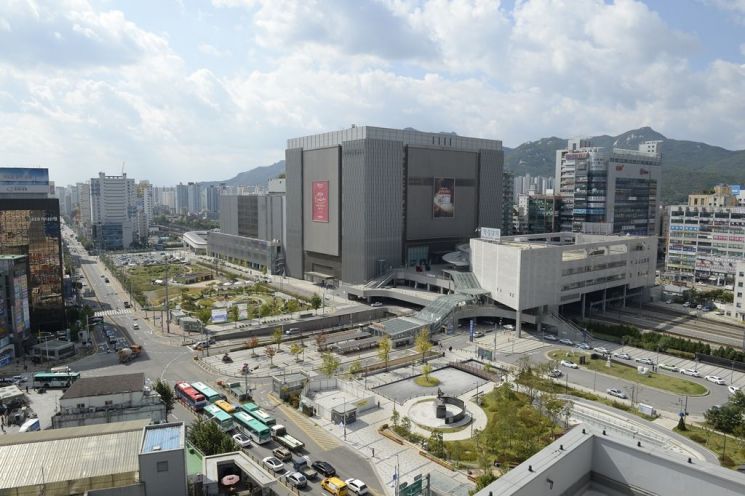
Transportation infrastructure is also being meticulously improved. Following the opening of the Camp Redcloud (CRC) bypass road, the city plans to establish a CRC urban planning road to connect the fragmented road network. In addition, after completing the optimization of the traffic signal system (from the Yangju city boundary to Ganeung Station), the city will further improve traffic conditions by implementing the Traffic System Management (TSM) project at Gyeongmin Square Intersection and eight other locations. The city will also continue to enhance mobility for citizens by introducing new bus routes connecting to Seoul and reorganizing existing bus lines.
The efficient use of public resources will also be expanded. Parking lots attached to churches, schools, and public institutions, as well as public sports facilities and community center spaces, will be opened to citizens, expanding the foundation for leisure, care, and community activities around shared spaces. This approach increases the efficiency and accessibility of space utilization without the need to build new facilities.
The city is also working to expand everyday, close-to-life infrastructure. An integrated child care center has been established at the former Uijeongbu 1-dong Community Center site, a barefoot loess trail for citizens' health has been completed, and the Gyeongmin University Road urban regeneration project has been finished to revitalize the area. In addition, the city is gradually building the second Hoho-dang branch and the Uijeongbu Nonghyup complex facility, with plans to continuously expand the foundation for care, leisure, and local community functions.
In particular, the city is moving away from a consumption-centered urban structure and is working to shift to an advanced industry-centered economic structure that will drive sustainable growth. The strategy is to build an industrial ecosystem in which jobs, businesses, and talent are connected within the region, thereby enhancing the city's future competitiveness.
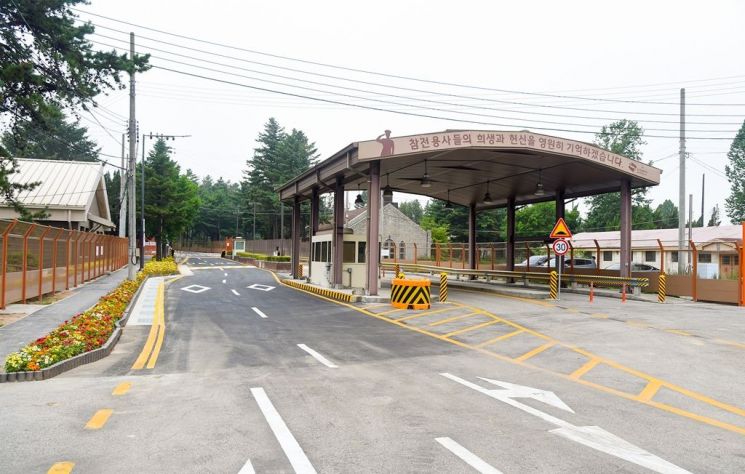
The key is the Camp Redcloud (CRC) site, which has been designated as a candidate for a Free Economic Zone. Covering about 840,000 square meters, this site is set to be reborn as a global business hub where new industries such as design, media content, and AI converge. While preserving the value of existing military facilities, if designated as a Free Economic Zone, the site will offer various incentives such as regulatory easing, customized incentives, and tailored site provision for companies, greatly strengthening its competitiveness in attracting businesses.
The structural innovation of traditional markets and old downtown commercial districts will also proceed in parallel. The city has established a 'Mid- to Long-Term Development Plan for Old Downtown Commercial Districts,' including Uijeongbu Jeil Market, Haengbok-ro, and the Uijeongbu Station underground shopping mall, and is working to improve the infrastructure to increase connectivity between commercial districts. A pedestrian-friendly street will be created on Haengbok-ro to guide the flow of foot traffic and foster an environment where consumption activities and urban vitality go hand in hand.
The foundation for linking local education and industry will also be strengthened. The city has introduced a 'Local Outstanding Talent Selection Track' at Gyeonggi Northern Science High School, and Uijeongbu Technical High School is preparing to transition into 'Korea Mobility High School.' In addition, the city is pursuing the establishment of a 'Sports Business High School' to foster talent for the sports industry.
© The Asia Business Daily(www.asiae.co.kr). All rights reserved.














