Urban Villages and Aging Housing Improvements in Cities
Unstable Exports and Ongoing Tariff Uncertainties
Demand Remains Weak Despite Government Efforts
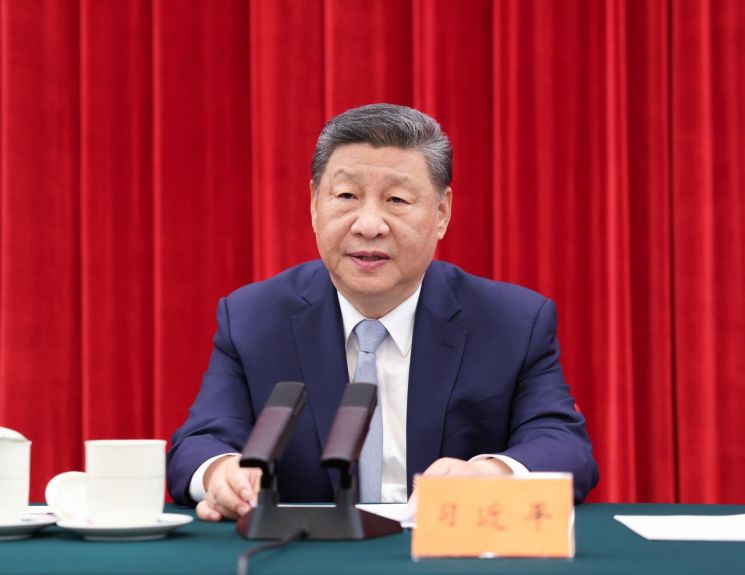 Chinese President Xi Jinping is giving a speech at the 120th anniversary event of Chinese elder statesman Chen Yun held in Beijing on the 13th of last month (local time). Photo by Xinhua News Agency
As China's real estate market continues to struggle to emerge from its prolonged slump, President Xi Jinping has called for the swift implementation of a "new model" for real estate development, according to a report by state-run Xinhua News Agency on July 15, 2025.
Bloomberg News, citing Xinhua, reported that President Xi officially announced this policy during the Central Urban Work Conference, which was held over two days on July 14 and 15. He emphasized the need for a more cautious approach to urban planning and renovation.
President Xi also stated that China will continue to steadily promote the redevelopment of chengzhongcun (urban villages) and the remodeling of aging residential buildings. This follows the Chinese government's pledge in October 2024 to renovate one million old homes in major cities as part of a housing project.
Even before this meeting, there had been speculation that China might be restarting a campaign similar to that of 2015. At that time, China held its first Central Urban Work Conference in decades, attended by President Xi and members of the Politburo Standing Committee. The conference was used to boost housing demand and stimulate domestic investment.
However, Bloomberg reported that China's prolonged real estate downturn continues to undermine government efforts. With exports remaining uncertain amid ongoing U.S.-China trade tensions, new home prices in June recorded their largest drop in eight months.
According to the National Bureau of Statistics, which announced China's second-quarter GDP on July 15, fixed-asset investment increased by 2.8% in the first half of the year. This figure reflects changes in capital investment in factories, roads, power grids, and real estate, excluding rural areas. The growth rate in the first quarter was 4.2%, but the pace slowed in the second quarter, bringing down the overall average for the first half. In particular, investment in real estate development, which remains in a slump, fell by 11.2% in the first half, with the decline in the second quarter being greater than the 9.9% drop in the first quarter.
The National Bureau of Statistics stated, "There are still relatively many external unstable and uncertain factors, domestic effective demand is insufficient, and the foundation for economic recovery still needs to be further consolidated." The Bureau added, "We must steadfastly do our own work well by comprehensively considering domestic economic tasks and international economic and trade struggles, and respond to external uncertainties with the certainty of high-quality development."
Meanwhile, according to Xinhua, the meeting was also attended by Premier Li Qiang, a member of the Communist Party's Politburo Standing Committee; Zhao Leji, Chairman of the Standing Committee of the National People's Congress; Wang Huning, Chairman of the National Committee of the Chinese People's Political Consultative Conference; Cai Qi, Secretary of the Secretariat of the Central Committee; and Ding Xuexiang, Vice Premier of the State Council.
© The Asia Business Daily(www.asiae.co.kr). All rights reserved.

















