Average Price Surpasses 30,000 Won at Traditional Markets, Up 6,000 Won in Ten Days
Nationwide Average Reaches 29,816 Won... 40% Higher Than a Year Ago
According to data compiled by the Korea Agro-Fisheries & Food Trade Corporation (aT) on July 15, the average retail price for a watermelon (standard grade) at traditional markets was 30,327 won as of the previous day, breaking the 30,000 won mark. In the distribution industry, the average retail price of watermelon was 29,543 won, nearly reaching 30,000 won, but there are already many places selling them for more than 30,000 won. Effectively, the "era of 30,000 won per watermelon" has arrived.
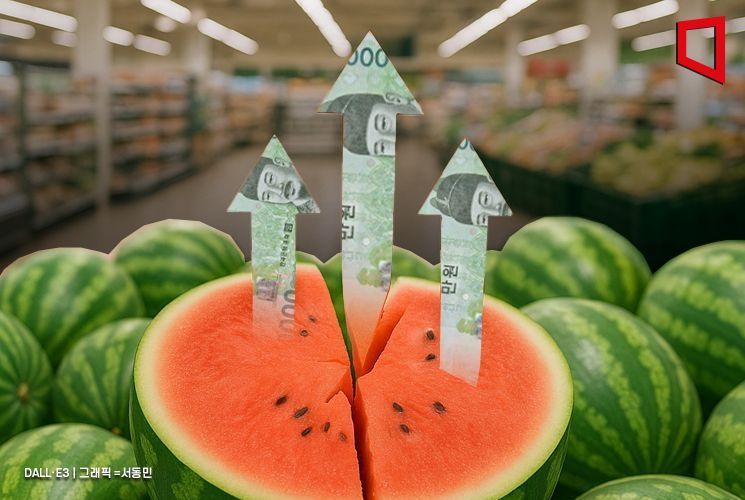
The nationwide average price of watermelon stood at 29,816 won as of the previous day, just shy of 30,000 won. This represents an increase of 700 won compared to the previous survey on July 11, and a jump of over 6,000 won in just ten days compared to July 4 (23,763 won). Compared to a year ago (21,336 won), the price has risen by about 8,500 won (39.8%), and it is 41.8% higher than the average year.
The main reason behind the price increase is cited as a decline in watermelon quality due to the heatwave. Industry insiders agree that "an unusually early heatwave this year has worsened the growing conditions for watermelons." In particular, the supply of high-quality watermelons that meet sugar content standards has decreased, resulting in limited quantities being distributed to the market and pushing prices up.
A fruit shop owner in Mapo, Seoul, told Yonhap News, "At the beginning of this month, I sold 8kg watermelons for 28,000 to 29,000 won, but now I sell them for 37,000 won." He added, "For 9kg watermelons, I need to charge at least 40,000 won, but I am selling them for 39,000 won." He explained, "Because the weather is hot, the sugar content hasn't increased, so supply is limited." He also noted, "If it keeps raining this week, prices could go up even more."
The rise in watermelon prices is being driven not only by supply shortages but also by increased demand due to higher temperatures. The Korea Rural Economic Institute (KREI) stated, "The shipment volume of watermelons in July is expected to remain at last year's level," but also assessed, "If the heatwave continues, demand will rise and prices are likely to trend upward."
To ease the instability in the prices of watermelons and other agricultural and livestock products, the government has launched an emergency response. The Ministry of Agriculture, Food and Rural Affairs announced that it will flexibly release reserve stocks of major crops and support the recovery of production bases. In addition, discount events and consumer rebate promotions for agricultural and livestock products will be held, focusing on major retailers and traditional markets. Through these measures, the government aims to alleviate the consumer burden of rising prices and simultaneously stabilize prices at the production sites.
© The Asia Business Daily(www.asiae.co.kr). All rights reserved.

















