A watermelon costs 29,816 won, up 42% from the average year
Shipment volumes to increase from late July
Special summer vacation discounts for agricultural and livestock products to be offered
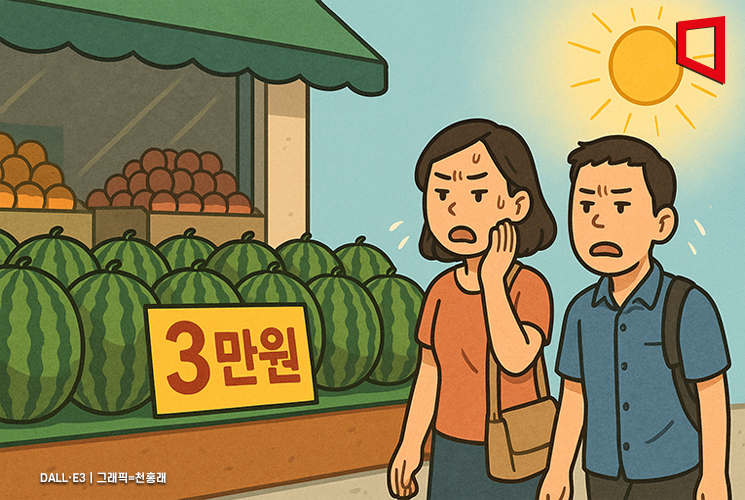
The government has projected that the soaring price of watermelons will stabilize toward the end of this month, as shipment volumes are expected to increase. Watermelon prices have nearly reached 30,000 won per fruit, driven by shipment delays due to insufficient sunlight in May and June this year, as well as increased demand caused by the heatwave.
The Ministry of Agriculture, Food and Rural Affairs announced on July 15 that, "This year, the heatwave began earlier than usual, causing prices of certain agricultural products, such as watermelons and cabbages, to rise more rapidly than in previous years." The ministry also stated that it is implementing measures to stabilize the supply and demand of agricultural and livestock products and to ease the burden on consumers.
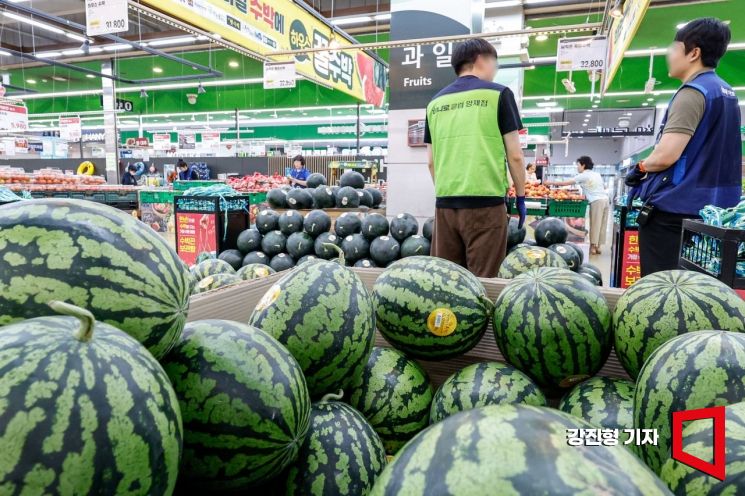 On the 14th, watermelons were displayed at Hanaro Mart Yangjae Branch in Seocho-gu, Seoul. 2025.7.14. Photo by Kang Jinhyung
According to the Korea Agro-Fisheries & Food Trade Corporation, as of the previous day, the price of a single watermelon (grade: standard) was 29,816 won, which is 41.8% higher than the average year. An official from the Ministry of Agriculture, Food and Rural Affairs explained, "Prices are higher than last year due to increased demand from the heatwave and shipment delays caused by reduced sunlight in May and June this year. However, from late July, supply is expected to become more stable as shipment volumes increase from areas with good crop conditions such as Yanggu in Gangwon, Bonghwa in North Gyeongsang, and Gochang in North Jeolla, and as the second-crop watermelons from Eumseong in North Chungcheong also begin shipping."
For summer cabbages grown in high-altitude regions, there were concerns about poor growth due to heatwaves and drought in the main production area of Gangwon Province. In particular, as the drought worsened in the eastern regions of Gangwon, including Gangneung, emergency water trucks and mobile irrigation equipment (such as sprinklers) were deployed to ensure that transplanting was completed without issues. Lee Gwanghyeong, Secretary-General of the Korea Agricultural Distribution Corporation Association, predicted, "With the rain expected this week resolving the drought and cooler weather continuing for a while, cabbage crop conditions should also recover."
The Ministry of Agriculture, Food and Rural Affairs is preparing for possible damage from unexpected heavy rains, heatwaves, or droughts by maintaining and expanding irrigation and drainage facilities, providing pest control agents, and preparing 2.5 million reserve cabbage seedlings so that they can be replanted immediately if early-stage cabbages die or are lost. If, despite these measures, production still decreases, the government plans to manage shipment volumes by flexibly supplying up to 35,500 tons of available government stock to wholesale markets and other channels depending on the situation in production areas.
Regarding potatoes, spring field potatoes, which account for 65% of total potato production, are currently being distributed. Although production is down compared to last year, it is about 2% higher than the average year, so the ministry expects there will be no major supply issues. However, for highland potatoes, which will be harvested in earnest from September, the cultivation area has decreased by 6.8% compared to last year, and as the potatoes are currently in the tuber enlargement stage, which requires a lot of water, growth has been somewhat sluggish due to the drought.
The ministry is guiding the full mobilization of irrigation facilities to help highland potatoes recover during the enlargement stage and plans to adjust market supply using 10,200 tons of highland potatoes produced under contract for price stabilization. In addition, as a decrease in highland potato production is expected, the government will hold public auctions for import rights for up to 3,200 tons under the Korea-US Free Trade Agreement (FTA) Tariff Rate Quota (TRQ) so that distributors can quickly secure supplies.
For livestock products, although heatwave damage has occurred among poultry, which are vulnerable to high temperatures, the impact on supply remains limited. As of July 14, 428,000 broiler chickens had been affected, representing 0.6% of the total raised, and 38,000 laying hens had been affected, accounting for 0.04%.
In July, the average daily egg production is 48.21 million, which is higher than the average year and similar to last year. The ministry expects that egg prices will gradually decrease due to reduced demand for school meals during the summer vacation and lower consumption caused by holidays. The ministry is working to expand egg supply by extending the laying period of hens (from 84 weeks to 87 weeks) and supporting nutritional and vitamin supplements to mitigate heat damage. To ease the burden on consumers, the ministry is also supporting a reduction in the delivery price of eggs supplied to large supermarkets (up to 1,000 won per carton of 30 eggs) using the egg producers' fund.
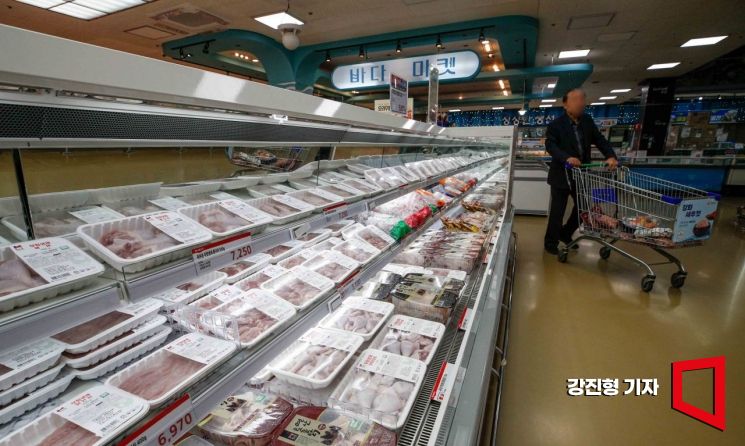 Chicken is being sold at Hanaro Mart Yangjae Branch in Seocho-gu, Seoul. Photo by Jin-Hyung Kang aymsdream@
For chicken, which sees seasonal demand spikes during Boknal (the hottest days of summer), supply is expected to meet or exceed average and previous year levels. To expand domestic chicken supply, the ministry has already increased the number of broiler chicks placed by 3.6% since June and has extended the productive lifespan of breeding stock (from 64 weeks to no limit). Concerns over supply disruptions of imported chicken due to outbreaks of highly pathogenic avian influenza in Brazil are being addressed by sequentially supplying an additional 4,000 tons of Thai chicken to the domestic market from mid-July to early August, and normal supplies from Brazil are expected to resume from mid-August, stabilizing the market.
To minimize heatwave damage, the ministry has organized and is operating a "Heatwave Response Livestock Damage Minimization Task Force," establishing a 24-hour emergency contact system in cooperation with local governments and producer organizations. The ministry has designated officials in each local government to address farm damages and difficulties, and has set up an emergency water supply system to support farms that request assistance and areas at high risk of heatwave damage. Local governments and producer organizations are also planning to do their utmost to reduce heatwave damage by providing ice, immunity boosters, and shade nets.
Additionally, to ease the burden on consumers during the summer, when demand for agricultural and livestock products increases, the ministry will implement a "Special Summer Vacation Discount Support for Agricultural and Livestock Products" campaign at 12,000 large and small supermarkets nationwide from July 17 to August 6, lasting three weeks. During this period, the per-person discount limit will be raised from 10,000 won to 20,000 won per week, and discounts of up to 40% per item will be available. At 130 traditional markets, a separate on-site cashback event worth 10 billion won will be held from August 4 to 9.
Separately, food companies and distributors will hold events at large supermarkets and convenience stores offering up to 50% discounts on processed foods such as ramen, bread, kimchi, ice cream, juice, and samgyetang. To further ease the burden of dining out, events will continue to provide discount coupons worth 10,000 won for those who place three orders of 20,000 won or more using public delivery applications such as "Ttaenggyeoyo."
A ministry official stated, "Given the weather conditions, it will be extremely challenging to stably manage the supply and demand of agricultural and livestock products this summer, but we will mobilize every available measure to ensure stable supply and minimize the burden on consumers."
© The Asia Business Daily(www.asiae.co.kr). All rights reserved.



















