Equipment Industry Landscape Shifts with Advancements in High Bandwidth Memory Technology
LG and Hanwha Enter Hanmi's Monopoly... Hybrid Bonding Competition Expected to Intensify
Transition from Thermo-Compression to Hybrid Bonding Anticipated Starting with HBM6
With the advent of High Bandwidth Memory (HBM) 6, there is growing speculation that the semiconductor bonder equipment market may shift from a focus on thermo-compression (TC) bonding to hybrid bonding methods. This potential transition is expected to reshape the competitive landscape among equipment manufacturers. As LG Electronics and Hanwha enter the domestic bonder market, which Hanmi Semiconductor has virtually monopolized, the industry anticipates the emergence of a new competitive structure centered around HBM6.
According to industry sources on July 15, LG Electronics announced at the beginning of this month during the 'Nano Korea 2025' exhibition that it has begun developing hybrid bonder equipment for semiconductor packaging. The company is conducting research and development led by its production technology center, and the industry expects the development to be completed by 2028. Previously, Hanwha Semitec also entered this business sector in March 2025.
Hybrid bonders are considered a technology well-suited for next-generation High Bandwidth Memory (HBM), which requires high-level stacking, as they offer greater precision than conventional TC methods in the process of connecting semiconductor chips and substrates. By directly connecting copper wiring and dielectric layers without bumps, hybrid bonding can reduce area and increase transmission speed. This has attracted attention as demand for HBM rises in line with the expansion of AI applications.
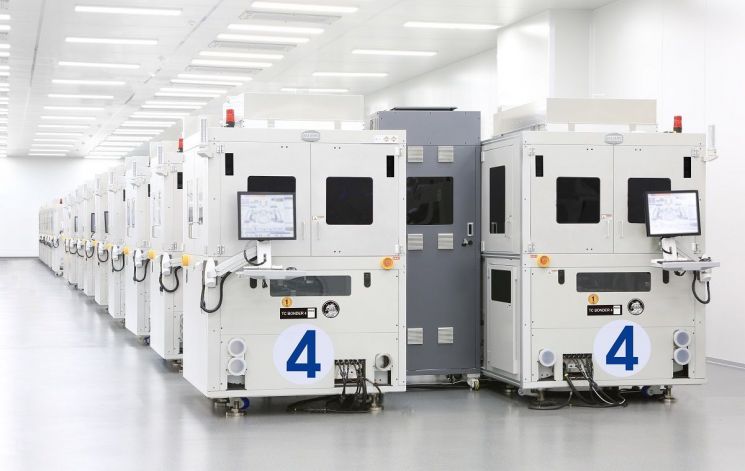
Regarding this, Hanmi Semiconductor Chairman Kwak Dongshin drew a clear line, stating, "Introducing hybrid bonders for HBM4 and HBM5 production would be like using a cow's knife to cut a chicken." He explained, "Hybrid bonders cost over 10 billion KRW each, more than twice as expensive as TC bonders. Moreover, in April, the international semiconductor standards organization JEDEC relaxed the packaging thickness standard to 775μm, meaning that existing TC equipment is sufficient to meet current requirements."
Nevertheless, he also stated, "We plan to proactively respond to the market by developing a hybrid bonder for HBM6, targeting a release by the end of 2027," signaling that a competitive bonder landscape could begin in earnest with that generation.
According to market research firm Verified Market Research, the global hybrid bonder market is projected to grow from 7.25 trillion KRW in 2023 to 19.34 trillion KRW by 2033.
For now, Hanmi Semiconductor continues to hold a dominant position in the HBM bonder market. In fact, since 2024, Hanmi has maintained a 90% market share in TC bonders for NVIDIA's HBM3E production, and the company is targeting a 95% market share in the HBM4 and HBM5 markets through 2027.
However, with LG Electronics and Hanwha beginning full-scale development, analysts predict that the single-supplier system centered on small and medium-sized enterprises will inevitably be disrupted. An industry insider commented, "The entry of large corporations will expand customer choice and foster competition in both technology and pricing. The bargaining power of major clients such as Samsung Electronics and SK hynix could also increase in the mid- to long-term."
The unit price of hybrid bonders is estimated to be in the hundreds of billions of KRW, raising concerns about an immediate increase in production costs. In particular, since SK hynix and Micron's 12-layer HBM4 products can still be mass-produced using TC bonders, most analysts believe the likelihood of a short-term transition is limited.
However, it cannot be ruled out that Samsung Electronics, which has lagged behind in HBM4, may consider early adoption of hybrid bonders to improve yield and differentiate its products. Additionally, if competition among equipment manufacturers intensifies, the price barrier to entry may decrease, potentially accelerating the pace of technological transition.
Hanmi Semiconductor has also clarified its future response strategy. Chairman Kwak stated, "A fluxless bonder is scheduled for release within this year according to our roadmap, and we possess all thermo-compression technologies required for HBM production, including NCF and MR-MUF, in-house." He added, "With a vertically integrated system that covers every process from design, component machining, software, assembly, to inspection, we lead the industry in technological innovation and cost competitiveness compared to other equipment manufacturers."
© The Asia Business Daily(www.asiae.co.kr). All rights reserved.
![Clutching a Stolen Dior Bag, Saying "I Hate Being Poor but Real"... The Grotesque Con of a "Human Knockoff" [Slate]](https://cwcontent.asiae.co.kr/asiaresize/183/2026021902243444107_1771435474.jpg)
















