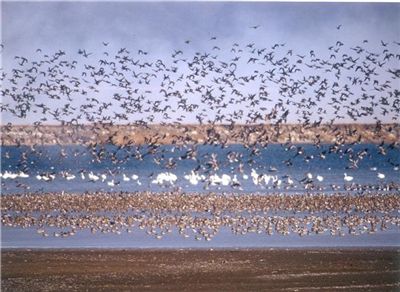
 Tens of thousands of greater white-fronted geese gather in flocks at domestic migratory bird habitats. Photo by Asia Economy DB
It has been confirmed that the bird involved in the collision with the Jeju Air passenger plane, which caused the disaster, was the greater white-fronted goose. As the number of these geese has surged in Japan as well, bird strike advisories have been issued at airports across the country.
On the 14th, Japan's public broadcaster NHK reported, "The same species of bird that collided with the Jeju Air passenger plane is also rapidly increasing in Japan. The Ministry of Land, Infrastructure, Transport and Tourism (MLIT) has designated it as one of the most dangerous birds for aviation safety and has urged caution at airports nationwide." In Japan, the greater white-fronted goose is known as "Tomoegamo."
According to NHK, a nationwide bird survey conducted by Japan's Ministry of the Environment every January for two weeks found that the number of Tomoegamo, which was just over 20,000 in 2020, had increased more than sixfold to over 140,000 in 2024. NHK also reported that a national review committee, which discusses bird strike countermeasures, designated the Tomoegamo as a "problem bird species" in March, a fact confirmed by the MLIT. As a result, the MLIT has classified it as one of the most dangerous birds for aviation safety and has sent notifications to 107 airports and heliports nationwide, urging caution.
Tomoegamo are known to form extremely large, dense flocks, which increases the risk of multiple birds colliding with an aircraft at once. Their weight is also greater than that of other duck species, making the likelihood of aircraft damage extremely high. Recently, large flocks have been observed near airports such as Izumo Airport in Shimane Prefecture, Narita Airport in Chiba Prefecture, and Saga Airport in Saga Prefecture, making extra caution necessary at these locations.
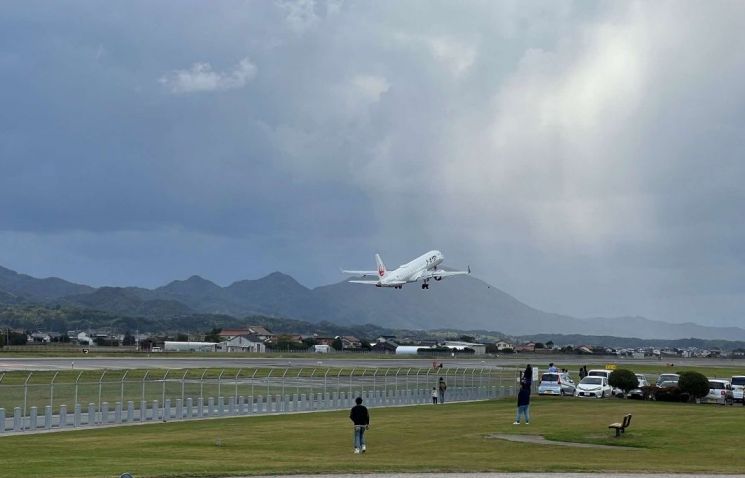 A view of Izumo Airport in Shimane Prefecture, one of the Japanese airports where a bird strike warning has been issued due to a surge in the number of greater white-fronted geese (local name Tomoegamo). Izumo Airport Office SNS
The airport that the MLIT is particularly monitoring is Izumo Airport, where tens of thousands of birds have been observed flying around the runway. In January 2024, an aircraft departing from Haneda Airport and attempting to land at Izumo Airport collided with three Tomoegamo, resulting in damage to the right wing and other parts of the aircraft, causing the return flight to be canceled.
According to the MLIT, the number of bird strike incidents in Japan was 1,599 in 2011, when record-keeping began, peaked at 1,967 in 2014, and then declined to 1,647 in 2024. There have been no cases in Japan where a bird strike has led to a crash.
Higuchi Hiroyoshi, professor emeritus at the University of Tokyo, explained the sharp increase in Tomoegamo entering Japan by stating, "Habitat loss due to urban development in China and Russia has caused some individuals to migrate to Japan." He also cited global warming, which has led to earlier melting of Siberian ice, an extended breeding season, and lower winter mortality rates, as additional causes. He added, "Tomoegamo is by far the most dangerous bird species. If an aircraft collides with one, there is a high possibility of a chain reaction leading to a major accident." He emphasized, "Because habitats can change significantly depending on climate and food availability, it is important to conduct thorough ecological surveys and monitoring, and to change the perception that 'birds are not a big deal.'"
© The Asia Business Daily(www.asiae.co.kr). All rights reserved.

















