Bank and Non-Bank Lenders Expected to Tighten Loan Standards in Q3
Stricter Lending for Households, Easing Only for Large Corporations
In the third quarter of this year, it is expected to become more difficult to obtain household loans from banks. As for corporate loans, while large companies are likely to see some easing in lending conditions, the tightening trend is expected to continue for small and medium-sized enterprises (SMEs).

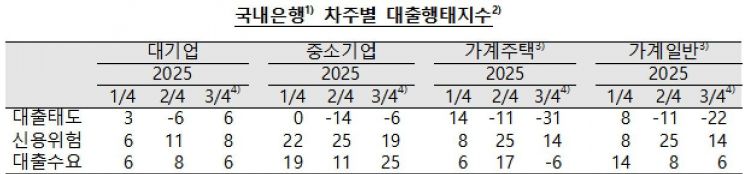
According to the results of the "Financial Institution Lending Attitude Survey" conducted by the Bank of Korea on lending officers at financial institutions and released on July 15, the overall lending attitude index for banks in the third quarter stood at -17, a further decline from -13 in the previous quarter. A more negative index indicates that more respondents expect lending standards to be tightened.
By borrower type, the tightening trend for corporate loans is expected to persist for SMEs, while lending attitudes toward large companies are projected to ease somewhat. The lending attitude index for large companies improved from -6 in the second quarter to 6 in the third quarter, whereas the index for SMEs remained negative, moving from -14 to -6.
Household loans are expected to face even stricter standards. The index for household mortgage loans fell sharply from -11 in the second quarter to -31, and for general household loans such as credit loans, the index declined from -11 to -22, indicating further tightening. In particular, the index for mortgage loans nearly tripled. A Bank of Korea official explained, "With the third stage of the stress-based Debt Service Ratio (DSR) being implemented from July, and additional measures to strengthen household debt management coming into effect, lending standards for both mortgage and credit loans are expected to tighten."
Although the credit risk for corporations and households is expected to decrease somewhat compared to the previous quarter in the third quarter, it is still projected to remain at a high level. The overall credit risk index forecast by domestic banks for the third quarter dropped to 14 from 21 in the previous quarter. Credit risk for corporations is expected to rise, especially among SMEs, due to ongoing economic uncertainty and concerns over declining profitability. The credit risk index is projected at 8 for large companies and 19 for SMEs. The household credit risk index is expected to remain at 14, with the Bank of Korea noting that concerns will persist due to sluggish real economic growth and worries about the debt repayment capacity of vulnerable borrowers.
Loan demand from corporations and households in the third quarter is expected to decrease, mainly due to reduced demand for housing-related loans. The overall loan demand index by borrower type for domestic banks fell sharply to 5 from 15 in the previous quarter. This was mainly attributed to a projected decline in household mortgage loan demand from 17 to -6. Corporate loan demand, on the other hand, is expected to increase mainly among SMEs, driven by the need for working capital and liquidity amid domestic and external economic uncertainties and sluggish business conditions. The loan demand index for SMEs surged from 11 to 25.
Non-bank financial institutions, including savings banks, mutual finance companies, card companies, and insurance companies, are also expected to maintain a tightening stance across all sectors. As concerns over borrowers' debt repayment capacity persist and delinquency rates continue to rise, these institutions are expected to continue tightening lending standards as part of efforts to manage asset soundness.
Credit risk is expected to remain high, particularly among savings banks and mutual finance cooperatives. Loan demand is projected to increase slightly, driven by corporate needs to secure liquidity in response to economic uncertainty and by households' demand for living expenses.
Meanwhile, this survey was conducted last month among a total of 203 financial institutions, examining trends over the past three months and outlooks for the next three months.
© The Asia Business Daily(www.asiae.co.kr). All rights reserved.


















