Since 2015, 277,000 Bags of Coffee Compost Delivered to Farms
Agricultural Products Grown with Coffee Compost Reborn as Starbucks Products
Starbucks Korea announced on July 15 that the total amount of coffee compost it has provided to local farms over the past 11 years, since 2015, has surpassed 5,500 tons.
On June 18 of last month, Starbucks delivered 10,000 bags of eco-friendly coffee grounds compost, totaling 200 tons, to a sweet potato farm in Gochang, Jeonbuk. The coffee grounds compost donated by Starbucks will be used by more than 10 farms to cultivate sweet potatoes. These sweet potatoes will be used to create one of Starbucks' signature food products, "Hanibeseok Goguma" (bite-sized sweet potatoes).
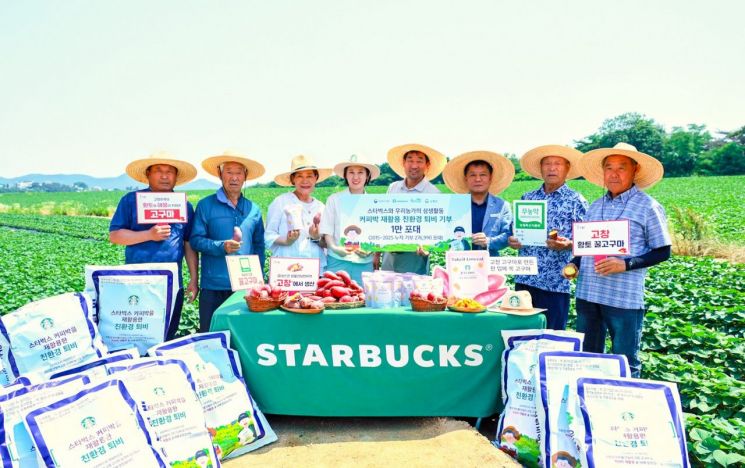 Starbucks visited a sweet potato farm in Gochang, Jeonbuk on June 18 and delivered 10,000 bags of coffee grounds compost.
 Photo by Starbucks Korea
"Hanibeseok Goguma," first launched in 2015, has undergone continuous renewal and is now made with sweet potatoes from Gochang, Jeonbuk, and sold at stores nationwide. True to its name, it is a convenient cube-shaped snack that can be enjoyed in one bite, and since its launch, more than 3.7 million units have been sold.
In practice, agricultural products grown using eco-friendly coffee grounds compost at local farms are used as ingredients in Starbucks products, creating a virtuous cycle of resource circulation that leads to their release at stores nationwide. A notable example is the "Yuja Mint Tea," which uses yuja from Goheung and has ranked among the top 10 best-selling beverages for two consecutive years, making it one of Starbucks' signature tea beverages.
The "Yeosu Bada Yuja Blended," a specialty drink at the Deyeosu Dolsan DT store, as well as the "Citrus Cold Brew Martini" sold at Jangchung Lounge R and Reserve Dosan, also use yuja from Goheung.
Since 2015, Starbucks has partnered with Gyeonggi Province to promote the consumption of agricultural products and resource recycling, by repurposing coffee grounds generated at its stores into eco-friendly coffee compost and delivering it to local farms. In 2016, Starbucks became the first in the industry to sign a memorandum of understanding with the Ministry of Environment and the Korea Zero Waste Movement Network for a pilot project to promote coffee grounds recycling, establishing a process for repurposing coffee grounds.
Over the past 11 years, Starbucks has delivered more than 277,000 bags of coffee compost to farms in regions such as Boseong, Hadong, Jeju, and Goheung. This is valued at over 1 billion KRW, and the total weight amounts to 5,540 tons, supporting resource circulation and fostering mutual growth with local farms.
In 2023, coffee grounds were officially recognized as recyclable resources for use as compost and in products. As a result, the coffee grounds tray made from these grounds was selected as Korea's first certified product using recyclable resources.
© The Asia Business Daily(www.asiae.co.kr). All rights reserved.

















