Core Process for Connecting Semiconductor Chips and Substrates
LG Begins Development of Hybrid Bonder
Hanwha Challenges Hanmi Semiconductor
SK hynix Remains Cautious Due to Cost Concerns
Samsung May Adopt for Product Differentiation
As LG Electronics and Hanwha have recently entered the bonder market?a key equipment sector for high bandwidth memory (HBM) production?changes are expected in a supply structure that has traditionally been dominated by small and medium-sized enterprises. While the participation of large corporations may increase the initial adoption costs for customers such as Samsung Electronics and SK hynix due to the advancement of equipment, some analysts believe that the formation of a more competitive landscape could, in the mid- to long-term, strengthen price negotiation power and stabilize market prices.
 Jo Joowan, CEO of LG Electronics, is delivering the keynote speech at the 'LG World Premiere' held at Mandalay Bay in Las Vegas, USA, on January 6 (local time). Photo by Yonhap News
According to industry sources on July 15, LG Electronics announced the start of hybrid bonder development earlier this month by unveiling semiconductor packaging equipment at the 'Nano Korea 2025' exhibition. The research and development is being led by the Manufacturing Technology Institute, with the industry expecting completion by 2028.
The hybrid bonder is considered a next-generation technology in the 'bonding' process, which connects semiconductor chips and substrates, offering higher precision than the conventional thermo-compression (TC) method. By directly connecting copper wiring and dielectric materials without bumps, it can reduce area and increase transmission speed. As demand for artificial intelligence grows, high-stack HBM is drawing attention, leading to increased demand for related equipment.
Until now, Hanmi Semiconductor has held a dominant position in the domestic bonder market. However, following Hanwha Semitec's entry in March and now LG Electronics, the monopoly structure centered on small and medium-sized enterprises is beginning to break down. Verified Market Research forecasts that the hybrid bonder market will grow from approximately 7.25 trillion won in 2023 to 19.34 trillion won by 2033.
Industry experts believe that breaking the single-supplier system led by small and medium-sized enterprises will expand customer choice and could also reshape not only the technology but also the price structure. The entry of large corporations is expected to drive technical and price competition among equipment suppliers, thereby strengthening the bargaining power of customers such as Samsung Electronics and SK hynix.
However, there are still significant challenges before the hybrid bonder can be fully established in the market. Although it has not yet reached the commercial release stage, it is expected to be priced in the tens of billions of won range once mass production begins. This could raise the production cost of HBM and affect supply prices, prompting major semiconductor manufacturers to remain cautious about adoption.
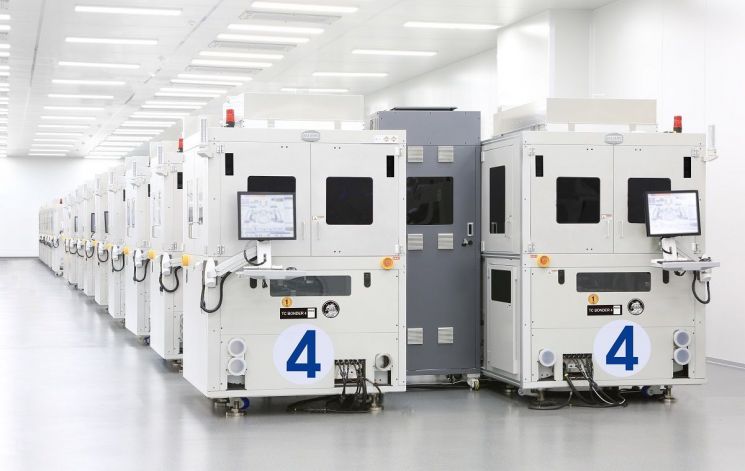
In particular, there is a view that the immediate necessity for hybrid bonders is not high, as the HBM4 12-stack products currently supplied by SK hynix and Micron can be mass-produced using TC bonders. As a result, it is widely believed that Samsung Electronics and SK hynix are unlikely to adopt the technology right away.
However, there is also speculation that Samsung Electronics, which has lagged behind in HBM4, may pursue early adoption to secure yield and differentiate its products. Additionally, if competition among Hanmi, Hanwha, and LG lowers prices, the entry barriers for customers could naturally decrease.
Meanwhile, on the same day, Hanmi Semiconductor Chairman Kwak Dongshin stated that hybrid bonders are an excessive choice for HBM4 and HBM5 and denied the necessity at this stage, but acknowledged the need to respond for the HBM6 generation. Accordingly, Hanmi Semiconductor also plans to develop a hybrid bonder by the end of 2027 to proactively respond to the market.
© The Asia Business Daily(www.asiae.co.kr). All rights reserved.


















