Busan Institute of Urban Affairs:
Urgent Need for Tailored Policies
Reflecting Local Characteristics
As the new administration has put 'respect for labor' and 'guaranteeing rights' at the core of its labor policy, the need for strategic responses by local governments is growing.
In response, the Busan Institute of Urban Affairs has assessed that it is urgent to establish a 'Busan-style labor policy model' that reflects the realities of the local employment structure and labor environment.
The Busan Institute of Urban Affairs (President Shin Hyunseok) stated in Policy Focus No. 441, released on July 14, that "Busan needs to respond proactively to policy changes such as the government's introduction of a 4.5-day workweek, extension of the retirement age, and expanded protection for workplaces with fewer than five employees," adding that "protecting vulnerable workers and strengthening industrial safety are key tasks."
In fact, Busan's labor indicators continue to reveal structural limitations. According to Statistics Korea, the proportion of employees working at businesses with fewer than five employees in Busan is 32.7%, higher than the national average of 30.3%. The proportion of low-wage workers is also the highest among metropolitan cities at 24.3%. The average wage stands at 2.84 million won, the lowest level nationwide.
Industrial accidents are also on the rise. Last year alone, there were 6,470 victims of work-related accidents in Busan.
The institute pointed out that although Busan has dedicated labor policy departments and intermediary support organizations in operation, there are still 'blind spots' in labor rights protection. In practice, Busan City has established Labor Rights, Labor-Management Support, and Industrial Safety Teams under its Employment and Labor Division, and carries out rights protection functions through the Busan Labor Rights Center and the Mobile Worker Support Center.
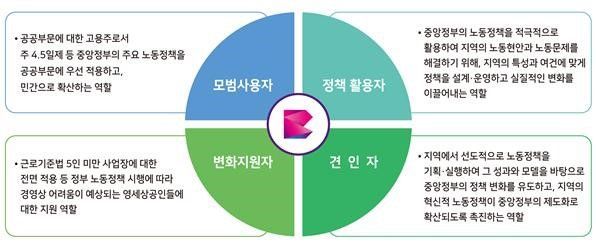
The report emphasizes that Busan should fulfill four roles going forward: ▲ acting as a 'model employer' through initiatives such as converting public sector workers to regular employment and piloting the 4.5-day workweek; ▲ tailoring and disseminating central government policies at the local level; ▲ serving as a 'change facilitator' by expanding industrial accident insurance for platform workers and small businesses; and ▲ acting as a 'policy driver' by leading the nationwide expansion of intermediary support organizations.
In particular, strengthening infrastructure to prevent industrial accidents has emerged as a key task. The Busan Institute of Urban Affairs stressed, "There is a need to expand the functions of the Industrial Safety Team and establish a Labor Safety and Health Center to provide an institutional foundation," adding, "Effective measures to address the safety blind spots at construction sites and other high-risk areas are urgently needed."
Son Heonil, Senior Research Fellow at the Busan Institute of Urban Affairs, said, "Local governments must go beyond simply implementing policies and take on the role of active coordinators," adding, "Busan must quickly devise regionally tailored strategies to address policy blind spots for elderly workers, small businesses, and platform workers."
© The Asia Business Daily(www.asiae.co.kr). All rights reserved.

















