Confirmation Hearing for Minister of Science and ICT Nominee
"R&D Budget Cuts: TF to Review Current Status... Agrees on Expanding Investment in Basic Science"
"AI Basic Act: Need to Consider Deferring Administrative Fine Provisions"
"Reviewing Introduction of a Fourth Mobile Carrier... Need to Promote Competition in the Telecommunications Market"
"Export of High-Precision Maps: To Be Approached Cautiously from a Security Perspective"
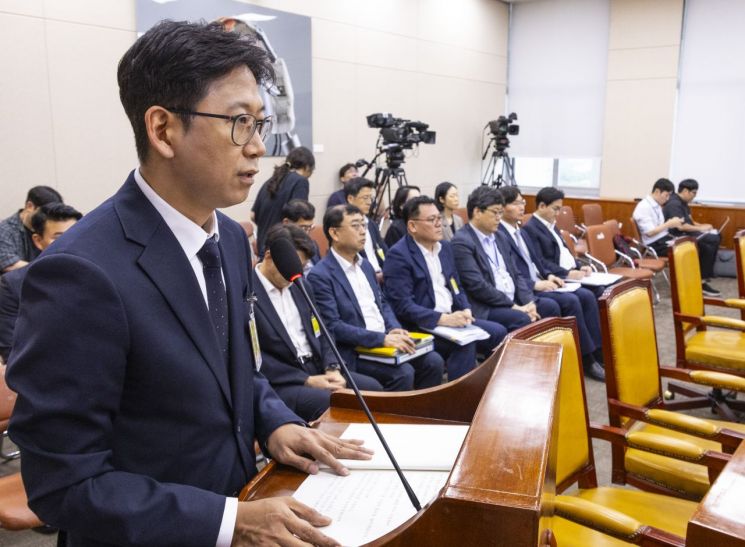
Bae Kyunghoon, the nominee for Minister of Science and ICT, expressed his determination at the National Assembly confirmation hearing on July 14 to establish a Korean-style artificial intelligence (AI), known as "Sovereign AI," by next year. Regarding the research and development (R&D) budget, which was significantly reduced during the Yoon Suk Yeol administration, he announced plans to form a task force (TF) to review the current budget situation and stated his intention to restore and expand investment in basic science.
The hearing was originally scheduled to begin at 10 a.m., but was halted at the outset after People Power Party lawmakers protested the passage of the three broadcasting laws by attaching "Choi Minhee Dictatorship OUT" placards to their laptops. Choi Minhee, Chair of the Science, ICT, Broadcasting and Communications Committee, declared the hearing adjourned and left, saying, "I believe placards unrelated to today's agenda are disruptive. It is difficult to maintain order." The session remained in disarray throughout the morning and only resumed around 1 p.m., adjourning again at approximately 10:03 p.m.
During the hearing, Bae emphasized that South Korea should not rely solely on foreign AI amid global competition for technological supremacy, and presented the establishment of "Sovereign AI" as a key goal. He stated, "To achieve a major transformation in Korean AI within two to three years, we must create Sovereign AI," adding, "It must be established by next year." He also revealed plans to secure a national AI computing center and GPU infrastructure in cooperation with the private sector.
On the need to expand basic research, he said, "Basic science is the foundation upon which AI is built, and now, through AI, we have an opportunity to advance basic science once again." He added that, with the current R&D budget at about 4% of GDP, "I will strive to increase it to over 5%." He further commented, "R&D has suffered significant setbacks in terms of continuity and diversity," and pledged, "I will do my best to restore the research ecosystem."
Regarding the AI Basic Act, which is scheduled to take effect in January next year, he said, "The current AI Basic Act needs to be supplemented and revised, as it is mainly focused on industrial promotion." He also mentioned that certain provisions, such as administrative fines, should be deferred for a certain period to support industrial growth. He explained that, given the rapid pace of AI development, it is necessary to strictly prevent misuse while minimizing the burden on the industry.
On the issue of data copyright, he stated, "A fair price must be paid for data required for AI training," emphasizing, "The government should take proactive steps in areas where data can be secured collectively."
In response to a proposal by Lee Hoonki, a Democratic Party lawmaker, to introduce a "fourth mobile carrier" as a way to lower telecommunications fees, Bae said, "If appointed, I will focus on reviewing this matter," and added, "Reducing telecommunications costs for the public is a key task for the Ministry of Science and ICT." He also agreed on the need for structural reforms to inject competition into the current three-carrier system.
He further stated, "After the repeal of the Device Distribution Act on the 22nd, there may be substantial changes in pricing for plans and devices," predicting, "This could contribute to an overall reduction in telecommunications costs for the public."
Regarding Google's request to export high-precision maps, he said, "The export of maps is an issue with both positive and negative industrial effects," and added, "We will approach this matter cautiously from the perspectives of national security and information sovereignty." This is an issue where the government is weighing its options, as the U.S. Trade Representative (USTR) has identified it as a trade barrier and is pressuring South Korea.
© The Asia Business Daily(www.asiae.co.kr). All rights reserved.

















