145 Rapid Integrated Planning Zones Designated Since 2021
Institutional Reforms and Expanded Project Support to Accelerate Housing Supply
On July 14, Seoul Mayor Oh Sehoon announced plans to accelerate housing supply by improving regulations.
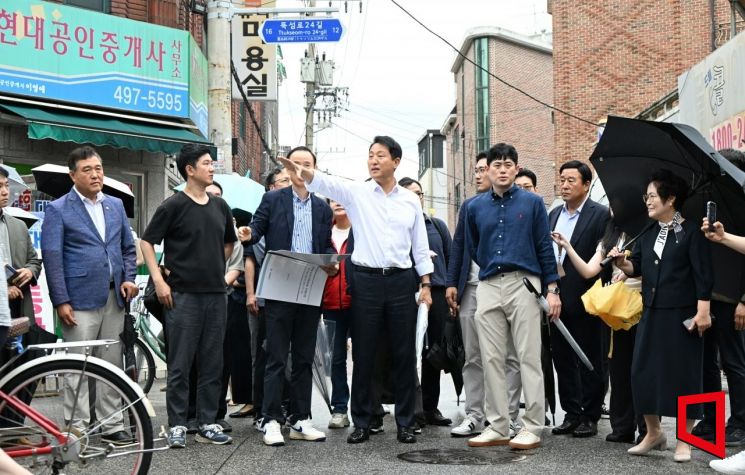 On the 14th, Seoul Mayor Oh Sehoon is touring the redevelopment site in Jayang4-dong, Gwangjin-gu, Seoul. Provided by Seoul City
That day, Mayor Oh visited Zone A of Jayang4-dong in Gwangjin-gu, a site designated for the Rapid Integrated Redevelopment Project, to listen to the concerns of local residents on site.
Zone A in Jayang4-dong was selected as a candidate for the Rapid Integrated Planning Project in December 2022, and after two years and six months, a redevelopment plan has been established. Following redevelopment, the area will be transformed into an apartment complex overlooking the Han River, with a total of 2,999 units, including 552 rental units. Although the high existing floor area ratio made the business conditions relatively unfavorable, the application of the "recognition of current floor area ratio" and the "business feasibility adjustment coefficient" introduced in the 2030 Urban and Residential Environment Improvement Master Plan made it possible to improve business feasibility.
This area is also the first to benefit from Seoul City's Regulation Elimination No. 115, which relaxes the consent rate required for direct establishment of associations and subsidy support. Jayang4-dong Zone A has already secured a 57% resident consent rate for direct association establishment. By utilizing the "direct establishment with public support" process, which allows for association establishment without forming a promotion committee, the project period can be shortened by at least six months, making it possible to establish the association by the first half of next year.
Mayor Oh pledged to fully support the establishment of the association in Jayang4-dong Zone A by the first half of next year. He stated, "Normally, it takes five to six years to form a promotion committee and then move to the association stage in the early phases of redevelopment projects, but we have started administrative support to skip the promotion committee and move directly to the association stage, aiming to reduce this period to two to three years. We will continue to introduce new systems and improve regulations that slow down project progress to further accelerate the process."
Since 2021, Seoul City has designated (including changes) 145 zones for rapid integrated redevelopment and reconstruction projects as of July. This is more than three times the number of zones designated ten years ago. From 2012 to 2020, the annual average number of redevelopment and reconstruction zones designated was only 12, but over the past four years since 2021, the average has increased to 36 per year. The city plans to increase the number of housing units secured through rapid integrated planning from the current 194,000 to 312,000 by June next year.
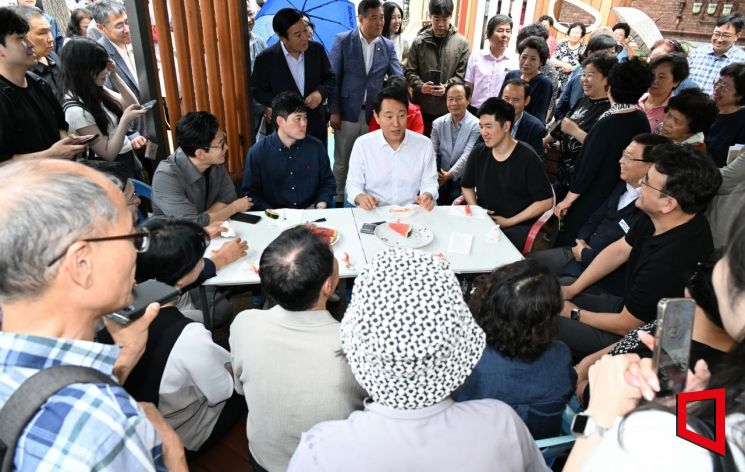 On the 14th, Seoul Mayor Oh Sehoon visited the redevelopment site in Jayang 4-dong, Gwangjin-gu, Seoul, and held a meeting with local residents. Provided by Seoul City
Seoul City is not only expanding supply but also working to increase the actual "speed of supply" through institutional improvements and comprehensive project support. Starting this month, the city will implement the following regulatory reforms: relaxation of public contribution requirements in height-regulated areas (No. 3), relaxation of floor area ratio for three-dimensional parks (No. 6), clarification of criteria for upgrading semi-residential areas near stations (No. 35), relaxation of consent rate for direct association establishment and subsidy support (No. 115), and the introduction of new regulatory eliminations for "four types of redevelopment projects."
During the previous mayor's term, from 2012 to 2020, 391 redevelopment zones were canceled, and except for some New Town districts after 2015, there were no new redevelopment designations. This led to a shortage in housing supply, prompting Mayor Oh to make "normalization of housing supply" a core task. Mayor Oh explained, "Seoul City is focusing on improving business feasibility to encourage hesitant complexes to proceed with reconstruction and redevelopment at a faster pace."
There are concerns that the recently announced loan regulations, which now also apply to relocation expenses, could disrupt redevelopment projects. In response, Mayor Oh said, "Some areas designated in the past one or two years that had planned to relocate in the second half of this year may face significant difficulties."
Mayor Oh added, "Rapid housing supply helps stabilize housing prices in Seoul, and to supply quickly, relocation and groundbreaking must happen quickly. However, relocation is becoming more difficult. Seoul City now faces the task of studying how to help these residents relocate more quickly."
© The Asia Business Daily(www.asiae.co.kr). All rights reserved.


















