Most Booths Operated by Out-of-Town Food Trucks
A 'Chimaek Festival' Without Chicken... Name Rings Hollow
Overpriced Food and Poor Hygiene, Safety Management Under Fire
It has been revealed that local merchants were excluded and only out-of-town food trucks participated in a large-scale regional festival recently held by Wando County, leading to growing criticism among local residents. In particular, the fact that local merchants could not participate in a festival aimed at revitalizing the local economy has sparked significant controversy.
On July 12, Wando County hosted a large-scale festival at Sinji Myeongsashimni Beach, featuring a variety of programs such as the 'Chimaek Festival,' a 'Barefoot Walking Competition,' and a 'CrossFit Competition.'
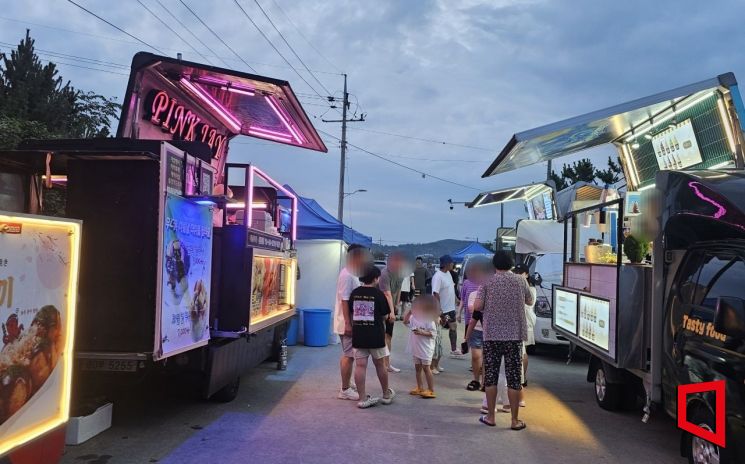 It has been revealed that local merchants were excluded and only out-of-town food trucks participated in a recent regional festival held by Wando County, sparking controversy. Photo by Lee Jungyeong
The festival attracted much attention with extensive pre-event promotions under names such as the 'National Barefoot Walking Festival,' the '2025 SUFF (Summer Ultimate Fitness Festival),' and the 'Marine Healing Chimaek Festival.' The organizers also raised visitor expectations by announcing a diverse lineup of content, including an EDM party, rapper performances, game booths, and food trucks.
However, the evaluations from visitors and local residents who attended the event fell short of expectations. Although more than 1,000 people gathered on the day of the event, there were no booths selling chicken at the so-called 'Chimaek Festival.' Instead, only out-of-town food trucks, temporarily brought in by an event agency, occupied the venue. The food on offer, such as sausage skewers, hot dogs, and ice cream, was unrelated to the festival's intended theme, and even these items drew complaints regarding both quality and price.
Tourist A remarked, "I was looking forward to the Chimaek Festival, but there wasn't even a meal menu, let alone chicken. The food truck was selling fried rice for 12,000 won, which was far too expensive. The taste was also disappointing compared to the price."
The most serious issue was that local merchants were completely unable to participate. It was revealed that most of the vendors selected to operate booths were from outside the region, and local merchants were not even given the opportunity to apply. This has led to criticism that the original goal of 'revitalizing the local economy' has been undermined. The controversy intensified further when it was discovered that even food trucks based in Wando were excluded from the event.
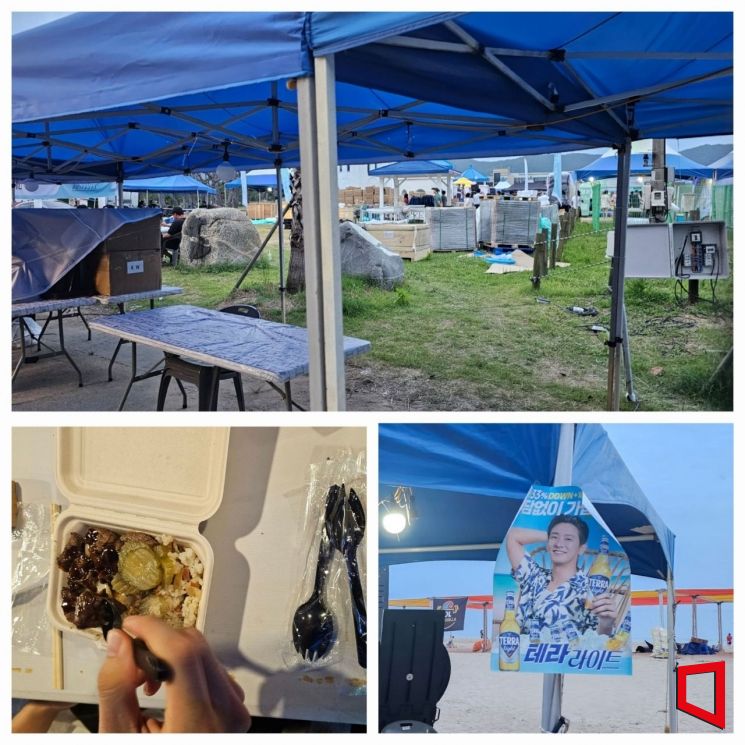 There were no chicken sales booths at the 'Chimaek Festival,' and the few food items available were either of poor quality or overpriced, drawing complaints from visitors. Photo by Lee Jungkyung
Local merchant B expressed frustration, saying, "We local merchants were not even given a chance to apply for participation. Out-of-town food trucks sold food at high prices, and all the profits flowed out of the region."
Hygiene and safety issues at the event site also came under scrutiny. Some booths lacked even basic safety equipment, and electrical connections were exposed to the rain, raising concerns about electric shock risks. Tables for eating lacked basic supplies such as tissues and trash bins, adding to the inconvenience.
In response, a county official stated, "We conducted a preliminary inspection, but there were some shortcomings. From the next event onward, we will strengthen cooperation with local businesses and thoroughly address hygiene and safety issues."
Wando County is planning to continue holding festivals aimed at promoting marine healing and tourism. However, following this event, there are increasing calls for more substantial preparations focused on content rather than form. Cooperation with local merchants, revitalization of the local economy, and stricter safety management are being emphasized as key priorities.
© The Asia Business Daily(www.asiae.co.kr). All rights reserved.


















