KDCA Launches Mixed Survey Pilot Project
Combining Traditional Face-to-Face Interviews and Online Self-Entry Methods
The Korea Disease Control and Prevention Agency (KDCA) announced on July 14 that it will conduct a "mixed survey pilot project" in nine cities, counties, and districts nationwide until September 30, aiming to improve the methodology of the Community Health Survey.
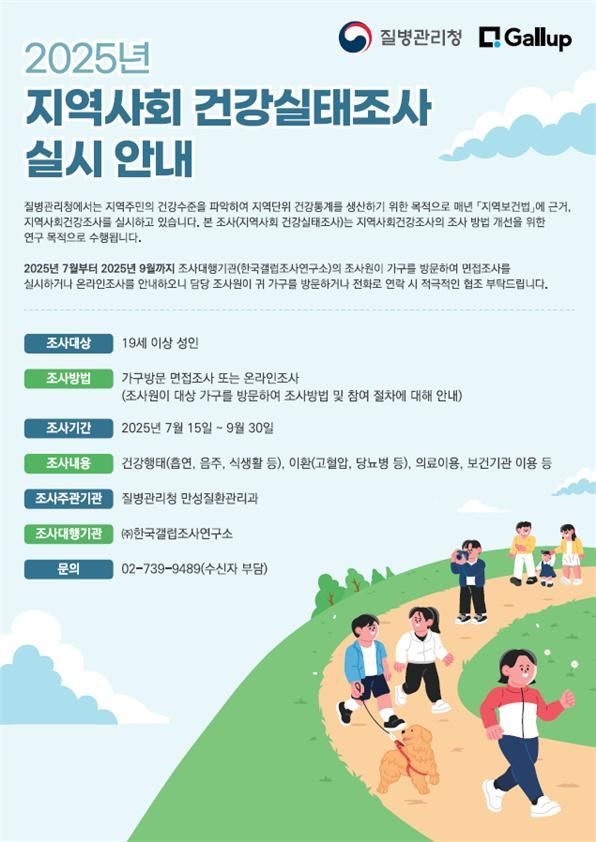
This pilot project is being conducted separately from the main Community Health Survey. Unlike the main survey, which produces and publishes statistics to assess local health conditions, the pilot will not publish separate statistics. Instead, it is being carried out for research purposes to identify differences between response methods (face-to-face and non-face-to-face) and to refine the mixed survey procedures.
Since 2008, the KDCA has conducted the Community Health Survey annually by visiting households and conducting one-on-one face-to-face interviews, in accordance with Article 4 of the Community Health Act. However, due to recent social changes such as the spread of non-face-to-face culture and the growing importance of privacy protection, there have been ongoing calls to improve the survey methods. In response, as part of efforts to improve the survey system, the KDCA will conduct a pilot project in nine cities, counties, and districts using a mixed survey method that combines traditional face-to-face interviews with online surveys. By analyzing differences in responses between face-to-face and non-face-to-face methods, the agency will assess the impact of survey methods on statistical results and review whether to introduce non-face-to-face surveys.
In this pilot project, survey participants will first be encouraged to take part through face-to-face interviews. If participants do not wish to participate in face-to-face interviews or have difficulty scheduling with surveyors, they will be offered the option of participating through a non-face-to-face method. However, to ensure a sufficient sample size for meaningful analysis of non-face-to-face responses, some participants in two regions?Jongno-gu in Seoul and Gongju-si in Chungcheongnam-do?will be designated to participate using the non-face-to-face method.
For face-to-face surveys, trained professional surveyors from Gallup Korea Research Institute will visit households in person and enter participants' responses into a tablet PC. For non-face-to-face surveys, participants will access a designated web address sent via text message and complete the survey themselves online.
The survey content includes items identical to some in the main survey, covering health behaviors (such as smoking, drinking, and safety awareness), health knowledge (such as stroke and myocardial infarction), prevalence of chronic diseases (such as hypertension and diabetes), and use of health and medical institutions. The non-face-to-face survey will include additional explanatory materials to aid participants' understanding and enhance convenience.
The KDCA explained, "This pilot project is being introduced to provide greater convenience to survey participants in line with social and cultural changes such as the spread of non-face-to-face culture, and to evaluate its applicability in real survey environments." Based on the results of this mixed survey pilot project, the KDCA plans to review the timing and procedures for introducing non-face-to-face surveys, including the possibility of gradual implementation in selected regions.
© The Asia Business Daily(www.asiae.co.kr). All rights reserved.

















